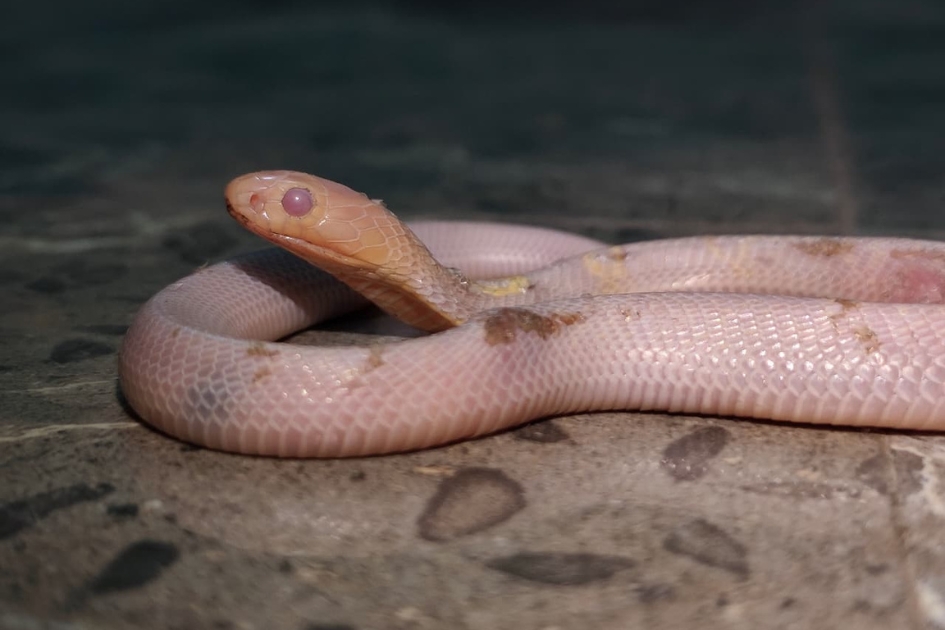




From pale pink lotus cobras to yellowish-white water snakes, recent rescues highlight the need for scientific research into rare pigmentation and genetic traits.
Several unusually coloured snakes have been found in different parts of Bangladesh in recent days, drawing public interest as researchers and wildlife experts examine whether the animals display albinism or other genetic colour variations.
An albino water snake was rescued from a house in the Colonel Hat area of Chattogram on November 3. The snake is currently being kept under observation by the relevant authorities.
Over an eight-day period, two unusually coloured water snakes and a lotus cobra were found in Dhaka, Chattogram and Panchagarh. Their normal body colours had changed to yellowish, white or pale pink, prompting discussion on social media as several such cases emerged within a short period.
Naimul Islam Niloy, joint general secretary and Chattogram representative of the Wildlife and Snake Rescue Team in Bangladesh, said the snake found in Colonel Hat was rescued by their team member Mehedi Hasan.
“We have never found such a snake in Chattogram before. This is the first albino water snake,” Niloy said.
He said the snake was being kept for initial treatment, care and necessary observation and would later be released into the wild at an appropriate time.
Meanwhile, a pale pink lotus cobra rescued from a factory in Dhaka’s Demra area on October 29 has attracted particular interest because of its unusual appearance.
The snake, about one foot long, has a body colour markedly different from that of a normal lotus cobra. Rescuers initially suspected that it could have albinism. However, it has not yet been established whether the colour is the result of a rare genetic characteristic or another form of pigmentation change.
Mohammad Noman, an associate researcher at the Venom Research Centre at Chattogram Medical College, said preliminary observations suggested the possibility of albinism.
“Such a characteristic is relatively rare among snakes,” he said. “However, there is no basis for considering it a new species simply because of its different colour. Physical observation of the snake and necessary tests are required to identify its actual characteristics.”
Mohammad Farid Ahsan, a supernumerary professor in the Department of Zoology at the University of Chittagong, said the genetic condition was caused by a lack of melanin.
“This is natural. It also occurs in humans and other animals. There is nothing to be worried about,” he said.
Why albino snakes can appear pink
Albinism is a genetic characteristic that causes the production of melanin, the pigment responsible for much of an animal’s normal dark colouring, to decrease or stop. When melanin is deficient, the body’s colour becomes paler. In some cases, the reddish colour of blood vessels beneath the skin can become visible, giving the body a pinkish appearance.
Experts say different types of pigment cells, known as chromatophores, are involved in producing colour in reptiles. Melanophores are associated with melanin. In albinism, genetic changes can disrupt the production of melanin. In some cases, the function of an enzyme called tyrosinase can also be reduced.
As a result, albino snakes are not always completely white. Some can appear yellowish, orange or pink. Their eye colour can also change, although it is not certain that every albino snake will have red or pink eyes.
Professor Mohammad Manzurul Kibria of the Department of Zoology at the University of Chittagong said the unusual colouring of the lotus cobra was mainly caused by genetic characteristics.
He said certain genes in an animal’s body may become active and produce such characteristics, while in other cases they may not be expressed. This is a normal process of heredity that can occur in tigers, rats, crows, snakes and humans.
Kibria said social media and news coverage could make it appear that such snakes were being seen more frequently.
“In the past, if such a snake was seen somewhere, it would not attract the attention of many people. Now, as people take photographs with mobile phones and share them on social media, such incidents quickly come to public attention,” he said.
“There is no reason to say that the number of such snakes has actually increased.”
He said the genetic characteristic could make it somewhat more difficult for an affected snake to survive in its environment. However, it was not a matter of concern for the lotus cobra species as a whole and did not pose a threat to other species.
It was also not certain whether the characteristic would be passed on to future generations, he said. That would depend on reproduction and genetic characteristics.
Mohammad Mizanur Rahman, director of the Wildlife Crime Control Unit of Bangladesh’s Forest Department, said genes played an important role in determining an animal’s normal colour.
Changes in those genes can disrupt melanin production and result in albinism, causing changes in an animal’s normal colouring. In snakes, this can produce white, yellowish or pinkish tones.
However, he said it was not possible to determine from appearance or photographs alone whether a rescued snake was albino. Observation by zoologists or researchers specialising in snakes, along with scientific testing, would be required.
Earlier unusual-coloured lotus cobra found in Bangladesh
The recent cases are not the first reports of unusually coloured lotus cobras in Bangladesh.
On November 23, 2023, a yellowish-white lotus cobra was found in Bhabanagar village in Maheshpur upazila of Jhenaidah district. Local residents became frightened and beat the snake to death with sticks.
Wildlife conservationists later collected its carcass. At the time, efforts were made to preserve the body for scientific testing and possible display in a museum. However, there is currently no specific information on where the carcass is being kept.
The Maheshpur snake had a yellowish-white body, while the snake rescued in Demra has a pale pink hue. Despite the difference in colour, both cases provide an opportunity to investigate the causes of unusual pigmentation.
Genetic colour variations can occur in other snake species as well, not only lotus cobras. One example is the water snake, or checkered keelback (Fowlea piscator), a non-venomous snake that normally has brown and dark patches on its body. Genetic variation in colour can cause some individuals to appear yellowish or whitish.
Mohammad Shahidul Islam, founder and president of the Wildlife and Snake Rescue Team in Bangladesh, previously rescued a water snake with unusual colouring after receiving information from local residents. The snake had signs of injury when it was rescued. It was kept under observation with the aim of releasing it into its natural environment after recovery.
Shahidul said his organisation had found five albino snakes in different parts of Bangladesh since 2020.
“Recently, an albino lotus cobra was rescued. A few days ago, an albino common wolf snake was also rescued. Another leucistic, or white or pale, water snake was rescued in Feni,” he said.
Age and physical condition of the rescued snake
The rescued lotus cobra is about one foot long. Noman believes it is a young snake and may have hatched from an egg around September or October. However, he said its age could not be determined with certainty from its length alone.
He also observed that parts of the snake’s body appeared to show an incomplete shedding process. Snakes periodically shed their old skin and develop new skin. The process can be disrupted by physical weakness or various environmental factors, although it was not possible to determine from photographs why this may have occurred in this case.
Noman said the snake’s moulting process also appeared not to have been completed properly. The snake may therefore require rest and care. Many snakes are sick or weak after being rescued, so treatment may be necessary depending on their physical condition.
Plans to preserve snake for research
Discussions are under way about taking the snake to the Venom Research Centre at Chattogram Medical College so that its unusual colour and other physical characteristics can be analysed.
Noman said bringing the snake to the research centre would create an opportunity to observe and analyse its physical characteristics while ensuring proper care.
The venom of the venomous lotus cobra is also important for research, he said, creating an opportunity to study its venom if the snake is kept at the centre.
He said snakes with such characteristics were relatively rare and that researchers therefore wanted to preserve the snake for research purposes. However, even if the characteristics of this particular snake are identified, there is no guarantee that the same explanation would apply to every snake born with similar characteristics in the future.
Wildlife rescuer Saif Roudra said the research centre had expressed interest in taking the snake and that he was communicating with the relevant people. Keeping it there would provide an opportunity to care for the snake while also studying its characteristics.
How the snake was rescued
Workers at an insulation company’s factory in Demra initially saw two snakes. After the two snakes were killed, they spotted another. The workers were surprised by the third snake’s unusually pale pink colour. One of them then contacted the Wildlife and Snake Rescue Team in Bangladesh.
Roudra went to the site and rescued the snake. It is currently in his care.
He said the first two snakes had been killed before a worker contacted the rescue team after noticing the third snake’s unusual colour. Roudra then went to the factory and rescued it.
Roudra has long been involved in wildlife rescue and conservation activities. While serving as the Noakhali representative of the Wildlife and Snake Rescue Team in Bangladesh, he took part in rescuing snakes and other wildlife and in public awareness activities.
He is currently a student in the Architecture Department of Dhaka Government Polytechnic Institute and continues wildlife rescue and awareness activities alongside his studies. He said he had rescued more than 100 snakes so far.
The unusual colour of the lotus cobra rescued in Demra has generated curiosity, but its scientific identity and the cause of its colouring have not yet been conclusively determined. Further observation and necessary testing will establish whether it is an example of albinism or another genetic colour variation. For now, ensuring the snake’s safety, scientific observation and necessary care remain the immediate priorities.