

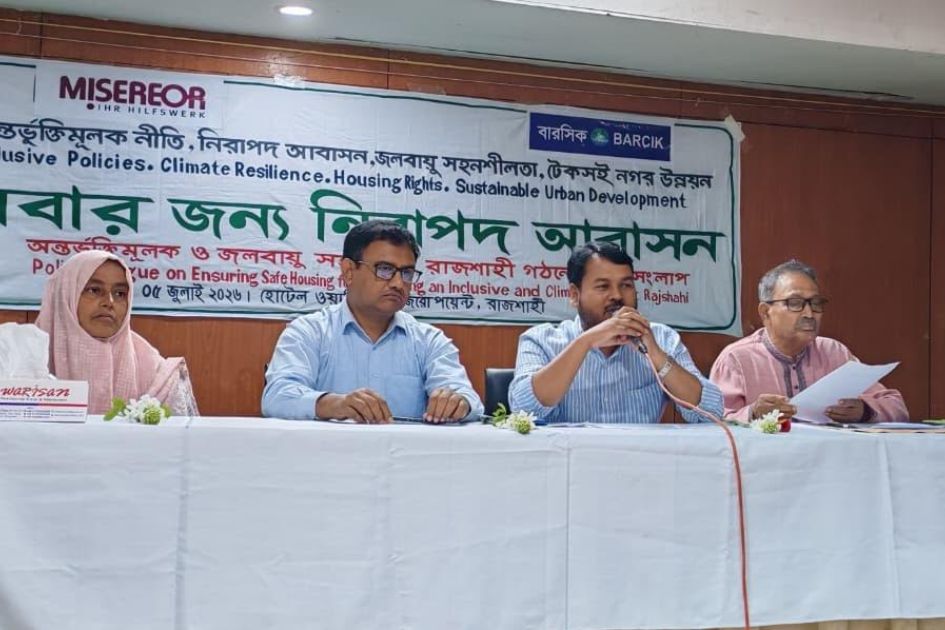



A BARCIK policy dialogue urged authorities to adopt a climate-resilient housing policy, expand social housing, protect green spaces and improve living conditions for Rajshahi’s vulnerable low-income communities.
A policy dialogue in Rajshahi, a metropolitan city in northwestern Bangladesh, has called for urgent government action to ensure safe housing for slum dwellers and low-income communities through an inclusive and climate-resilient urban housing policy, as growing climate risks and inadequate civic services continue to threaten vulnerable residents.
The recommendations were presented during a policy dialogue titled “Safe Housing for All: Building an Inclusive and Climate-Resilient Rajshahi”, organized by development research organization BARCIK at Hotel Warisan in Rajshahi’s Zero Point area on Sunday.
BARCIK researcher and regional coordinator Md. Shahidul Islam presented a policy brief highlighting the need for a long-term housing strategy for Rajshahi that prioritizes low-income communities, climate resilience and environmental sustainability.
According to the policy brief, Rajshahi, a city of more than 800,000 people, still has a significant number of residents living in unsafe and informal settlements. Data from the Bangladesh Bureau of Statistics Slum Census 2014 shows that more than 39,000 people lived in at least 104 slums across the city. The brief noted that the number has likely increased over the past decade while safe and dignified housing has yet to receive adequate attention in urban development planning.
The document said slum residents continue to face inadequate access to secure housing, safe drinking water, sanitation, healthcare, open playgrounds and green spaces. Climate change has further intensified their vulnerability through severe heatwaves, drought, waterlogging and water shortages. It argued that housing should be viewed not only as a development issue but also as a matter of human rights, social justice and climate justice.
The policy brief also stated that while several major cities in Bangladesh have introduced slum improvement and social housing initiatives, Rajshahi has yet to establish a comprehensive and long-term social housing programme. It therefore called for a separate participatory and climate-resilient urban housing policy tailored to the city’s needs.
The recommendations urged Rajshahi City Corporation, Rajshahi Development Authority, relevant government agencies, development partners, researchers, civil society organizations and the media to work together on the issue. They also proposed social housing for low-income residents, climate-resilient infrastructure, preservation of playgrounds and open spaces in every ward, protection of ponds and green areas, creation of green livelihood opportunities for women and youth and ensuring a safe urban environment for both people and biodiversity.
Rajshahi City Corporation Administrator Mahfuzur Rahman Riton attended the dialogue as chief guest. He said steps were being taken in coordination with the land minister, the Rajshahi Development Authority and citizen groups to resolve the housing crisis faced by slum residents in the city.
He also announced that no more ponds in Rajshahi would be occupied or filled. The city corporation has allocated funds and, if necessary, would purchase privately owned ponds to preserve them.
Representatives from civil society organizations and marginalized communities also participated in the discussion. Among them were Green Coalition Rajshahi President Mahbub Siddiqui, Rajshahi Urban Poor Rights Implementation Committee Member Secretary Nilufa Ismat Ara, Save the Nature Chairman Mizanur Rahman, Barendra Youth Forum President Atikur Rahman and representatives from several slums in Rajshahi.
Zaheda Begum from Budhpara Slum said residents struggle to survive while constantly fearing eviction. She demanded secure housing for slum dwellers.
Joydeb Kumar from the Harijan Colony said the pond inside their settlement had been leased out, depriving residents of water that they once relied on. He added that their homes were in poor condition and called for safe housing and an end to pond leasing.
Mahbub Siddiqui, president of Green Coalition Rajshahi, said no further slum evictions should take place until housing is guaranteed for slum residents. He also urged authorities to quickly develop housing projects similar to those introduced in Dhaka.
At the end of the dialogue, BARCIK handed a seven-point strategic guideline to Rajshahi City Corporation Administrator Mahfuzur Rahman Riton as part of its call for safe housing for all and an inclusive climate-resilient Rajshahi.
The seven recommendations called for:
- Launching a government and community-based social housing programme in Rajshahi, drawing lessons from Dhaka while adapting to local realities, with special emphasis on housing for low-income communities.
- Ensuring all new housing is climate-resilient through improved heat control, ventilation and rainwater management systems.
- Preserving playgrounds and open spaces for children in every ward to restore the human dimension of urban life.
- Protecting ponds, canals and green spaces as integral parts of urban development while ensuring reliable electricity and water services.
- Expanding green livelihood opportunities and skills development programmes for women and youth to strengthen both housing and economic security.
- Recognizing slum residents not only as beneficiaries but also as active partners in urban planning and decision-making.
- Giving equal importance to protecting habitats and food sources for urban biodiversity alongside ensuring safe living conditions for people.




