


Eco Theatre has been launched in Bangladesh’s Barind region to mobilise communities through theatre and cultural expression, promoting agroecology, food sovereignty, environmental protection and climate justice.
A new cultural platform named “Eco Theatre” has been launched in Bangladesh’s northwestern Barind region with the aim of strengthening the movements for agroecology, food sovereignty and climate justice through theatre, music and other forms of cultural expression.
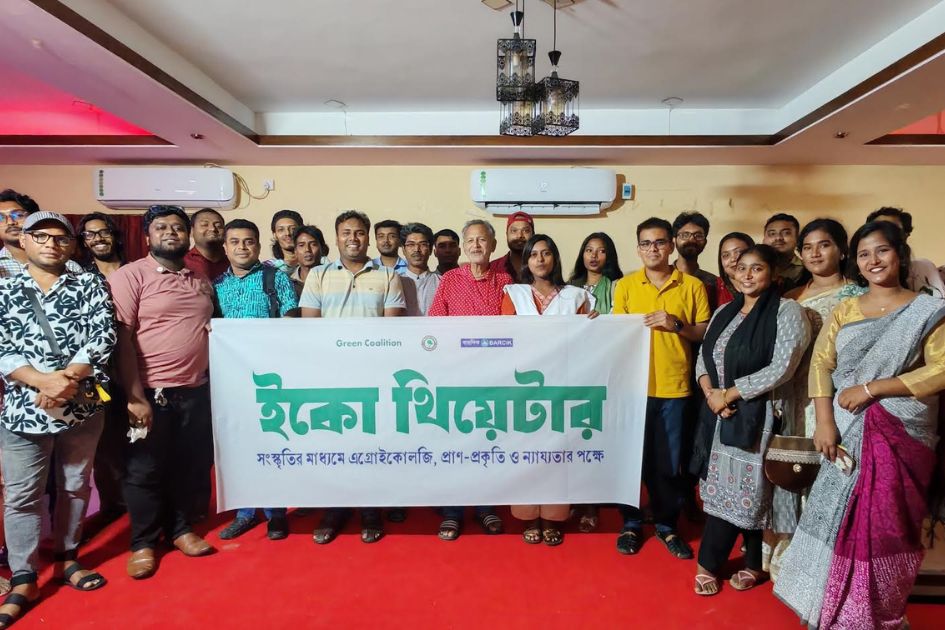
The formal launch was announced at a meeting titled Eco Theatre for Agroecology, Nature and Justice through Culture held at a restaurant in Rajshahi on Monday. The initiative has been jointly organised by the Barind Youth Forum, Green Coalition and development research organisation BARCIK.
Members of the Barind Youth Forum from rural and urban communities, young organisers, cultural activists and individuals involved in environmental and social movements attended the event. Participants discussed the objectives of Eco Theatre, its future work plan and upcoming cultural initiatives.
Speakers said that culture could serve as a powerful tool for raising public awareness and encouraging social participation at a time when environmental destruction, river encroachment and pollution, the climate crisis, biodiversity loss, the growing challenges facing agriculture and inequalities in the food system continue to intensify.
They said messages promoting agroecology, food sovereignty, environmental protection and climate justice could be communicated effectively to people from different sections of society through theatre, songs, folk performances, storytelling and other creative artistic practices.
The programme was chaired by Barind Youth Forum President Md. Atikur Rahman Atik and moderated by General Secretary Poly Rani.
BARCIK researcher and anthropologist Md. Shahidul Islam presented the concept of Eco Theatre, its global context and the role of culture in environmental and social movements.
“The climate and agricultural crisis is not only an environmental issue. It is also part of our social, cultural and political reality. To bring changes in people’s thinking and way of life, culture must become one of the key instruments of social movements. Eco Theatre is a creative platform developed to serve that purpose,” he said.
Atik said the initiative would build a people-centred cultural movement by transforming the life experiences, struggles, indigenous knowledge and relationship with nature of farmers, women, young people and local communities in the Barind region into theatrical performances.
He said the initiative would not only raise awareness but also provide fresh momentum to campaigns for environmental conservation, stronger local food systems and the creation of a more just society.
Participants pledged to organise regular Eco Theatre performances, training sessions, workshops and cultural campaigns in villages, educational institutions and urban areas across the Barind region.
They expressed confidence that harnessing the power of culture would help broaden public engagement and strengthen the movements for agroecology, food sovereignty and climate justice.