

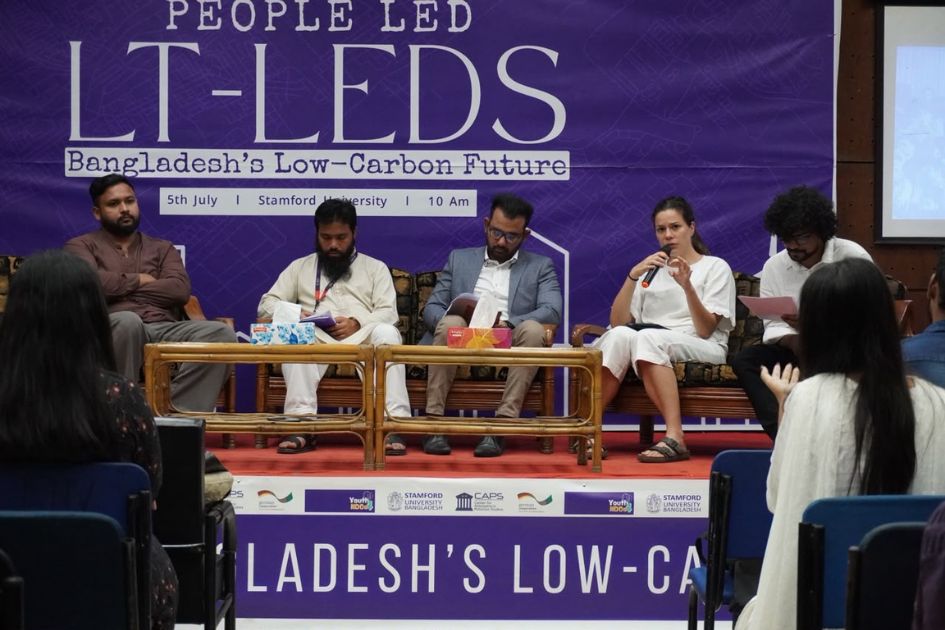



Youth, academics and climate experts launched a people-led dialogue in Dhaka, offering recommendations to help shape Bangladesh’s first Long-Term Low Emission Development Strategy for an inclusive low-carbon future.
Youth leaders, academics, environmental experts and development practitioners launched a people-led dialogue on Bangladesh’s long-term low-emission development strategy (LT-LEDS) on Saturday, aiming to ensure broader public participation in shaping the country’s future climate and development policies.
The University Dialogue on People-led LT-LEDS: Bangladesh’s Low Carbon Future was held at Stamford University Bangladesh. The event was organized by Youth for NDCs in partnership with Stamford University Bangladesh and the Center for Atmospheric Pollution Studies (CAPS) with support from the German Embassy Dhaka.
Bangladesh is preparing its first Long-Term Low Emission Development Strategy (LT-LEDS), a long-term planning framework that will guide the country’s development across sectors including energy, transport, urban development, infrastructure, industry, finance and public investment.
The dialogue sought to introduce the strategy to young people and other stakeholders while gathering recommendations to support a low-carbon climate-resilient and inclusive development pathway.
Around 110 to 120 participants attended the programme, including students, faculty members, youth representatives, researchers, practitioners and sectoral stakeholders. Discussions focused on long-term emissions pathways and sectoral planning with particular emphasis on urban planning and infrastructure.
Vice Chancellor of Stamford University Bangladesh Dr. Sharif Nafe As-Saber attended the event as chief guest and stressed the need for sustained youth participation in environmental protection and policymaking.
“Young people must remain actively involved not only in environmental awareness but also in policy conversations that shape the future of the country,” he said.
“Universities have an important responsibility to create spaces where students can think critically, engage with national challenges and contribute to sustainable development.”
Vice Chancellor of Dhaka Central University Professor Dr. Md. Nurul Islam attended the programme as guest of honour.
The panel discussion featured Elisa Benistant Fremigacci, Technical Officer for Just Transition at ILO Bangladesh, Professor Dr. Mrityunjoy Acharjee, Professor and Proctor at Stamford University Bangladesh, Md Nasir Ahmmed Patoary, Lecturer in the Department of Environmental Science at Stamford University Bangladesh and Shah Rafayat Chowdhury, Founder of Footsteps.
The panellists discussed just transition, urban sustainability, environmental health, infrastructure choices, youth employment, poverty alleviation and community-centred development within the context of Bangladesh’s long-term low-emission future.
Executive Director of Youth for NDCs Amanullah Porag said LT-LEDS was not solely about reducing emissions but about determining the country’s development pathway over the coming decades.
“If young people, universities, communities, businesses and local actors are not part of this conversation from the beginning, the strategy will remain incomplete,” he said.
“Through this process, we want to make Bangladesh’s long-term climate planning more people-led, evidence-based and development-aligned.”
Participants also joined group discussions to prepare practical recommendations for Bangladesh’s first LT-LEDS. The sessions covered urban planning, infrastructure, transport, energy use, public services, social equity and just transition. The recommendations will contribute to the wider People-led LT-LEDS process and help develop consolidated People’s Recommendations for Bangladesh’s LT-LEDS.
Professor Ahmad Kamruzzaman Majumder, Dean of the Faculty of Science at Stamford University Bangladesh, delivered the vote of thanks and highlighted the need to connect scientific knowledge, academic research and public engagement with long-term national planning.
“Bangladesh’s low-carbon future will require evidence, coordination and participation. Academic institutions can play a vital role by generating knowledge, engaging students and supporting policy-relevant discussions on climate change, pollution, urban development and sustainability,” he said.
The event concluded with closing remarks from Fatema Nur Jarin, Communications Manager of Youth for NDCs, who thanked participants, speakers, partners and supporters for contributing to the dialogue.
Organisers said the People-led LT-LEDS: Bangladesh’s Low Carbon Future project will continue through a series of university-based and stakeholder-specific dialogues across the country to generate structured evidence-based and people-led recommendations for developing a robust, inclusive and nationally relevant LT-LEDS for Bangladesh.




