

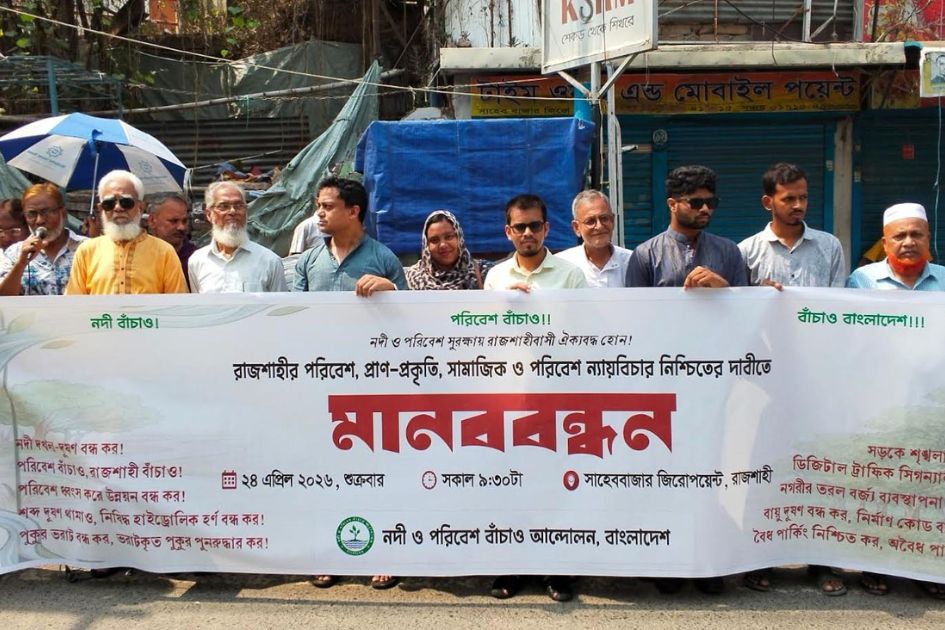



Activists in Rajshahi form human chain, presenting 20-point charter urging action on pollution, river protection, water crisis, healthcare, and sustainable urban management.
Environmental activists and citizens formed a human chain in Rajshahi on Friday, calling for social and environmental justice and placing a 20-point set of demands before the government and relevant authorities.
The programme was held at 9:30 am at Saheb Bazar Zero Point, the city’s commercial hub, under the banner of “Save rivers, save environment, save Rajshahi, save Bangladesh.” It was organised by the River and Environment Protection Movement, Bangladesh, as part of a public awareness initiative.
Participants included members of environmental and civic organisations, representatives of civil society and concerned residents. The event was presided over by Advocate Enamul Haque, president of the organising body, and conducted by its general secretary Advocate Hossain Ali Piyara.
Speakers highlighted a wide range of challenges facing Rajshahi, including environmental degradation, tree felling, filling of ponds, conversion of agricultural land into water bodies, poor solid and liquid waste management, noise and air pollution, river encroachment and contamination, healthcare gaps, water scarcity, traffic disorder and inadequate fuel and electricity supply.
They urged the government, local administration and relevant authorities to take immediate action to resolve these issues and ensure a livable city for all forms of life.
Among those who addressed the gathering were Dr Wasim Hossain, president of Doctors Association of Bangladesh (DAB); Mahbub Siddiqui, president of Heritage Rajshahi and Sabuj Sanghati Rajshahi; Dr Zakir Khan, a teacher at Bangladesh Army University of Engineering and Technology; Dr Mohammad Kamruzzaman, vice-president of the organising body; former councillor Belal Ahmed; Nurul Haque, general secretary of Diganta Prosari Club; Atikur Rahman Atik, president of Barendra Youth Forum and joint general secretary of the movement; Md Mizanur Rahman, chairman of Save the Nature and Life; Professor Walidul Islam, president of Maulana Bhashani Memorial Parishad; Kamran Hafiz, executive director of Social Progress and Environment Retrieval Center; Md Abul Bashar, general secretary of ADAB Rajshahi; Shamsul Abedin Don, member secretary of Bangladesh Samajtantrik Dal (BASAD); Anjuman Ara Shilpi, women’s affairs secretary of the movement; Ishita Yasmin, youth women’s affairs secretary; Mohona Khatun, president of Diner Alo Hijra Sangha; Poly Rani Pramanik, executive member of Green Coalition Rajshahi; cultural activist Waliur Rahman Babu and Julfikar Ali Haidar, president of Water Crisis Parliament, among others.
From the human chain, organisers announced a 20-point demand to ensure environmental protection, social justice and sustainable development in Rajshahi.
Key demands include an immediate halt to tree cutting in the name of development and protection of existing trees, a ban on environmentally destructive activities and enforcement of eco-friendly development practices. They also called for legal action against those involved in environmental damage.
The speakers demanded strict measures to curb noise pollution, including banning the use, production and sale of prohibited hydraulic horns. They said filling of ponds must stop despite existing High Court directives and called for restoration of already filled water bodies and protection of remaining wetlands.
They stressed the need to protect agricultural land, halt pond excavation on farmland and implement the Land Use Control and Agricultural Land Protection Act 2026. They also demanded exemplary punishment for those involved in illegal land use practices.
Healthcare services in the city must be improved, they said, including the immediate launch of a specialised 200-bed children’s hospital in Rajshahi.
Other demands included controlling air pollution through enforcement of building codes, banning single-use plastics and ensuring proper waste management. They called for treatment of liquid waste before discharge and mandatory installation of sewage treatment plants in industries.
The speakers urged authorities to stop river encroachment and pollution, reclaim the Padma riverbank and halt illegal sand extraction. They also demanded planned capital dredging to restore river navigability.
Traffic management reforms were also highlighted, including removal of illegal parking and garages, ensuring pedestrian access to footpaths, installing digital traffic signals and regulating illegal vehicles through proper licensing and identification systems.
They called for ensuring rights of all living beings in the city, including birds and stray animals, promoting chemical-free agriculture and banning hazardous pesticides.
Water security was another major concern, with demands for a separate water management system for the Barendra region, reduced reliance on groundwater and increased use of surface water.
The speakers further called for re-excavation of rivers such as the Padma, Brahmaputra, Baral and Shiba, as well as distributaries including Baranai, Barahi, Nabaganga, Swaromongola and Doya.
They also proposed the creation of a dedicated drought fund for the drought-prone Barendra region and introduction of allowances for affected communities.
The human chain concluded with a renewed call for coordinated and urgent action to make Rajshahi a sustainable and livable city.




