

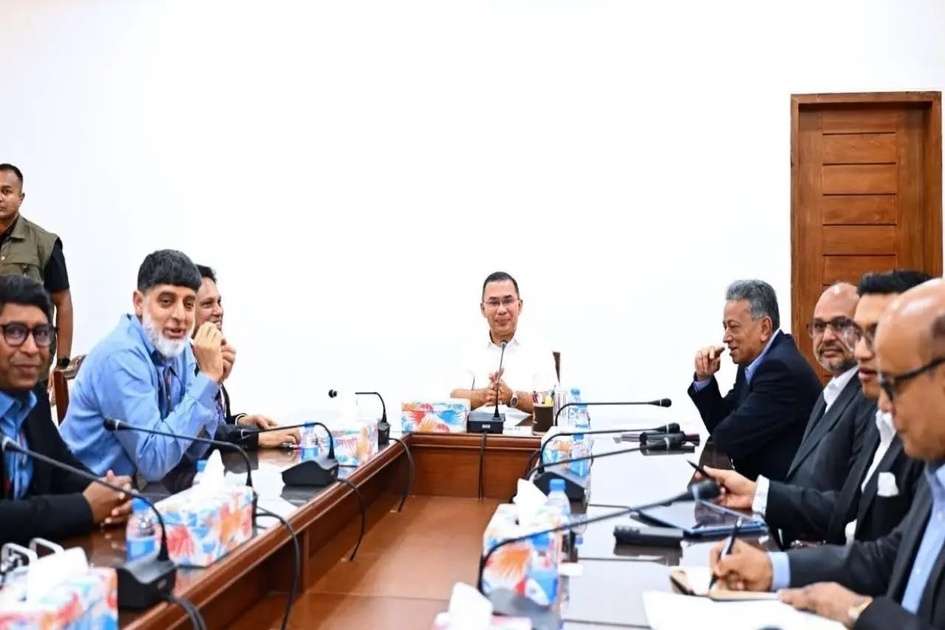



Officials and local manufacturers discussed rooftop solar models, incentives for inverter raw materials and measures to make renewable power more affordable for consumers.
Key government buildings are to get solar panels under the Prime Minister’s energy plan.
The initiative targets energy security, the local solar industry and wider rooftop adoption.
Bangladesh Prime Minister Tarique Rahman has directed the installation of solar panels on major government buildings as part of a broader effort to expand renewable energy use, strengthen energy security and reduce reliance on imported fuels.
The decision was taken on Monday(3 Auguest) at a high-level meeting on solar power generation held at the Cabinet Division in the Prime Minister’s Office (PMO) at the Secretariat in Dhaka.
The meeting outlined a three-part strategy focusing on installing rooftop solar systems at government institutions, supporting the domestic clean energy industry and developing an affordable economic model to encourage wider adoption of renewable power among households and businesses.
Under the initial phase, photovoltaic installations will be introduced at major state facilities, including Bangabhaban, the official residence of the President of Bangladesh, the Prime Minister’s Office in Tejgaon, Jatiya Sangsad Bhaban, the Bangladesh parliament building, the Prime Minister’s Office wing at the Bangladesh Secretariat, the Ministry of Finance building and the Planning Commission headquarters, among other important government establishments.
Prime Minister Tarique Rahman said visible deployment of renewable energy systems at public institutions would help build public confidence and encourage wider adoption of clean energy solutions.
He also directed relevant authorities to provide targeted support and incentives for importing essential raw materials required for domestic solar inverter production, aiming to strengthen local manufacturing capacity and supply chains.
The meeting also discussed developing a practical economic framework to make renewable energy more affordable and accessible for ordinary consumers.
Representatives from Pran-RFL Group and Walton Group presented rooftop solar models for residential and commercial users, including systems that can supply surplus electricity to the national grid through appropriate mechanisms.
The companies said expanded rooftop solar adoption could help reduce energy costs, conserve conventional fuel resources and create new employment opportunities. They also presented technological solutions designed to support high-load appliances used in households and commercial establishments.
Bangladesh has been seeking to diversify its energy mix amid rising electricity demand, pressure from fuel import costs and the need to accelerate the transition towards cleaner energy sources. Renewable energy expansion is increasingly viewed as an important pathway to improve long-term energy resilience and reduce dependence on imported fossil fuels.
The initiative is expected to demonstrate the feasibility of clean energy use in public institutions and encourage greater investment in renewable power across the country.
The meeting was attended by Finance and Planning Minister Amir Khsru Mahmud Chowdhury; Prime Minister’s Adviser on Finance and Planning Rashed Al Mahmud Titumir; State Minister for Local Government, Rural Development and Cooperatives Mir Shahe Alam; Bangladesh Investment Development Authority (BIDA) Executive Chairman Ashik Chowdhury; National Board of Revenue (NBR) Acting Chairman Ahsan Habib; Pran-RFL Group Chairman Ahsan Khan Chowdhury and AGM for Solar and Renewable Energy Tawhidul Ahad; Walton Group Managing Director SM Mahbubul Alam; along with senior government officials and ministry secretaries.




