

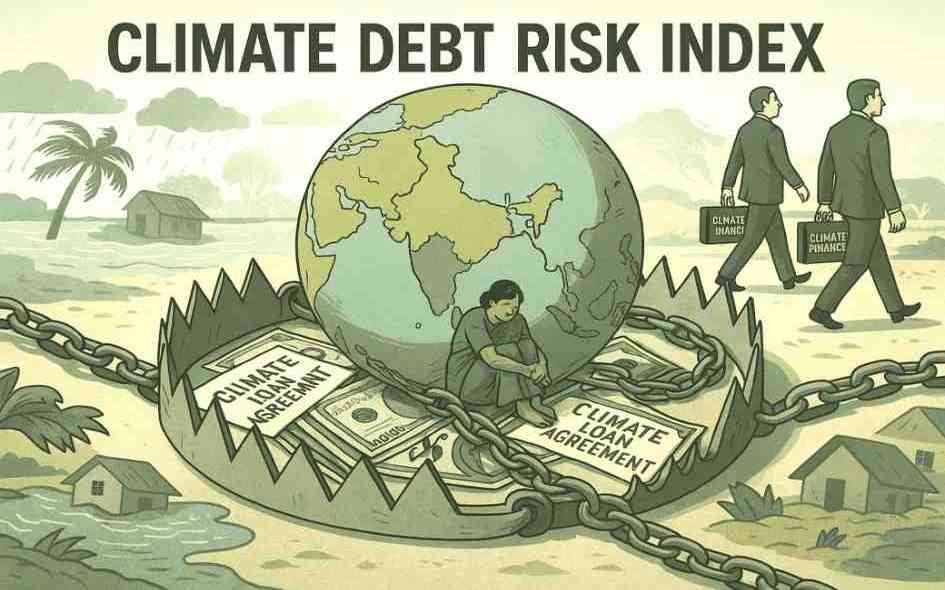



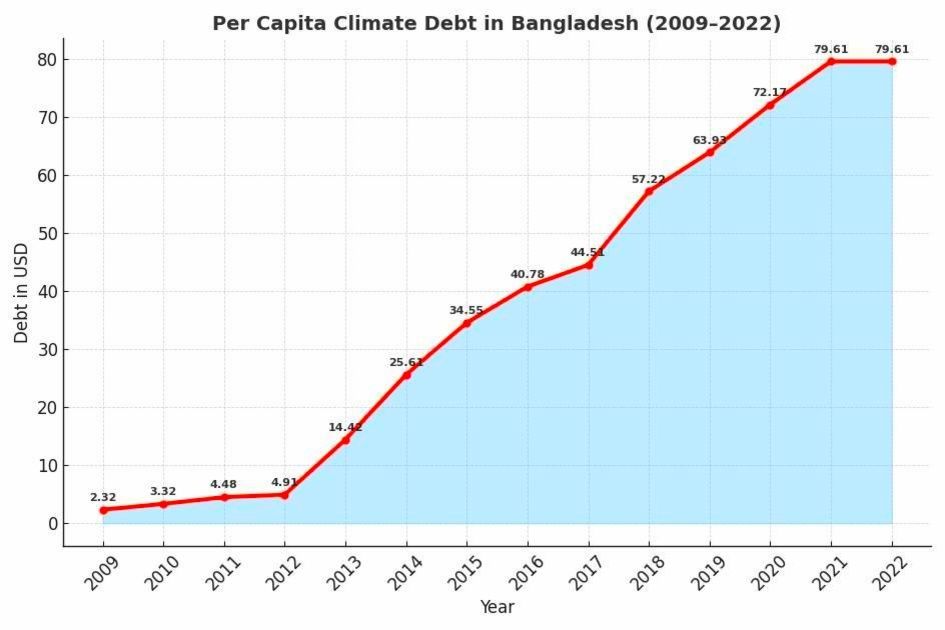
As one of the most climate vulnerable countries, Bangladesh’s overall per capita climate debt burden has risen sharply from zero dollar in 2009 to a staggering $79.61 by 2022
When a devastating natural disaster hits Bangladesh, the country takes steps – often with hefty international loans – to help protect and rebuild the lives of those affected. But the long-term economic repercussions from such initiatives are always overshadowed by the urgency.
But one thing is certain, the country is racking up climate debt at an unprecedented level.
A report by the Climate Debt Risk Index (CDRI) warns that sea level rise and severe storms could displace millions of people living in coastal cities, with the annual economic cost exceeding $1 trillion by 2050.
Back in 2023, Bangladesh’s per capita climate debt from multilateral climate funding stood at $2.04. However, as one of the most climate vulnerable countries, Bangladesh’s overall per capita climate debt burden has risen sharply from zero dollars in 2009 to $79.61 by 2022.
Between 2002 and 2021, Bangladesh received $5.64 billion for adaptation efforts and $8.83 billion for mitigation. In 2023, the adaptation-to-mitigation ratio of multilateral climate funding stood at 0.90, reflecting a worsening trend.
According to CDRI projections, Bangladesh’s Climate Debt Risk Index score is expected to rise from 67.91 in 2024 to 70.47 by 2030, signaling mounting financial pressure.
What happened in 2024?
Flash floods originating from Tripura state of India struck Bangladesh in 2024, affecting several districts including Feni, Comilla, Noakhali, Brahmanbaria, Chattogram, Khagrachari, Rangamati, Cox’s Bazar, Lakshmipur, Sylhet, Moulvibazar, and Habiganj.
According to the Department of Disaster Management, the total financial losses from multiple floods across 25 districts reached nearly Tk 20,200 crore.
A report by the United Nations Office for the Coordination of Humanitarian Affairs (UNOCHA) states that 18.3 million people in Bangladesh were affected by natural disasters – including cyclones and floods – between May and August 2024.
One of the victims is Rais Uddin from Noakhali, who lost his home and one acre of farmland in the floods. Now, he pulls a van to support his family.
Sharing his predicament, Rais said while sobbing tearfully, “Everything I had is gone. During the 2024 floods, my life was swept away by the rushing waters. My family and I are now living on the streets.
“I took out a loan from a local cooperative to plant crops, and I am still repaying it. The government is asking us to be patient, but we have received nothing yet.”
Asia Khatun, another victim from Cumilla, has been living on the footpath in the Gulistan area of Dhaka with her four children. Her husband died in last year’s floods.
“I used to beg on the streets. My husband was the only breadwinner in our family. After his death, I became homeless with four children,” Asia told The Climate Watch.
Hundreds of families have shared the same fate. According to the Department of Disaster Management, 122 people lost their lives in four phases of flooding across the country in 2024.
Reports paint a grim picture
A UNICEF report noted that 52 people died and 1.3 million were affected by the 2023 floods across four districts. The 2022 floods caused an estimated $1 billion in damage in Bangladesh.
According to a Bangladesh Bureau of Statistics (BBS) Labour Force Survey conducted from October to December last year, the number of people employed in agriculture fell to 31.78 million by the end of 2023, from 33.36 million in December 2022.
Climate change is projected to reduce global agricultural productivity by up to 30% by 2050, potentially impacting nearly 500 million smallholder farmers in developing countries.
Burdened with mountain of debt
Despite being one of the least developed countries, Bangladesh is increasingly falling into a climate debt trap through various bilateral and multilateral agreements.
A decline in fiscal capacity and depletion of natural resources are compounding the risks associated with this debt. Alarmingly, nearly half of all international climate finance to least developed countries (LDCs) come in the form of loans rather than grants.
Following Cyclone Amphan in 2020, Bangladesh entered a climate-induced debt cycle, largely driven by high-interest loans. From 2009 to 2022, Bangladesh received only $14.47 billion in international climate financing – barely 9.7% of the $149.5 billion it urgently needed.
In Bangladesh, mitigation projects are prioritized over adaptation efforts. The adaptation-to-mitigation funding ratio stands at just 0.90, indicating an underinvestment in adaptation, which is essential for vulnerable communities.
The CDRI report notes that although initiatives such as the LDCF and the Pilot Program for Climate Resilience (PPCR) are supporting sustainable agriculture, water management, and disaster-resilient infrastructure, the overall funding remains skewed towards long-term mitigation rather than immediate adaptation needs.
Addressing the issue, Change Initiative CEO M Zakir Hossain said, “Bangladesh urgently needs an adaptation-centered economic strategy to protect itself from escalating climate threats. The country’s climate debt-to-GDP ratio in 2023 was only 0.0008, which is low.
“Similarly, the per capita debt-to-income ratio is just 0.08, suggesting the debt’s impact on the average citizen’s income is minimal. However, the lack of adequate funding for critical adaptation and mitigation projects is a major concern.”
In 2002, Bangladesh’s external debt-to-GDP ratio was 0.30, which fell to 0.12 in 2017 but rose again to 0.15 in 2023.
According to Hossain, one major driver behind this rise in climate debt is authoritarianism.
Over the past 15 years, the government has allegedly misrepresented key statistics – such as GDP growth, inflation, and export earnings – to obscure the country’s financial risks, thereby exacerbating the debt burden.
Harmful projects disguised as climate action
In 2009, Bangladesh had no climate-related debt. But since the Awami League government came to power, the debt has steadily increased to $79.61 per capita by 2022. Although the official figure is reported at $2.04 per capita, the CDRI estimates this figure to be significantly higher.
Many of the climate-related projects funded by loans are neither environmentally friendly nor relevant to climate adaptation. For instance, the Matarbari Coal Power Project built with Japanese financial and technical assistance is Bangladesh’s most expensive coal-based power plant.
Despite strong opposition from environmentalists, it continues to move forward at an estimated cost of Tk 52,000 crore. The agreement for this project was signed in 2014, with construction beginning in 2017.
Little to no support from climate agreements
In 2022, numerous bilateral and multilateral climate agreements were signed globally, especially during the COP27 conference, where key declarations were made – including the landmark decision to establish a “loss and damage” fund.
However, the exact number of these agreements was not disclosed publicly, and most focused on long-term adaptation rather than immediate disaster response.
That same year, floods in Bangladesh caused an estimated $1 billion in damages, yet none of the agreements provided direct financial relief. Instead, Bangladesh took on substantial climate-related loans, increasing its debt burden.
These included a $246 million loan from the Asian Development Bank for the Coastal Towns Climate Resilience Project, a $500 million World Bank IDA loan for the Resilient Infrastructure for Adaptation and Vulnerability Reduction Project, and a $250 million IDA loan for the Bangladesh Environmental Sustainability and Transformation Project.
“While these projects aim to build future resilience, they have added to the country’s climate debt,” said Zakir.
Misused climate funds
Examples of misused climate funds include the Sheikh Russell Eco Park in Khulna, built for Tk 290 million, and solar lighting projects in three upazilas of Khulna.
These projects were prioritized despite the region’s pressing issues with saline water and drinking water shortages. In 2020, four buses purchased with climate funds were abandoned and left to deteriorate at the Department of Environment.
Between 2019 and 2023, 322 projects were approved under the Climate Fund. Of these, 209 projects or 65% were for installing streetlights, with a combined budget of Tk 3.38 billion. An additional 23 projects were approved for sewer construction, costing Tk 410 million.
Since 2009, a total of 969 projects have been implemented using climate fund money, with total expenditures reaching Tk 3,968 billion.
Climate change is also increasing the cost of borrowing. Climate-vulnerable countries face higher interest rates, paying an extra $1 for every $10 borrowed. By 2035, the cost of climate-driven debt is expected to double, with extra interest payments estimated to reach $146 billion to $168 billion over the next decade.
This reliance on debt-based adaptation financing is unsafe for Bangladesh in the long term and severely undermines its resilience to climate change.
Climate fund mismanagement and politically motivated allocations have worsened this crisis, according to environmentalist Professor Ahmed Kamruzzaman Majumder.
Climate debt distribution
According to Aid Atlas, Bangladesh has received a total of $14.31 billion for climate-related initiatives. Of this, $12.78 billion came as loans, while only $8.34 billion was in grants. This results in a loan-to-grant ratio of 1.53, indicating that loans significantly outweigh grants.
Grants should ideally be the primary form of climate assistance for Least Development Country -LDCs. However, in Bangladesh’s case, this imbalance is threatening long-term economic stability.

Climate expert Md Shamsuddoha attributes this situation partly to Bangladesh’s limited project implementation capacity, which restricts its ability to secure grants.
What’s the global comparison?
Bangladesh has a per capita income of $2,529 and a per capita climate loan of $2.04, representing a moderate but significant debt burden.
In contrast, Rwanda has $5.05 debt per capita compared to $1,038.64 income, Senegal has $4.47 debt per capita compared to $3,393.50 income, while Zambia has $4.21 debt per capita compared to $1,369 income.
These figures show a greater strain on personal incomes compared to Bangladesh.
Countries like Haiti ($1.94 debt per capita) and Mozambique ($1.44 debt per capita) carry a relatively manageable debt burden. Meanwhile, Bangladesh falls in the middle, bearing a moderate but impactful climate debt load.
Bangladesh’s Adaptation-Mitigation Ratio is 0.69, suggesting a tilt toward mitigation funding at the cost of immediate adaptation needs. Countries like Ethiopia (0.18) and Haiti (0.03) are more grant dependent and thus face lower debt risks.
In contrast, countries like Sri Lanka (12.13) and Pakistan (2.10) face dangerously high debt ratios due to similar overreliance on climate loans.

Cambodia (2.07) and Senegal (1.10) have more balanced funding across adaptation and mitigation. However, countries like Pakistan (0.29) and Tanzania (0.48) receive disproportionately more mitigation funding.
Md Shamsuddoha stresses that without proper loan utilization and sustainable management, countries heavily reliant on debt for climate finance will face long-term instability.
Risk of a climate debt trap
Bangladesh needs approximately $22.55 billion annually to address its climate risks, including $7.7 billion for disaster preparedness (mostly private sector), $8.5 billion for adaptation (National Adaptation Plan), $3.26 billion for mitigation and renewable energy, and $3.1 billion for government-led climate expenditures.
The total adaptation cost is projected to reach $230 billion by 2050, while the mitigation goal includes achieving 40% renewable energy by 2041.
However, only $4.3 billion is currently allocated from domestic sources such as the Annual Development Program (ADP) and the Bangladesh Climate Change Trust Fund.
Just $0.1 billion comes from international sources like the Green Climate Fund and PPCR, leaving a funding gap of $18.15 billion annually.
This enormous shortfall makes it critical to increase international grant-based assistance. Otherwise, Bangladesh may plunge into an unsustainable climate debt trap, warns Change Initiative CEO M Zakir Hossain.
However, due to corruption in projects, the chances of receiving climate grants are diminishing. Therefore, he emphasized the need for sustainable development in project planning.
From 2011 to 2022, interest payments on external debt in LDCs steadily increased, peaking at $50 billion in 2021. Though slightly reduced in 2022, this burden continues to strain national budgets and undermine investments in development and resilience.




