

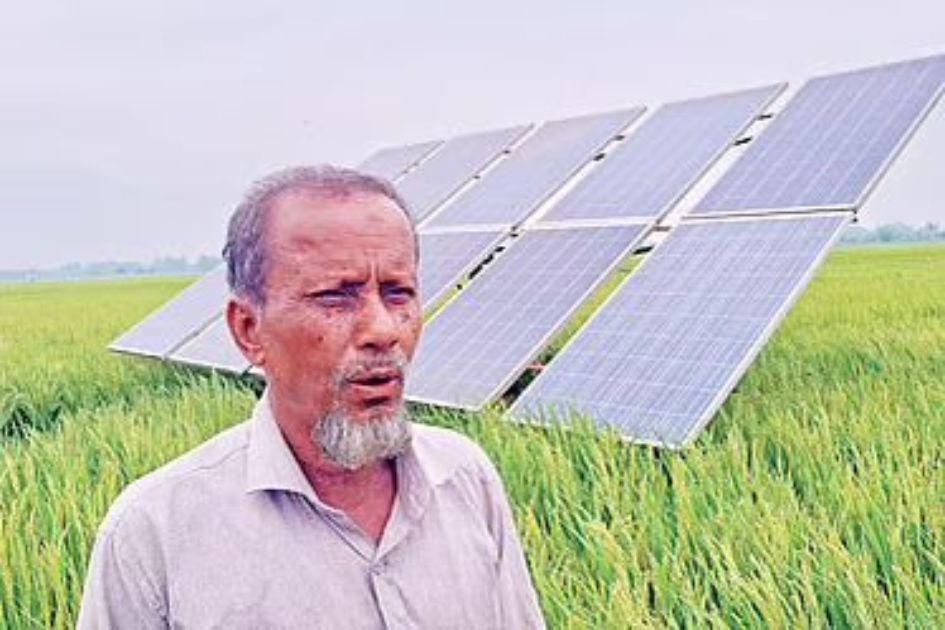

Solaiman Ali, a self-taught innovator from Bangladesh, has developed a low-cost solar irrigation system, providing farmers with a reliable, sustainable, and affordable solution amidst the country’s energy crisis.
As fuel shortages and power outages disrupt farming across Bangladesh, a self-taught rural innovator has developed a low-cost solar irrigation system that reduces costs, improves yields and offers a scalable clean energy solution.
In Molani village of Thakurgaon sub-district, locally known as an upazila, Solaiman Ali has built a mobile solar irrigation pump that runs entirely on sunlight, reducing reliance on diesel and unreliable grid electricity. The locally assembled system is already being used in the area, providing farmers with a cheaper, cleaner and more dependable alternative for irrigation.
From School Dropout to Grassroots Innovator
Ali’s formal education ended after primary school, but his technical curiosity led him from repairing bicycles to working with instant power supply systems. Over time, he developed hands-on expertise in renewable energy technologies.
In 2013, he began experimenting with solar-powered irrigation. After years of trial and error, collecting panels, controllers and mechanical components, he developed a working model, later improving it with a gearbox to increase water flow and a manual tracking system to better align panels with the sun.
Simple Design, Practical Impact
The system uses a 2.5 kilowatt solar array to power a three-horsepower water pump. Under sufficient sunlight, it can lift around 700 litres of water per minute, enough to irrigate up to 10 acres, about 4 hectares, of farmland in a day.
Mounted on a wheeled structure, the unit can be easily transported between fields. Farmers only need an existing borehole to connect the pump, making it adaptable without requiring additional infrastructure.
Lower Costs, Higher Resilience
A complete unit costs approximately 120,000 Bangladeshi taka, around 1,100 US dollars. Farmers say the system has significantly reduced irrigation expenses, from 7,000 to 8,000 taka per bigha, a local land unit of roughly 0.13 hectares, to about 3,000 taka.
“I no longer worry about power cuts or fuel shortages. When the sun is out, I can irrigate my land on time,” said a local farmer using the system.
Local agricultural officials also see potential in the innovation. “This kind of solar irrigation could reduce pressure on both farmers’ costs and the national energy system,” said an official from the Department of Agricultural Extension, requesting anonymity as they were not authorized to speak publicly.
A Growing Local Enterprise
Ali has turned his innovation into a small-scale enterprise. He has built and sold more than 100 units and currently operates 26 pumps, of which 20 are rented out to farmers at affordable rates.
This rental model has expanded access for smallholder farmers who cannot afford the upfront investment, while also creating a sustainable income stream for the entrepreneur.
Climate and Energy Implications
Bangladesh remains heavily dependent on imported fossil fuels, leaving it vulnerable to global price shocks, intensified in recent years by geopolitical tensions affecting energy markets.
Experts say decentralized renewable solutions like solar irrigation can help reduce diesel use, cut greenhouse gas emissions and strengthen resilience in climate-vulnerable farming communities.
The systems developed by Ali are already supporting irrigation across an estimated 7,000 hectares in the region, demonstrating the scalability of locally driven innovation.
Adding to this perspective, Sohanur Rahman, Executive Coordinator of YouthNet Global, emphasized the broader significance of such initiatives: “Locally led innovations like this are at the heart of a just transition. When communities design and own solutions, they not only reduce emissions but also ensure equity, affordability and resilience.” He added, “Supporting grassroots innovators is essential if we want climate action to be truly inclusive and sustainable.”
Policy Gaps and Scaling Challenges
Despite its success, the technology has yet to receive structured government backing, highlighting gaps in Bangladesh’s renewable energy financing and rural innovation policies.
Analysts say scaling such solutions will require targeted support, including low-interest agricultural loans, technical training and public investment to integrate local innovations into national energy and agriculture strategies.
A Model With Global Relevance
Ali’s work highlights how practical, locally developed technologies can address interconnected challenges of energy access, food security and climate resilience, particularly in developing economies.
As energy insecurity deepens across many parts of the world, innovations like his raise a critical question: Can grassroots solutions scale fast enough to meet growing demand, or will they remain under-supported despite their potential?




