

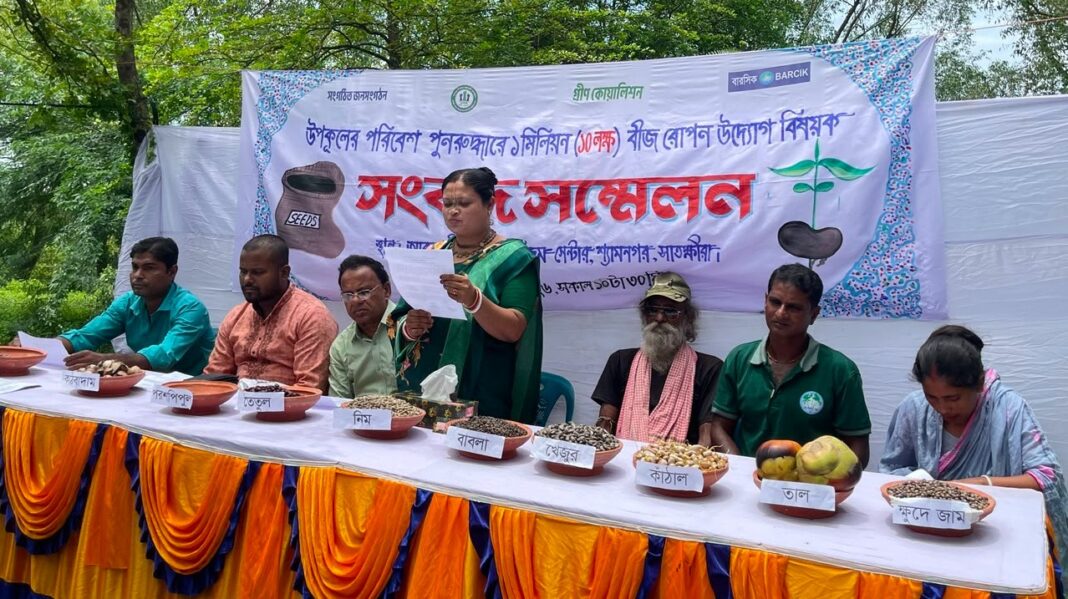



Organizers say the citizen-driven effort will promote native species, support biodiversity and strengthen natural protection for climate-vulnerable communities across Satkhira and the wider coastal belt.
A broad coalition of community-based organizations, environmental activists, volunteers and local citizens has launched an ambitious campaign titled “1 Million Seeds Plantation for Coastal Restoration”, aiming to restore the fragile coastal ecosystem of Bangladesh through the collection and planting of one million indigenous tree seeds.
The campaign was officially announced at a press conference held on Wednesday (15 July) at Akashlina Eco Tourism Centre in Shyamnagar upazila of Satkhira, a southwestern coastal district of Bangladesh. The initiative is jointly led by community-based organizations, Upazila Volunteer Association, Shyamnagar Green Coalition and Bangladesh Resource Center for Indigenous Knowledge (BARCIK).
Addressing journalists, the organizers highlighted that Bangladesh’s coastal region remains one of the world’s most climate-vulnerable areas, facing increasing threats from sea-level rise, salinity intrusion, cyclones, tidal surges, riverbank erosion and biodiversity loss. They stressed that alongside infrastructural interventions, Nature-based Solutions (NbS) are essential for strengthening climate resilience and restoring degraded ecosystems.
The initiative aligns with the Government of Bangladesh’s nationwide 250 million tree plantation program and seeks to mobilize citizens to collect, conserve and plant seeds of indigenous fruit and forest tree species across the coastal belt.
Speaking at the event, the organizers stated that the campaign is more than a tree-planting programme; it is a citizen-led environmental movement designed to restore biodiversity, enhance carbon sequestration, protect riverbanks and coastal landscapes, improve wildlife habitats and strengthen the natural resilience of coastal communities against climate change.
The campaign encourages participation from all sections of society, including women, youth, students, farmers, fishers, forest-dependent communities, Indigenous peoples, persons with disabilities, volunteers, educational institutions, civil society organizations and environmentally conscious citizens.
People are being encouraged to collect seeds of native tree species such as Neem, Mango, Jackfruit, Java Plum, Monkey Jack, Tamarind, Palmyra Palm, Date Palm, Gum Arabic (Acacia), Banyan, Arjun, Tropical Almond and other locally adapted species. According to the organizers, more than 400,000 seeds have already been collected through community participation.
Citizens willing to contribute can preserve and donate collected seeds, after which volunteers will collect them from their locations. All seed donors will be officially documented and recognized during the campaign’s closing ceremony as a token of appreciation for their contribution to coastal restoration.
Concluding the press conference, the organizers called upon everyone to join the campaign, saying: “We believe that a single seed has the power to transform the future of our coast. Today’s seed is tomorrow’s tree, and tomorrow’s tree is a stronger, greener and more climate-resilient Bangladesh.”




