

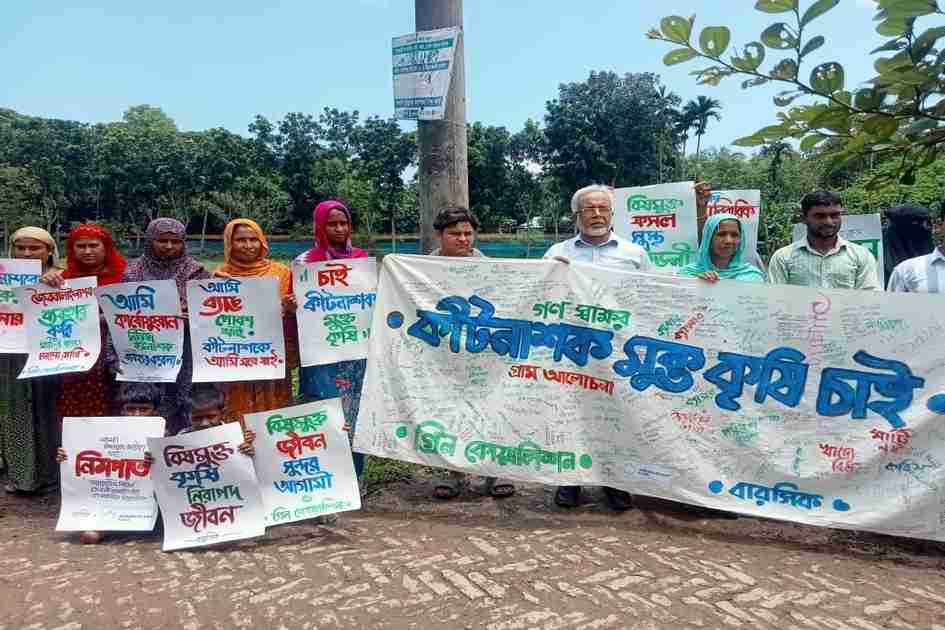



Organisers said banned pesticides remain in markets, while villagers pledged to promote organic pest control, protect soil and water, and build wider support for safer food production.
Farmers, teachers and young people in a village in northern Bangladesh joined a discussion and mass signature campaign on Wednesday demanding pesticide-free agriculture and safer farming practices.
The event, titled “We want pesticide-free agriculture”, was held on July 15 at the Kailati Agroecology Learning Centre in Kailati village under Netrakona Sadar Upazila of Netrakona district.
It was organised by the Green Coalition Committee with support from the Bangladesh Resource Center for Indigenous Knowledge, known as BARCIK, a private research organisation.
Netrakona Sadar Upazila Youth Development Officer Nuruzzaman attended the discussion as the chief guest. Also present were Enamul Khan, a youth farmer researcher and supervisor of the Kailati Agroecology Learning Centre, BARCIK regional coordinator Md. Ohidur Rahman, organic farmers from the village and young farmers.
In his opening remarks, Rahman said pesticides were among the major sources of environmental pollution.
“One study has found that pesticides used on agricultural land contaminate soil, air, water, crops, fish and even breast milk,” he said. “Pesticides are widely used on farmland in Bangladesh. As a result, aquatic environments are severely polluted. In immediate reactions, fish and other animals also die. Pesticides enter the bodies of animals through breathing from the air.”
Farmers said excessive pesticide use was damaging the biological balance of soil, water and the wider environment while increasing risks to human health.
“We use a lot of poison on crops,” farmer Shahjahan Mia said. “The soil is no longer like before. On the day I spray poison, I cannot sleep at night. I feel dizzy.”
Nuruzzaman said farmers should reduce chemical-based farming and move towards organic agriculture.
“We have to reduce chemical agriculture and move towards organic farming,” he said. “If chemical use cannot be reduced, soil, water and air will all be destroyed in the future. Pesticide use severely damages human organs such as the kidneys, liver, lungs, stomach and brain. Agriculture must be kept pesticide-free.”
He also said that if biogas was produced and used in villages, “women will be able to cook without tears”. He urged farmers to seek support from the Department of Youth Development for biogas production and technical assistance in the village.
Organisers said banned pesticides were still available in markets across the country, posing a direct threat to the environment and public health. They said the use and marketing of such toxic pesticides needed to be stopped.
Participants, including local farmers, teachers and young people, joined the mass signature campaign and pledged support for pesticide-free and safe farming practices.
A procession and nature-binding activity were also held in the village to raise awareness about reducing pesticide use.
During the event, farmers carried festoons reading “Why poison on the food plate”, “Stop soil, air and water pollution”, “Ban dangerous pesticides”, “We want a poison-free life”, “Use organic pest control, keep soil healthy”, “Organic agriculture, safe food” and “Pesticides are increasing environmental and health risks”.




