

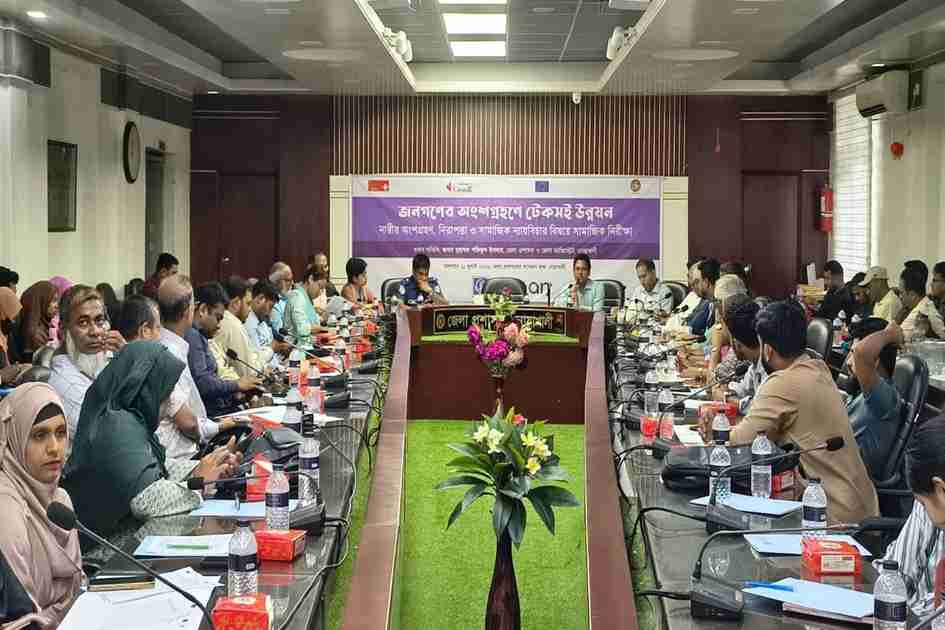



The audit across four upazilas highlighted barriers to mobility, livelihoods and basic services, with participants urging practical steps to reflect community voices in planning for underserved and climate-vulnerable areas.
A social audit in Bangladesh’s southeastern Noakhali district has found significant challenges facing women in safety, income, healthcare, disaster vulnerability and access to public services, organisers said after sharing the findings at a consultation meeting on 21 July 2026.
PRAAN organised the meeting at the Noakhali District Administration Conference Room, with support from the Centre for Policy Dialogue to discuss the audit on “Women’s Participation, Safety and Social Justice in Noakhali”.
The audit, conducted in Noakhali Sadar, Begumganj, Sonaimuri and Subarnachar found that 49% of women do not feel safe travelling at night and 70% have witnessed harassment on public transport.
It also found that 52% of women have no personal income, while nearly 70% of people remain outside online government services. The findings showed that 64% of women face health risks during disasters and 71% experience sanitation-related challenges.
The consultation brought together government officials, local authorities, civil society representatives, citizen groups and other stakeholders.
Participants included Dr Md Sheikh Sadek, Deputy Director and Deputy Secretary of Local Government; Shantanu Kumar Das, Additional Deputy Commissioner, Shuva Debnath, Additional Deputy Commissioner , Abu Tayyab Md Arif Hossain, Additional Superintendent of Police, and Katharina Konig, Deputy Team Leader of GFA Consulting Group and the Nagorikata Programme.
Representatives from CPD, PRAAN, district and upazila-level government offices, citizen groups and community volunteers also took part.
The discussion focused on women’s economic independence, sustainable employment, agro-based industrialisation, improved access to public services and stronger attention to underserved and climate-vulnerable communities.
Participants also stressed the need to turn the social audit findings into practical action and ensure that community voices inform future development planning and policy discussions.




