





The four-year census shows gains across most tiger habitats, with Parsa, Banke and Shuklaphanta posting increases while Bardiya recorded Nepal’s only decline since the 2022 count.
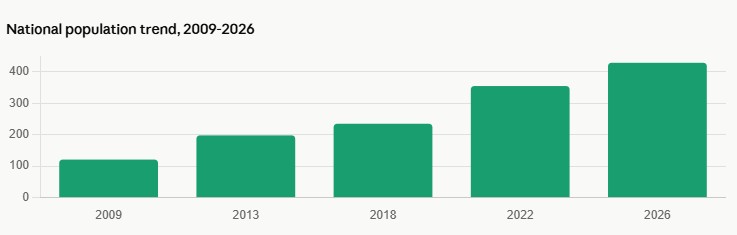
Nepal’s wild tiger population has risen to 429, the government announced on Wednesday as it released the National Tiger Census in Kathmandu to mark Global Tiger Day.
The Department of National Parks and Wildlife Conservation unveiled the findings in the presence of Honourable Minister for Agriculture, Forests and Environment Geeta Chaudhary.
The latest count continues a steady increase from 121 tigers in 2009 to 198 in 2013, 235 in 2018, 355 in 2022 and 429 in the new census, representing a more than threefold rise over a decade and a half.
Nepal’s tigers inhabit the Terai Arc Landscape, which stretches across Chitwan, Bardiya, Parsa, Banke and Shuklaphanta national parks, as well as their surrounding buffer zones, forests and wildlife corridors.
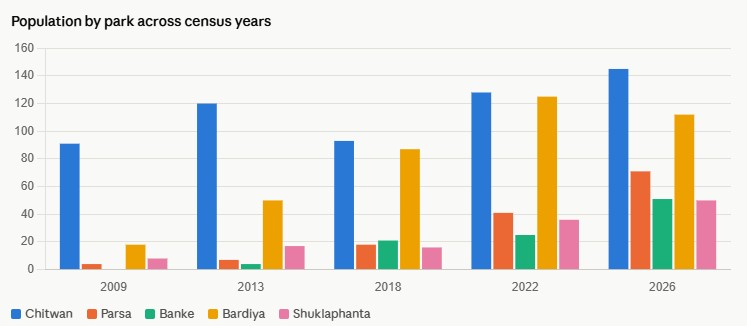
The census recorded 145 tigers in Chitwan, 112 in Bardiya, 71 in Parsa, 51 in Banke and 50 in Shuklaphanta.
Tiger numbers increased in every park except Bardiya, where the population declined from 125 in 2022 to 112, the only fall recorded nationwide.
Officials said Parsa registered the largest increase, with its tiger population rising from 41 to 71. Banke’s population grew from 25 to 51, while Shuklaphanta recorded an increase from 36 to 50.
Nepal conducts the census every four years to assess tiger populations, prey species and habitat conditions, with the findings used to guide future conservation planning.
The survey is led by the Department of National Parks and Wildlife Conservation in collaboration with the Department of Forests and Soil Conservation, provincial governments, the Nepal Army and conservation partners.
In Nepal, the International Union for Conservation of Nature supports conservation through the Integrated Tiger Habitat Conservation Programme, or ITHCP, which contributes to global commitments including the Global Tiger Recovery Programme, the Sustainable Development Goals and the Kunming-Montreal Global Biodiversity Framework.
ITHCP is IUCN’s flagship tiger initiative and is funded by German Cooperation, or BMZ, through KfW Development Bank.
Launched in 2014, the initiative is a multi-country grant-making programme that funds practical, science-based projects across priority tiger landscapes in Asia.




