


The proposal seeks annual high-level climate dialogues, stronger scientific assessments and dedicated UN climate mechanisms to address glacier loss, water insecurity and mounting risks to mountain communities.
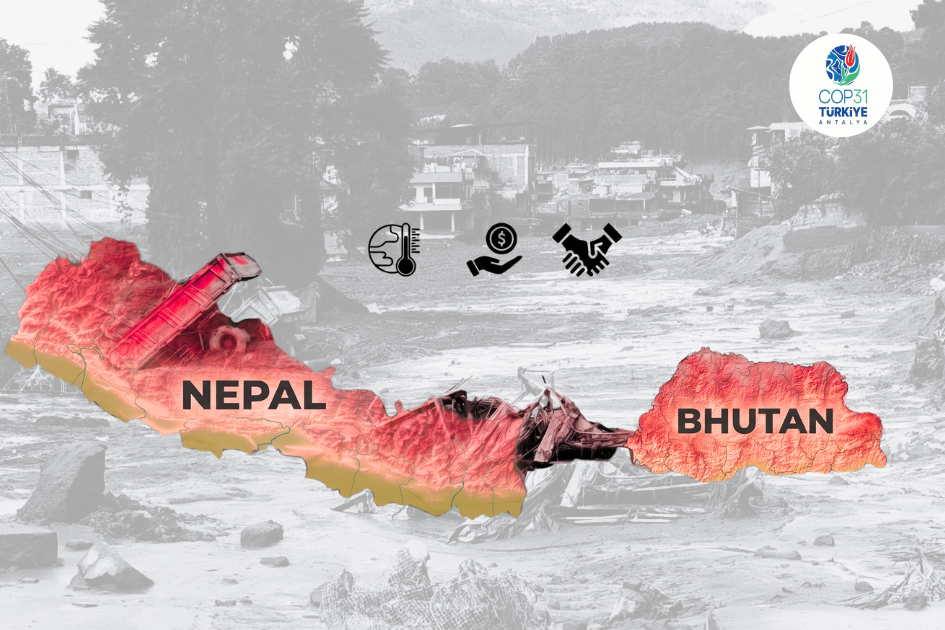
Nepal and Bhutan have put forward a joint proposal to make climate change-induced risks in mountain regions a key issue in international climate negotiations.
The two countries have proposed including a separate agenda item titled “1.5°C Warming in Mountains” at the 31st Conference of the Parties to the United Nations Framework Convention on Climate Change (COP31), scheduled to take place in Antalya, Türkiye, from November 9 to 20.
Minister for Agriculture, Forests and Environment Gita Chaudhary submitted the proposal on behalf of Nepal and Bhutan under Rule 12 of the draft rules of procedure of the conference.
The proposal highlights that rapidly rising temperatures in mountain regions are increasing the risks of glacier melting, water insecurity and irreversible damage to mountain ecosystems and local communities due to extreme weather events.
Rivers originating in mountain regions provide water, food and energy to more than two billion people living in downstream areas. Similarly, nearly half of the world’s biodiversity hotspots are located in mountainous regions.
Nepal and Bhutan have proposed advancing scientific assessments of the impacts of 1.5°C warming in mountain regions, including the risks associated with exceeding the 1.5°C temperature threshold.
The proposal also calls for an annual high-level dialogue on mountains and climate change, initiating the process of developing a dedicated Work Programme on Mountain Ecosystems under the United Nations Framework Convention on Climate Change (UNFCCC), and incorporating mountain-specific priorities into climate adaptation, climate finance, and loss and damage mechanisms.
According to the proposal, the 2026 Bhote Koshi flood caused an estimated USD 2.7 billion in damage, while approximately USD 4.7 billion would be required for recovery and reconstruction.
According to the National Disaster Risk Reduction and Management Authority, the estimated reconstruction requirement is equivalent to around 10 percent of Nepal’s Gross Domestic Product (GDP).
Nepal and Bhutan have based their joint proposal on Article 4.8 of the United Nations Framework Convention on Climate Change.
The proposal also draws on the outcome of the Global Stocktake at COP28, the decision at COP30 to include mountain-related issues as a formal agenda item, the Dialogue on Mountains and Climate Change held under SB64 on June 12, 2026, and the Sagarmatha Call for Action.
The proposal states that mountain-related issues have not been adequately integrated into the core decision-making processes of the UNFCCC.
The two countries expect that establishing a separate agenda item for mountain regions will ensure that their specific challenges are addressed regularly and institutionally within the international climate process.
Minister Chaudhary has emphasized that mountains do not recognize national boundaries and that the risks emerging in mountain regions are not confined within national borders. She noted that mountain communities are among the first and hardest hit by climate change, while its impacts extend to billions of people living in downstream areas.
Maheshwar Dhakal, Joint Secretary at the Ministry of Agriculture, Forests and Environment, said that events ranging from Melamchi to Bhote Koshi have demonstrated how a single disaster can destroy years of development.
Stating that communities that have contributed the least to climate change are bearing losses beyond their capacity to cope, he emphasized the need for equitable climate action and financial support to address loss and damage.