

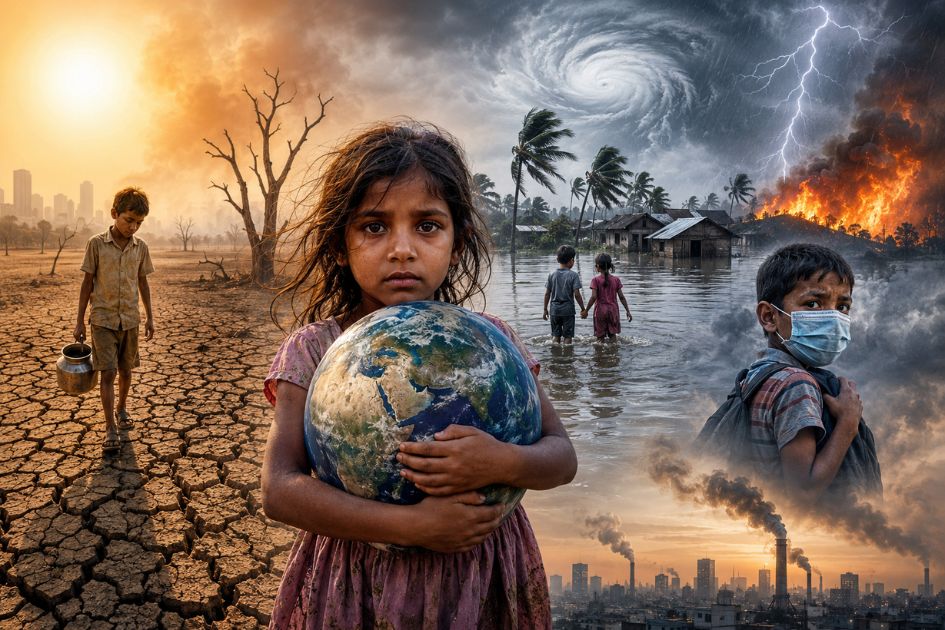



UNICEF’s 2026 report finds nearly all children face climate hazards, with 1.1 billion exposed to multiple threats, raising risks to health, education, protection and long-term wellbeing worldwide.
Nearly every child in the world is now exposed to at least one major climate-related hazard, while 1.1 billion children face three or more overlapping threats, according to UNICEF’s Children’s Climate Risk Report 2026, which warns that climate change is increasingly undermining children’s health, education, protection and future prospects.
The report presents what UNICEF describes as its most comprehensive assessment to date of children’s exposure to climate risks, showing that human-induced global warming is intensifying and increasing the frequency of hazards including floods, droughts, heatwaves, tropical storms, fires and sand and dust storms.
According to the report, almost all children globally are exposed to at least one climate hazard. Around 1.8 billion children are exposed to droughts, 1.5 billion to heatwaves, 1.2 billion to extreme heat, 662 million to tropical storms, 337 million to riverine floods, 206 million to fires, 123 million to sand and dust storms and 33 million to coastal floods. In addition, 2.3 billion children are exposed to air pollutants and 1 billion live in areas affected by malaria, a climate-sensitive disease.
UNICEF said the impacts on children’s physical and mental health, wellbeing and access to essential services remain largely under-measured despite their growing severity.
Storms and floods continue to displace families and disrupt daily life, while record-breaking temperatures increase the risks of heatstroke and dehydration. Droughts contribute to food insecurity and malnutrition, while climate hazards also increase the spread of diseases such as dengue and malaria and contribute to air-polluting wildfires.
Children face greater risks than adults because their bodies are still developing, making it harder for them to cope with environmental and psychological stress. Climate-related disasters also expose children to displacement, instability and heightened vulnerability.
The report stresses that climate impacts are not distributed equally. Children’s exposure and vulnerability vary depending on age, gender, disability, ethnicity, including Indigenous identity, geographic location and socio-economic conditions. Limited access to essential social services often compounds existing disadvantages.
UNICEF said identifying the most vulnerable children and understanding where they live is critical for designing effective adaptation and disaster risk reduction measures. The report combines high-resolution climate hazard data with information on access to health, nutrition, water, sanitation and hygiene, education, child protection and social protection services.
The findings show that climate risks become particularly severe when multiple hazards occur simultaneously.
Globally, 2 billion children are exposed to at least two climate hazards, while 1.1 billion face at least three overlapping hazards. Around 364 million children are exposed to at least four hazards, 53 million to at least five, 4 million to at least six and 123,000 children to at least seven climate hazards.
UNICEF noted that climate threats often trigger a chain reaction of impacts. Severe droughts can destroy crops and worsen food insecurity, while dried vegetation increases the risk of wildfires. Fires can worsen air pollution and leave land more vulnerable to flooding. Floods can then damage homes, schools and hospitals, displace communities and spread waterborne diseases.
Such overlapping shocks can create a cycle of vulnerability. Families who lose their homes may be displaced and left without adequate shelter, while disrupted education can have lifelong consequences for children.
The report also highlights differences between absolute and relative exposure. Countries with large child populations, including Bangladesh, India, Nigeria and Pakistan, account for some of the highest numbers of children exposed to multiple climate hazards. At the same time, many Small Island Developing States and landlocked developing countries experience some of the highest relative levels of exposure to individual hazards.
An analysis of multi-hazard intensity found some of the highest levels of exposure in heavily populated countries such as Egypt, India, Nigeria and Pakistan. In relative terms, children living in the Sahel region, particularly in Burkina Faso, the Central African Republic, Mali, South Sudan and Sudan, face the greatest exposure to intense overlapping hazards.
UNICEF said a child’s vulnerability depends not only on exposure to hazards but also on access to services that help families cope and recover.
In health, the report notes that 20 million children missed life-saving vaccinations in 2024, including 14.3 million who received no dose of a diphtheria, tetanus and pertussis-containing vaccine. Climate shocks can damage health facilities, disrupt vaccine supply chains and increase disease transmission.
In nutrition, climate change threatens food production and supply chains. Without timely action, climate change could contribute to an additional 28 million wasted children and 40 million stunted children globally by 2050.
Water and sanitation services remain another major concern. In 2024, 634 million children lacked safely managed drinking water, 1 billion lacked safely managed sanitation services and 489 million lacked basic hygiene services. Floods can contaminate water supplies while droughts can leave communities without access to safe water.
Education systems are also under pressure. Climate-related hazardous events disrupted schooling for at least 242 million students across 85 countries and territories in 2024 alone.
Child protection risks are increasing as well. Between 2016 and 2023, climate hazards triggered 62.1 million internal displacements involving children, equivalent to more than 21,000 child displacements every day. Climate-related poverty and displacement can also increase the risks of child labour, child marriage and family separation.
Meanwhile, limited access to social protection leaves families vulnerable to harmful coping mechanisms. The report warns that climate change could push more than 130 million people into extreme poverty by 2030.
UNICEF said governments’ ability to protect children often depends on wider structural challenges, particularly in low-income countries, fragile states, Small Island Developing States and landlocked developing countries.
The agency called for risk-informed policies based on detailed assessments of children’s exposure and vulnerability. It recommended hazard-specific analyses to guide early warning systems and infrastructure planning, sector-specific assessments to strengthen services such as health, education and water systems and multi-dimensional risk analyses to support comprehensive national adaptation strategies.
In its call to action, UNICEF urged governments and partners to reduce greenhouse gas emissions, phase out fossil fuels, accelerate a just transition to renewable energy and strengthen climate adaptation measures focused on children.
The agency also called for greater investment in climate-resilient social services and stronger efforts to ensure children and young people can participate meaningfully in climate action and decision-making processes.
“Upholding every child’s right to a clean, healthy and sustainable environment requires urgent, coordinated and child-responsive climate policies, action and investment,” the report said.




