




Senegal’s climate pressures, from heat stress to fisheries disruption, highlight the need for just transition policies that protect workers while opening pathways to green jobs and resilient incomes.
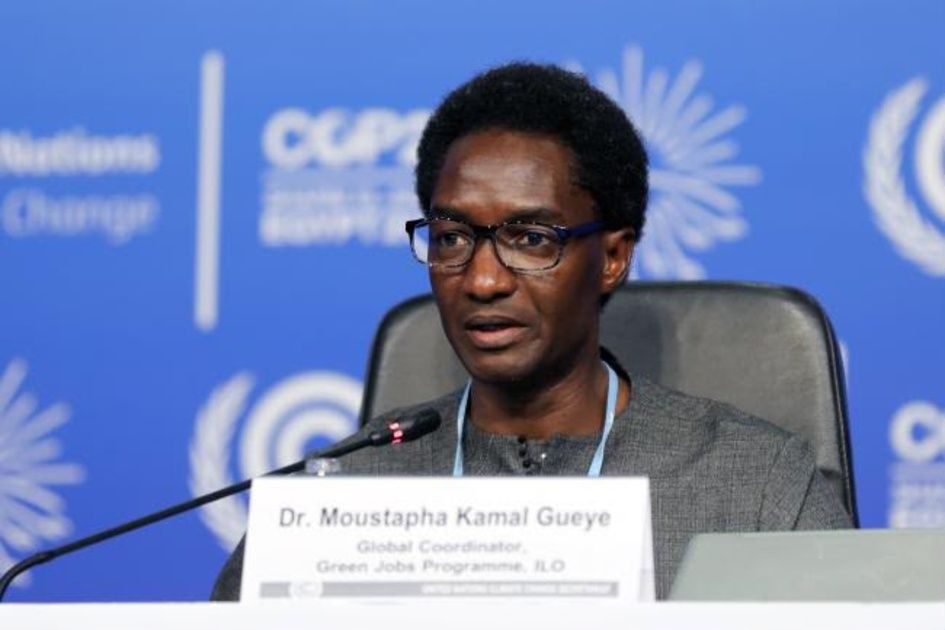
ILO expert Moustapha Kamal Guèye warns that climate change is already reshaping livelihoods, jobs and economies, while a fair green transition can create new opportunities for vulnerable communities
From disappearing coastlines and rising flood risks to shrinking fishing grounds and increasing workplace temperatures, Senegal is experiencing the growing human and economic consequences of climate change. The country’s challenges reflect a wider reality facing climate-vulnerable nations across Africa and the Global South: how to protect livelihoods, create decent jobs and build a sustainable future in a rapidly changing climate.
In a recent interview, Moustapha Kamal Guèye, Director of the Priority Action Programme on Just Transitions at the International Labour Organization (ILO), discusses Senegal’s climate vulnerabilities, the impact of rising temperatures on employment, the challenges facing workers and communities and why human well-being must be at the centre of climate action.
Climate change is creating economic and social pressures
Senegal is facing increasing climate risks, including rising temperatures, changing rainfall patterns, floods and coastal erosion. These impacts are putting pressure on key economic sectors such as agriculture, fisheries and tourism.
“Climate change is affecting livelihoods, food security and economic stability,” Guèye said.
With a coastline stretching more than 700 kilometres along the Atlantic Ocean, Senegal is highly exposed to sea-level rise, coastal erosion and storm surges. Around 56 percent of the country’s coastline is already affected by erosion, with Saint-Louis among the most vulnerable urban areas.
By 2080, large parts of Saint-Louis could face recurring flood risks. Saltwater intrusion is also threatening agricultural production, particularly rice farming in delta regions, while warmer oceans and changing marine conditions are affecting fisheries and marine biodiversity.
Without significant adaptation measures, climate-related economic losses could reach 3 to 4 percent of Senegal’s GDP by 2030 and 9.4 percent by 2050, according to estimates cited by Guèye.
“Climate change is not only an environmental challenge. It is a social and economic transformation that affects jobs, incomes and communities,” he said.
Heat stress threatens productivity and employment
Beyond floods and coastal impacts, rising temperatures are creating a major challenge for workers and businesses.
Guèye referred to a recent ILO project on the “Impact of Heat Stress on Employment,” which provided the first quantitative assessment of the impact of extreme heat on workplace productivity, occupational safety and health in Senegal.
“The analysis shows that Senegal lost an additional US$2.5 billion in economic value in 2023 compared to the historical average between 1985 and 2014 due to increasing heat stress,” he said.
The economic impacts are particularly concentrated around Dakar and the western economic corridor. By 2040, heat-related productivity losses could be equivalent to between 129,000 and 176,000 full-time jobs.
For workers in agriculture, construction, fisheries and other outdoor sectors, rising temperatures are becoming not only a productivity issue but also a question of health, safety and dignity.
Adaptation must protect people, not only infrastructure
Guèye emphasised that climate adaptation cannot focus only on technical solutions such as infrastructure development. It must also include social policies that protect workers, farmers, fishers and vulnerable communities.
“Human well-being must be prioritised in the response to climate change,” he said.
According to him, successful adaptation requires combining environmental solutions with policies that allow people to maintain employment, secure incomes and build resilience.
“The challenges are not simply ecological. They are part of deep socioeconomic transformations that require people to be at the centre of every climate response,” he added.
This approach reflects the core principle of a just transition: climate action must reduce emissions while ensuring that no worker, community or vulnerable group is left behind.
Senegal’s energy transition challenge
Senegal faces a complex energy transition pathway as it begins developing its oil and gas sector while also investing in renewable energy.
Countries around the world have committed to moving away from fossil fuel dependence in a fair, orderly and equitable manner to achieve global carbon neutrality by 2050. However, Senegal’s position as a new oil and gas producer creates additional challenges.
Guèye explained that Senegal’s energy strategy for 2025-2029 seeks to combine fossil fuel development with renewable energy investments.
“The challenge is ensuring that the transition is just, inclusive and creates opportunities for workers and communities,” he said.
The key question for Senegal and other emerging energy producers is how to use current resources to accelerate clean energy development, strengthen climate resilience and avoid long-term dependence on fossil fuels.
Protecting fishing communities during economic transformation
The expansion of offshore oil and gas activities has created concerns among artisanal fishing communities, particularly in northern Senegal.
Fishing communities have reported difficulties accessing traditional fishing areas due to offshore platforms, resulting in potential losses of income and employment opportunities.
“These tensions show why dialogue and inclusive solutions are essential,” Guèye said.
To address these challenges, Senegal’s Ministry of Public Service, Labour and Public Sector Reform, in partnership with the ILO, has established a platform bringing together fishing communities, industry representatives, workers’ and employers’ organisations and government institutions.
The initiative aims to protect artisanal fisheries while supporting livelihood diversification and new employment opportunities.
“Oil and gas activities and artisanal fishing must coexist in a way that protects the thousands of men and women whose lives depend on the fisheries sector,” Guèye said.
A just transition in this context means ensuring that communities affected by economic changes have access to new skills, alternative livelihoods and social protection.
Green transition can create jobs and opportunities
Despite the challenges, Guèye believes Senegal’s ecological transition can become a driver of employment, innovation and sustainable economic growth.
Senegal’s national transformation agenda, “Vision 2050,” aims to achieve higher economic growth, reduce poverty and inequality and create a more sustainable development pathway.
“Transition policies can create jobs, income and wealth if they integrate environmental, social and economic priorities,” he said.
In 2025, the ILO, in partnership with Cheikh Anta Diop University of Dakar and Senegal’s National Agency of Statistics and Demography, supported the development of an economic model assessing the employment impacts of green transition policies.
The study examined two pathways: renewable energy expansion and green agriculture. Both scenarios showed positive impacts on GDP growth, employment creation and carbon reduction.
However, Guèye stressed that green growth must be inclusive.
“The success of the green transition will depend on whether people, especially vulnerable workers and communities, are protected and empowered,” he said.
A lesson for the Global South
Senegal’s experience reflects challenges faced by many climate-vulnerable countries across Africa, Asia and other regions where communities are confronting rising temperatures, extreme weather events and threats to traditional livelihoods.
As countries navigate the difficult balance between economic development and climate responsibility, Senegal’s journey offers an important lesson: climate action will only succeed when it protects people, creates opportunities and delivers justice for communities on the frontlines of the climate crisis.




