

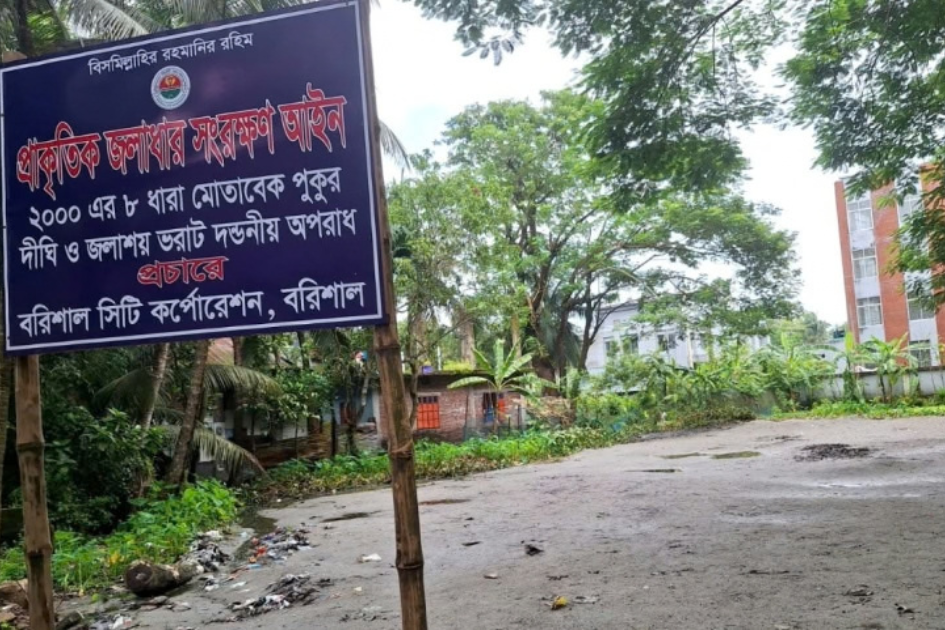



Barishal’s shrinking pond network is deepening concerns over groundwater recharge, waterlogging and land subsidence as officials struggle to curb illegal filling.
More than 1,000 ponds have disappeared over the past decade across Barishal district due to rampant filling, encroachment, pollution and unplanned development, according to a survey conducted by the Department of Fisheries in January this year.
Both privately owned and government ponds are being filled, raising concerns over waterlogging, groundwater depletion and the gradual sinking of the city.
The survey found that there are 20,692 ponds in the district at present, around five percent fewer than in 2015.
This indicates that over 1,000 ponds have disappeared during this time, said Dr Md Hadiuzzaman, district fisheries officer.
He said influential individuals were filling up ponds to construct buildings and develop residential plots for sale.
Despite laws to protect government waterbodies, inadequate monitoring and enforcement allowed many of those to be filled, said officials and environmental activists.
The Barishal City Corporation (BCC), the local government authority, in its 2011 master plan identified 436 ponds in the city, including more than 155 owned by the government. While the city authorities could not provide an updated figure, this correspondent has found that almost half of those ponds could no longer be traced.
BCC Chief Architect Saidur Rahman said ponds play a crucial role in recharging groundwater and maintaining the balance of the underground water table.
“In 2011, potable groundwater could be found at a depth of around 800 feet in the city. Now, it is not available until below 1,000 feet,” he said.
The increase in concrete surfaces across the city, alongside pond filling, has reduced the amount of rainwater that can seep into the ground. “As a result, the groundwater level is gradually falling, which could have serious consequences, including land subsidence,” Saidur added.
During a visit last month, this correspondent found that over 60 percent of a pond beside the Chest Disease Hospital in Barishal had been filled by a group claiming ownership of the land. Although police and other relevant agencies were informed, the hospital authorities said no effective action was taken for nearly 20 days, until the BCC intervened to stop the filling.
Also, a pond belonging to the Bangladesh Inland Water Transport Authority (BIWTA), in front of Barishal Diabetic Hospital, and a pair of ponds near Barishal Nursing College were partially filled recently, before the city corporation intervened to halt the work.
A portion of Sitaram’s Dighi in Kashipur has already been filled, while several ponds in Kawnia Branch Road, Baidyapara and Kaunia areas have also disappeared.
The pond inside the court compound has already been filled. A large pond near Bell’s Park was also filled, and a Model School and College was subsequently built there by the government.
There are also allegations of further encroachment and filling of government ponds in different parts of the city.
Officials at the Department of Environment said complaints about the filling of government ponds are piling up, often involving influential individuals.
In many cases, the classification of ponds is changed before they are filled up and occupied, they added.
Tunu Rani Karmakar, convener of Sachetan Nagarik Committee, said Barishal city once had more than 1,000 ponds and large waterbodies, both government and privately owned.
“Most of those have been filled up for building structures and developing residential plots across the city,” she said.
Lincoln Bayen, divisional coordinator of Bangladesh Environmental Lawyers Association (BELA), said the organisation had issued notices to three institutions and people over pond filling in the past year, including two government institutions.
Subhankar Chakrabarty, an environmental activist, said at least 200 privately owned ponds have been filled in the city in the past decade.
City residents and environmentalists called for strict enforcement of existing laws, regular monitoring of government waterbodies and immediate action against those involved in illegal filling and encroachment.
Kazi Saifuddin, DoE assistant director in Barishal, said they have issued notices to at least 10 private and government offices over the past three months, including three government institutions, over pond filling, while at least five cases were filed over similar allegations.
“We issue notices as soon as such activities come to our attention. However, despite these measures, pond filling could not be completely stopped,” he said.
Saifuddin added that in some cases, pond filling continued even after the land classification was changed.
This article is republished from the Daily Star.




