

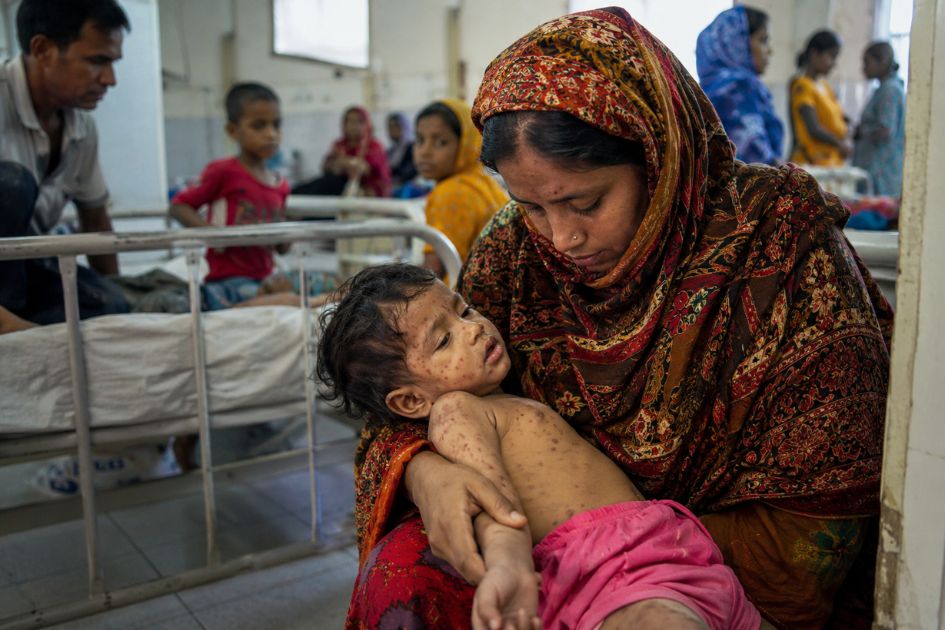



Infants below routine vaccination age accounted for the largest affected group, while researchers say wider studies are needed to assess vaccine effectiveness during the outbreak.
Preliminary findings from an icddr,b investigation have found no genetic evidence that the measles virus circulating in Bangladesh has changed in a way that reduces protection provided by the existing vaccine, the health research organisation said on Sunday.
The findings come amid a major measles outbreak in Bangladesh that has prompted questions over whether genetic changes in the virus have reduced vaccine effectiveness.
According to Bangladesh’s Directorate General of Health Services (DGHS), 122,763 suspected measles cases and 15,272 laboratory-confirmed cases were reported between March 15 and July 25, 2026. During the same period, 721 suspected and 95 confirmed measles-related deaths were recorded.
The preliminary findings do not support the belief that the vaccine has become ineffective. Among suspected cases investigated, children who had received both recommended vaccine doses were less likely to test positive. Genetic analysis also found that the circulating virus belongs to the B3 genotype, which has been reported in outbreaks elsewhere in the world.
Researchers from icddr,b, an international health research organisation based in Bangladesh, and Bangladesh Shishu Hospital and Institute (BSH&I) investigated 341 children aged up to 14 years who were admitted to the hospital with suspected measles between April 20 and May 21, 2026. Laboratory testing confirmed measles in 324 children.
Children aged between three and eight months constituted the largest affected group, accounting for 137 confirmed cases.
Researchers divided the 341 children into four groups according to age and vaccination status. Among 146 infants below nine months, who were therefore too young for routine vaccination, 142 tested positive, representing 97 percent.
Among 126 children who were old enough to be vaccinated but had received no dose, 122 tested positive, also 97 percent. Of 48 children who had received one dose, 44 tested positive, or 92 percent. Among 21 children who had received both recommended doses, 16 tested positive, or 76 percent.
The researchers cautioned that the figure does not mean 76 percent of all fully vaccinated children are contracting measles. All children included in the investigation had already been admitted to hospital with suspected measles, and the percentage refers only to the 21 fully vaccinated suspected patients included in the hospital investigation.
The progressively lower positivity rate, from approximately 97 percent among children with no vaccine protection to 76 percent among those who had received both doses, is consistent with vaccination providing protection. However, a wider study including unaffected children for comparison is needed to measure how effectively the vaccine is working during the outbreak.
“The size of this outbreak has understandably raised concerns about whether the vaccine is still working. Our findings provide no evidence that the virus has escaped vaccine protection. We observed lower positivity among children who had received both doses, although this hospital-based investigation cannot provide a population-level estimate of vaccine effectiveness,” said Dr Noorjahan Maliha, Associate Scientist in the Virology Laboratory of the Infectious Diseases Division at icddr,b.
Researchers said the finding that 16 fully vaccinated children were confirmed with measles requires further investigation.
Possible explanations include some children not developing a sufficiently strong immune response after vaccination, antibody protection declining over time, malnutrition or other health and individual factors. The investigation was not designed to determine which of these factors contributed to infection.
icddr,b also conducted phylogenetic analysis, which compares the genetic sequences of viruses to understand how closely related they are and how they may have spread.
The analysis covered 55 whole-genome sequences, including 18 samples sequenced by icddr,b and 37 by Bangladesh’s Institute of Epidemiology, Disease Control and Research (IEDCR).
The analysis showed that all viruses belonged to the B3 subclade and were similar to B3 viruses reported in other countries.
Researchers also identified four changes, or mutations, in regions of the virus’s H protein epitopes that are recognised by antibodies. The H protein helps the virus enter human cells and is one of the principal targets of vaccine-induced antibodies.
Some of the mutations have previously been reported in measles viruses circulating elsewhere. Their presence does not mean the virus has become resistant to the vaccine, researchers said.
Measles remains a single serotype and vaccine-induced antibodies recognise several different sites on the virus. Further laboratory testing is needed to determine whether the mutations have any measurable effect on antibody protection.
The findings also highlighted a period of vulnerability among young infants.
In Bangladesh, the first routine measles-rubella vaccine is provided at nine months and the second at 15 months. Before receiving the first dose, infants depend partly on antibodies transferred from their mothers and on community protection created through widespread vaccination.
An initial analysis of stored samples from 16 mother-child pairs in an earlier icddr,b birth cohort found that maternal measles antibodies declined rapidly during the first months of life.
No protective antibodies were detected at three to eight months of age among the small group of children assessed. As the analysis included only 16 children, further investigation using samples from the larger birth cohort is needed.
“Vaccination remains the most effective way to prevent measles and reduce the risk of severe illness. At the same time, we need to understand why this outbreak became so large despite comparatively high reported national vaccination coverage,” said Dr Mustafizur Rahman, Senior Director of the Infectious Diseases Division at icddr,b.
“We need to determine why children miss vaccination and whether reported national coverage conceals communities with substantial immunity gaps. Evidence from these studies will help Bangladesh refine its vaccination strategy and better protect children during future outbreaks,” Dr Kamrun Nahar, Assistant Scientist of the Virology Laboratory, added.
“These preliminary findings answer some important questions, but they also show how much more we need to understand. icddr,b is developing a wider research response to examine why some vaccinated children became infected, what factors are contributing to severe disease and death, how malnutrition may affect protection and when infants lose antibodies received from their mothers,” said Dr Tahmeed Ahmed, Executive Director of icddr,b.
In response to the current outbreak, icddr,b researchers have initiated a clinical cohort across four major divisional hospitals, continued laboratory and genomic surveillance, an expanded birth-cohort immunology study, a pilot study of zinc alongside standard measles treatment and community research on the reasons children miss vaccination.
Researchers emphasised that parents should not delay or avoid vaccination. Children should receive all measles-rubella vaccine doses for which they are eligible, and parents and caregivers should follow the government’s vaccination guidance during the outbreak.




