

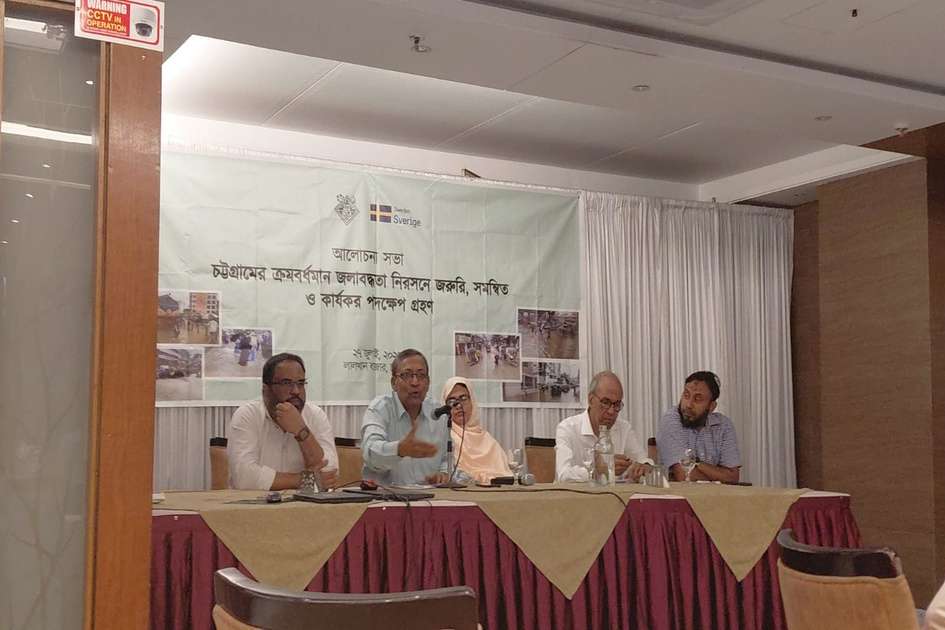



Speakers urged incentives for pond conservation, recovery of historic water bodies and stricter coordination among Chattogram agencies to curb worsening urban flooding.
Around 21,000 ponds and water bodies have already disappeared in Chattogram, speakers told a consultation meeting on Monday, warning that the city’s chronic waterlogging cannot be resolved without coordinated action by all service agencies.
Environmentalists and civil society representatives said protecting natural reservoirs in the southeastern port city would require not only enforcement of laws, but also special benefits and incentives for homeowners and those who preserve ponds.
They made the comments at a meeting organised by the Bangladesh Environmental Lawyers Association, a national environmental rights organisation, at a restaurant in the city’s Lalkhan Bazar area from 11:00am to 2:00pm.
Urban planner Engineer Delwar Hossain Majumder chaired the meeting, while Dr Mohammad Rashidul Hasan, dean of the Faculty of Architecture and Planning at Chittagong University of Engineering and Technology, presented the keynote paper.
Speakers said ponds and water bodies could no longer be protected through laws or fines alone. They called for alternative measures to encourage conservation.
They proposed holding tax rebates and special facilities in plot plan approval for people who preserve ponds on their land. They also suggested introducing a policy under which an “environment surcharge” would be collected from others and used as incentives for pond conservation.
Speakers also stressed the need to preserve green areas and water reserve zones in the city.
Civil society representatives expressed concern over the loss of Chattogram’s historic ponds and large tanks, many of which have disappeared from the city map because of filling.
They cited several traditional water bodies, including Kamaldighi in Chawkbazar, Askar Dighi, historic Laldighi, Veluar Dighi, Ranir Dighi, Agrabad Dighi, Hazar Dighi, Bara Dighi and Munshi Pukur, saying many were now on the verge of extinction.
They demanded accountability from agencies including the Chittagong Development Authority, Chattogram Water Supply and Sewerage Authority and Chattogram City Corporation to recover lost heritage water bodies and protect those that remain.
Speakers also criticised what they called a serious lack of coordination among agencies involved in tackling waterlogging in the city. They said all agencies must work in a “single tone” and urged policymakers to frame realistic laws and ensure strict monitoring.
The meeting was told that the two waste dumping stations of the Chattogram City Corporation were now overloaded, causing waste to accumulate in drains and canals and worsening waterlogging.
Speakers said the watchdog role of non-government organisations should be viewed positively, and urged the government and service agencies to identify their own weaknesses and take corrective measures.
Ahmed Moinuddin, project director and executive engineer of the Chittagong Development Authority’s part of the city’s mega waterlogging project, presented an overview of the project’s progress.
However, speakers also urged citizens not to shift all responsibility onto service agencies. They said waterlogging would not ease despite projects worth crores of taka unless the indiscriminate dumping of polythene, plastic and household waste was stopped.
They said public awareness was essential, adding that better plastic waste management would reduce not only waterlogging but also environmental pollution.
The meeting was moderated by Monira Parvin Ruba, divisional coordinator of BELA in Chattogram.
Other speakers included Romana Akter, assistant director of the Department of Environment in Chattogram city and Kaiser Ahmed, assistant engineer of the Bangladesh Water Development Board.
Journalists, human rights activists, social workers, teachers, television presenters and other civil society representatives from different professions also attended the meeting and took part in the open discussion.




