




Bangladesh’s youthful population and continued urbanisation could reshape housing demand, requiring homes and communities designed around changing needs across different stages of life.
My son and daughter both belong to Gen Z. Their thinking, creative instincts and sense of purpose are quite different from those of our generation. Even when it comes to something as emotional as owning a home, I find them more calculated about what they want from life and where a home fits into that vision.
Watching them often makes me wonder: when Gen Z and eventually Gen Alpha become the primary decision-makers, how will they choose where and how they live?
What should the homes of Bangladesh look like 10, 20 or 30 years from now?
To answer that question, perhaps we should not begin with land, FAR, apartment size or construction cost.
We should begin with demography.
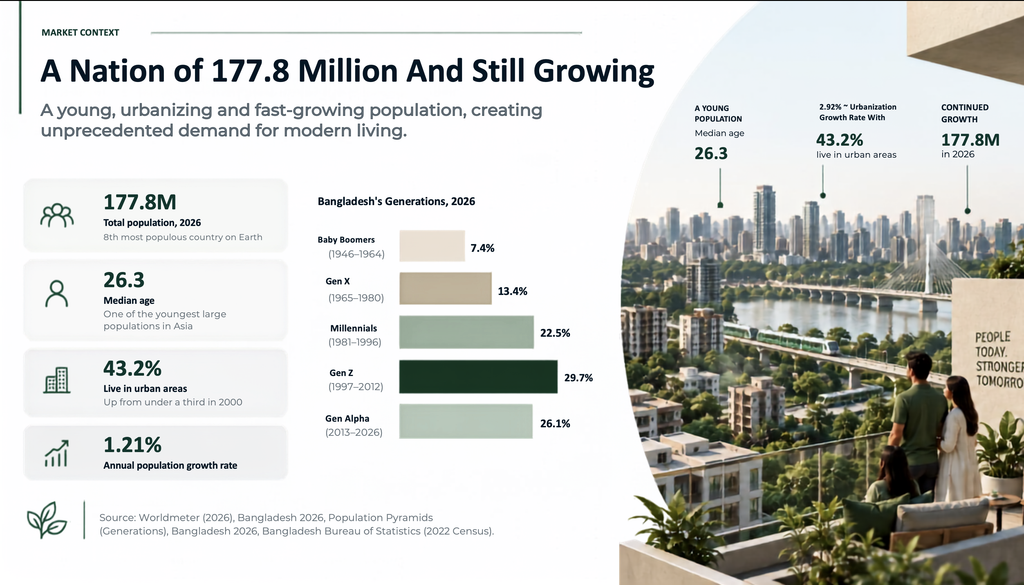
Bangladesh is one of the world’s most populous countries, with its population projected at around 177.8 million in 2026. But for the housing industry, the more interesting question is not simply how many people we have. It is how old they are.
The country’s median age is around 26 years. Gen Z represents roughly 30 percent of the population. Bangladesh’s 2022 census also showed that almost 48 percent of the population was below 25, while more than 56 percent was below 30.
In other words, roughly half of Bangladesh is still near the beginning of its housing journey.
Over the coming decades, millions of these young Bangladeshis will enter universities, start careers, marry, have children, move between cities and countries, and eventually grow old.
That is not simply a demographic story. It may be one of the biggest housing stories of our future.
A demographic wave moving through life
Around two-thirds of Bangladesh’s population is of working age, while the median age remains below 27. At the same time, urbanisation continues, with projections putting the urban share at around 43 percent in 2026.
Now imagine this enormous generation moving through different stages of life.
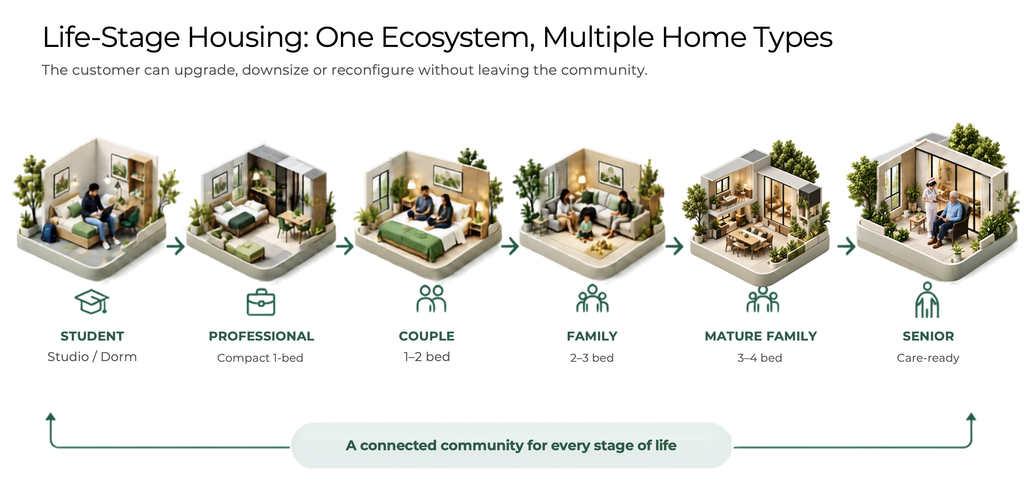
A 20-year-old university student may need a studio, dormitory or shared accommodation close to campus. At 25, the same person may become a professional looking for a compact one-bedroom apartment close to work, the metro or other transport links.
At 30 or 35, marriage and children may change the equation. Two or three bedrooms, schools, healthcare, safety and community become more important. At 45 or 50, the family may need more space.
By 60 or 70, the same person may want exactly the opposite: a smaller, accessible and easier-to-maintain home, with healthcare and everyday services nearby.
One person. Different ages. Different needs. Different homes.
This is the idea behind life-stage housing.
We cannot build tomorrow’s housing around today’s customer
Real estate development traditionally begins with a piece of land. We acquire the land, determine what can be built, calculate the saleable area, decide apartment sizes and then look for customers.
Future-ready housing may require us to reverse that process.
We should first ask: Who will live here?
How old are they? What stage of life are they in? What can they afford? How large is their family? Where do they work? How mobile are they? And how might their needs change over the next 10 or 20 years?
The answers could lead us towards a much wider housing mix: student residences and studios, compact apartments for young professionals, one- and two-bedroom homes for couples, larger family apartments, professionally managed rental housing and, eventually, senior and care-ready living.
A future-ready city cannot consist mainly of variations of the same apartment.
Today’s young country will also grow older
There is another demographic reality we must prepare for: Bangladesh will not remain this young forever.
As life expectancy rises and today’s large young population grows older, demand for age-friendly housing will increase.
This presents an interesting challenge. We need housing for a young population, but we must design it knowing that this population will live longer and grow older.
The apartment that works perfectly for a family at 40 may become a burden at 70.
Life-stage housing, therefore, should not simply mean constructing different apartment sizes. It should mean creating communities where people can move through different types of housing as their lives change.
Imagine a young professional beginning with a compact apartment in a connected community. After marriage, the couple moves into a two-bedroom home. With children, they move into a larger family residence. Decades later, they downsize into a smaller, accessible home within the same broader community.
They change their home without necessarily losing their neighbourhood, social connections or familiar services.
To me, that is a far more human way of thinking about real estate.
From ownership to housing journeys
Younger generations may also approach housing differently.
Their careers are increasingly mobile. They may move between cities or countries. Some may rent for longer before buying. Others may prefer furnished or serviced accommodation during particular stages of life.
The future housing market, therefore, should offer more than a binary choice between buying a permanent home and renting informally.
Rental housing, serviced apartments, corporate accommodation, ownership, resale and property management can become different points along the same housing journey.
A home is not just a financial asset. It is where a particular chapter of life happens.
Building for people, not only square feet
Bangladesh’s demographic window gives the real estate industry an extraordinary opportunity. But we should not interpret a young population simply as millions of future apartment buyers.
We should see millions of individual housing journeys ahead of us.
A student needs independence at an affordable cost. A young professional needs mobility and convenience. A young couple needs flexibility. A family needs space and community. An older person needs accessibility, security, healthcare and companionship.
The real question for developers, architects, urban planners, investors and policymakers is therefore not simply: How many homes will Bangladesh need?
It is: What kinds of homes will Bangladesh need at each stage of people’s lives?
If we can answer that question well, we can move beyond building apartments to creating communities that evolve with their residents.
Future-ready housing is not about predicting one perfect home for the future.
It is about creating a housing ecosystem that can change as people’s lives change.

The Author is Director of ACI Properties Ltd and a sustainability advocate. The views expressed are his own.




