

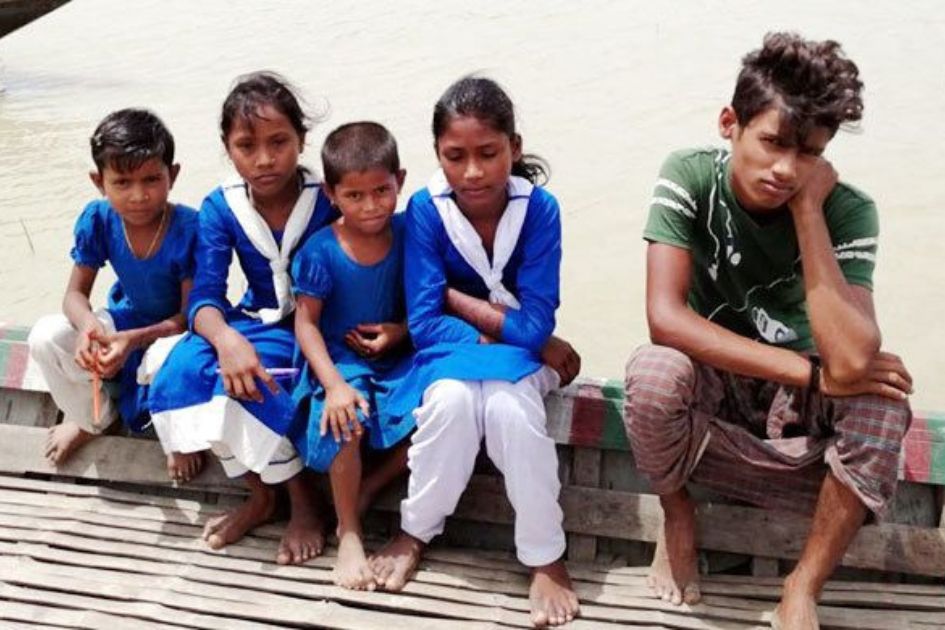



On Bangladesh’s shifting Jamuna chars, children juggle work and fragile schooling while climate change intensifies erosion, disrupts livelihoods, and forces families to adapt, migrate, and rethink their uncertain futures.
On the shifting sandbars of the Jamuna River in northern Bangladesh, thousands of children grow up on land that can disappear overnight, where survival often comes before schooling.
Before sunrise, children are already awake. The sound of water against fragile banks and the calls of birds signal the start of another day. Many begin with chores such as carrying water, checking fishing nets or feeding livestock. Only after hours of work, if time allows, do some make their way to school or local maktabs.
“I wake up with the sun,” says 12-year-old Sadik, balancing a basket of fish on his shoulder. “I used to work until evening with my father.”
Across the chars, temporary islands formed and reshaped by the Jamuna, childhood is defined by instability. Homes, schools and livelihoods can vanish as the river erodes and reforms the land.
As the Jamuna continues to reshape the land, a pressing question remains: how long can communities adapt before resilience alone is no longer enough?

A childhood shaped by survival
By midday, sandy fields become both workplace and playground. Children graze cattle, collect firewood and steal brief moments of play between responsibilities. Afternoons are filled with household work, leaving little time for rest.
As evening falls, families gather under open skies, often without electricity. Stories and conversations replace digital distractions as families reflect on their day and the challenges ahead.
“Our evenings are full of stories and discussions about our future and how to survive,” says Fatima, Sadik’s mother. “The river teaches us many things.”
Education on uncertain ground
Access to education remains a major challenge. Schools are often far away and difficult to reach, especially during the monsoon season when rising water submerges roads and forces children to cross dangerous channels by boat.
“I want to go to school every day and become a doctor,” says 11-year-old Sadia. “But when the water rises, the road disappears. Still, I try.”
Most children begin their education in maktabs, informal learning spaces based in mosques, where they acquire basic literacy and religious knowledge. Transitioning to formal schooling is often uncertain.
Yet learning on the chars extends beyond classrooms. Children develop practical knowledge by observing the river, reading weather patterns and adapting to constant environmental change.
“You know the river is dangerous when the birds fly low,” says Saddam. “Then we hurry home.”

Rivers in crisis, riverine communities too
The challenges facing char communities are intensifying as the Jamuna and its tributaries lose navigability due to sedimentation, reduced water flow and prolonged dry seasons. Bangladesh, one of the countries most vulnerable to climate change, is experiencing growing pressure on its river systems.
Scientists link increasing river instability to changing rainfall patterns, upstream flow disruptions and climate change, all of which are accelerating erosion and reshaping river channels.
In Sirajganj district, more than 26,000 full-time fishers and around 5,000 seasonal workers depend on these rivers. As water levels decline and new land emerges, fish production has dropped sharply.
“Before, we caught plenty of fish every day,” says fisherman Nimai Das. “Now we spend hours and catch almost nothing.”
Boat workers are also struggling as many routes become unusable.
“Transporting people and goods by boat was our livelihood,” says Abdul Karim. “Now we cannot even sail properly.”
Migration and economic strain
With traditional livelihoods collapsing, many families are forced to sell boats and fishing nets, often their last assets. Many migrate to cities like Dhaka in search of work, taking jobs as rickshaw drivers, garment workers or construction laborers.
This shift is reshaping rural communities, increasing pressure on urban areas and breaking generational ties to river-based livelihoods.
Travel has also become more difficult. Journeys that once took an hour can now take three to four hours due to sediment buildup and changing river routes, affecting access to markets, courts and essential services.
Dreams that endure
Despite the challenges, hope persists among children on the chars.
“I want to be a teacher,” says Shiwly, “so I can teach children even if schools are far away.”
Under dim kerosene lamps, children continue their studies, balancing responsibilities with aspirations. Their ambitions remain strong even as the ground beneath them remains uncertain.

Calls for urgent action on adaptation
Local communities say short-term relief is not enough. They are calling for large-scale river dredging, improved water management and restoration of navigability to protect livelihoods and maintain connectivity.
Officials acknowledge the scale of the problem but responsibilities are divided among agencies and large-scale action often depends on seasonal water levels.
Experts warn that without coordinated river management and sustained intervention, the crisis will deepen, pushing more families into poverty and displacement.
“Locally led adaptation is essential here,” says Sohanur Rahman, Executive Coordinator of YouthNet Global. “Char communities already know how to adapt. What they need is support, investment and recognition of their solutions.”
Life on the Jamuna chars demands resilience, adaptability and strength. Children grow up learning lessons beyond textbooks, shaped by a landscape that is constantly changing.
Every flood and every dry season redraws the boundaries of their lives.




