

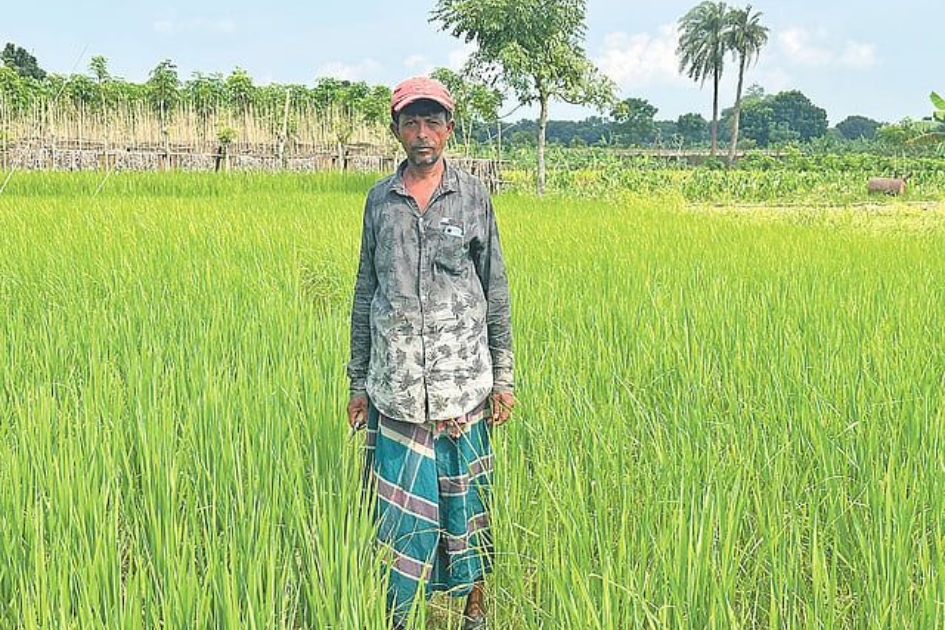



In Jhenaidah, farmer Md Sohel Rana is reviving 10 nearly lost rice varieties to conserve indigenous seeds, improve nutrition and support climate-resilient farming as monocropping threatens biodiversity.
As climate change, intensive farming and monocropping continue to reshape agriculture in Bangladesh, a farmer and development professional in the country’s southwest has taken an initiative to revive indigenous rice varieties that are rapidly disappearing from cultivation.
Md Sohel Rana has cultivated 10 nearly forgotten rice varieties at his community-based farm, Adan-Prodan, in Bhadra village under Chandpur Union of Harinakundu upazila in Jhenaidah district. The initiative aims to conserve traditional, nutrient-rich and climate-resilient rice varieties and to produce quality seeds for wider cultivation in the future.
During the current monsoon rice season, Sohel Rana cultivated the varieties on small experimental plots covering about 15 decimals of land. The rice types include Pankhiraj, Dadkhani, Begunbichi, Bhashamanik, Kolomkati, Dolabhog, Elai, Ranashail, Parangi and Krishnakoli. Many of these varieties were widely grown in Bangladesh before the expansion of high-yield rice farming from the 1970s onward.
Sohel Rana said his initiative was driven by concern over the steady loss of indigenous crop diversity. He said traditional rice varieties, many of which are rich in nutrients such as zinc, have gradually disappeared as farmers shifted to newer varieties that promise higher yields.
A resident of Harinakundu, Sohel Rana completed his higher education in Jhenaidah and currently works as co-leader of the Global Alliance for Sustainable Nutrition project at The Hunger Project Bangladesh. The Hunger Project is an international non-governmental organisation that has been operating in Bangladesh since 1974, focusing on ending hunger and poverty through community empowerment, nutrition programmes, good governance and climate-resilient development.
He said that while working with rural and climate-affected communities across the country, he observed that many traditional rice varieties are better adapted to local weather conditions. These varieties usually mature within 75 to 85 days and require fewer chemical fertilisers and pesticides, making them suitable for low-input farming systems.
Bangladesh is considered one of the most climate-vulnerable countries in the world, facing increasing floods, droughts, erratic rainfall and salinity intrusion. Agricultural experts warn that heavy dependence on a limited number of high-yield rice varieties increases risks to food security, particularly under changing climate conditions.
With support from local professionals and educators, including architects and teachers, Sohel Rana established the Adan-Prodan farm in November 2024. The farm focuses on safe food production, conservation of indigenous seeds, protection of the agro-ecosystem and the use of local knowledge to promote sustainable and self-reliant livelihoods.
Seeds of the revived rice varieties were collected from different parts of Bangladesh, including Pabna, Sirajganj, Manikganj and Rajshahi. Cultivation methods are similar to those used for modern rice, but production costs are lower due to reduced chemical input. Average yields range between 14 and 15 maunds per bigha, while market prices tend to be higher because of the nutritional value of the rice.
Some of the revived varieties have distinct characteristics. Ranashail produces red rice that is often recommended for health reasons. Begunbichi is aromatic and round in shape, Kolomkati is long and slender and traditionally served to guests, while Dadkhani rice has been mentioned in Bengali literature, reflecting its cultural significance.
Local farmer Amirul Islam said villagers regularly visit the farm to observe the cultivation. He said farmers are waiting to assess the final yield and market value and many have already requested seeds for future planting.
Deputy Director of the Department of Agricultural Extension in Jhenaidah, Md Kamruzzaman, said conservation of indigenous rice varieties is important for agricultural research and biodiversity. He said although such varieties generally produce lower yields than modern hybrids, they play a valuable role in climate resilience and long-term food security. He described Sohel Rana’s initiative as commendable.
The initiative highlights how small-scale, locally led efforts can contribute to preserving agricultural biodiversity and strengthening climate resilience at a time when Bangladesh faces growing challenges to its food system.




