

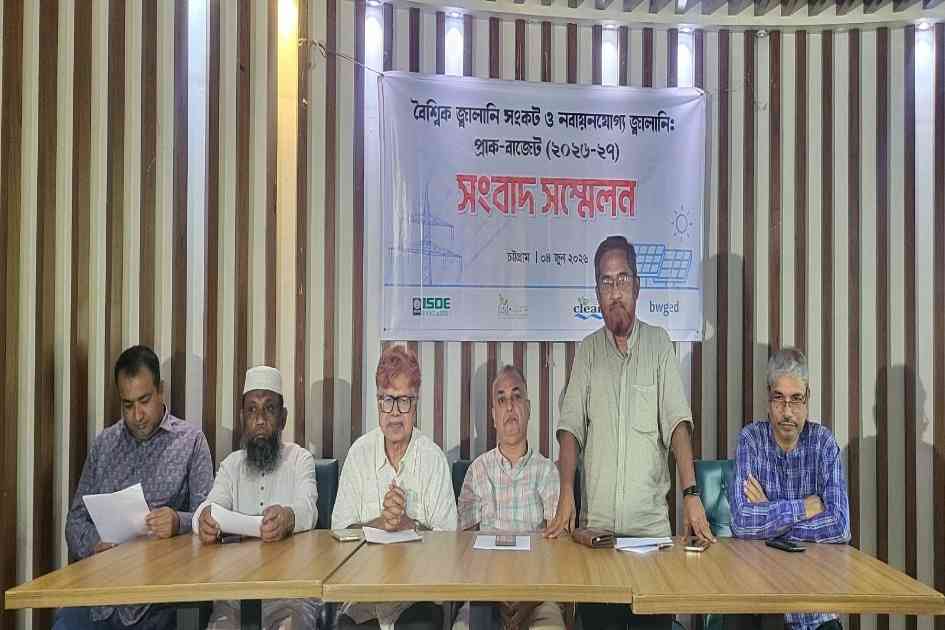

Environmental and consumer rights groups on today urged the government to give top budget priority to renewable energy in the 2026-27 national budget, saying Bangladesh must reduce its exposure to global fuel market volatility, rising fossil fuel prices and growing power generation costs.
The call came at a pre-budget press conference titled “Global Energy Crisis and Renewable Energy: Pre-Budget 2026-27 Press Conference” held in Chittagong and organised by CLEAN, ISDE Bangladesh and the Bangladesh Working Group on Ecology and Development, or BWGED.
Speakers said Bangladesh’s energy security, economic stability and climate-resilient future would depend on placing renewable energy at the centre of national development planning.
The event was chaired by Prof Dr Khaled Misbahuzzaman, president of Ecology and Development Chattogram focum and a professor at the Institute of Forestry and Environmental Sciences at the University of Chittagong. It was moderated by Kazi Iqbal Bahar Chaberi, executive director of CRCD. The main keynote speaker was SM Nazer Hossain, vice president of the central committee of the Consumers Association of Bangladesh, or CAB, and executive director of ISDE Bangladesh.
In his opening remarks, Khaled Misbahuzzaman said Bangladesh had no alternative to renewable energy if it wanted to confront the adverse impacts of climate change and ensure long-term energy security.
“An energy development model dependent on fossil fuels is becoming increasingly risky for the environment, the economy and public health,” he said. “The national budget must give special priority to renewable energy and increase investment in research, innovation and technological development.”
He also stressed the need to build local technology and skilled human resources through universities and research institutions.
SM Nazer Hossain said Bangladesh’s economy was repeatedly coming under pressure because of price instability in the international fuel market. He alleged that long-standing weaknesses in power sector planning, unnecessary expenditure and import-dependent policies had forced people to bear the burden of high costs.
“To ensure energy security, investment in renewable energy must be increased while inequalities in the power distribution system must also be removed,” he said. “In particular, structural problems in the Rural Electrification Board and the Palli Bidyut Samities must be resolved to ensure uninterrupted and quality electricity supply in rural areas.”
He said a review of electricity supply conditions in rural areas ahead of Eid al-Adha had shown that significant disparities still existed between urban and rural power services. Even areas connected to the national grid, he said, remained without electricity for long periods, raising concern for development and daily life.
Other speakers said Bangladesh, as an import-dependent country, was facing growing risks because of volatile prices of oil, LNG and coal in international markets as well as wider geopolitical tensions. As a result, they said, electricity generation costs were rising, subsidy pressure was increasing and the cost of living for ordinary people was continuing to climb.
They said Bangladesh’s power sector still relied mainly on gas, oil and coal. Excessive dependence on fossil fuels had made the economy highly sensitive to fluctuations in international markets, they said, while capacity payments, fuel import costs and subsidy burdens were creating a long-term strain on the national economy.
For that reason, the speakers said, there was no alternative to expanding the use of domestic and renewable energy sources to ensure energy security.
They also said rural consumers were still not receiving the full benefits of universal electrification because of infrastructure weaknesses, staff shortages and management limitations within the Rural Electrification Board, or REB, and the Palli Bidyut Samities, or PBSs. Even minor storms and rain often disrupted power supply, they said, and in many cases it took a long time to restore normal service.
They called for quality electricity services through reforms that would address disparity, dissatisfaction and policy weaknesses between REB and PBSs.
The speakers said that despite the country’s vast potential, renewable energy still accounted for only a very small share of total electricity generation in Bangladesh. Yet technologies and systems such as rooftop solar, solar irrigation, agrivoltaics, floatovoltaics, net metering and community-owned energy systems could play an important role in strengthening energy security, saving foreign currency, creating jobs and protecting the environment, they said.
From the press conference, the organisers placed an 11-point set of recommendations ahead of the 2026-27 national budget. These included increasing budget allocations for renewable energy, reducing taxes and duties on solar panels and related equipment, expanding green financing on easy terms, widening net metering, increasing the use of solar power in agriculture, discouraging new fossil fuel-based projects, modernising the national grid, supporting community-based energy transition, reforming REB and PBSs, creating a renewable energy research fund and ensuring planning and budget allocations to significantly raise the share of renewable energy by 2030.
Among those who spoke at the event were environmentalist Prof Dr Idris Ali, Consumers’ Media Alliance President Alamgir Shobuj, Independent Television Bureau Chief Anupam Das, Daily Amader Shomoy Bureau Chief Hamidullah, Banglanews24.com representative Al Rahman, Daily Sokaler Khobor Bureau Chief SM Pintu, Chattolar Khobor’s Mariam Jahan Munni, Times of Bangladesh’s Mizanur Rahman, Daily Purbodesh’s MA Hossain, The Business Standard Bureau Chief Shamsuddin Illius, Ecology and Development Chattogram focum member Jannatul Ferdous and Mohammad Jane Alam.
Environmental activists, energy experts, students, renewable energy entrepreneurs, representatives of civil society and journalists from different media outlets were also present.
The speakers said renewable energy must be brought to the centre of national development planning if Bangladesh wanted to ensure economic stability, energy security and a climate-resilient future.




