




Backed by international recognition for youth leader Sazid Mahamud, the four-month initiative will train students in climate education, leadership, peaceful problem-solving and community-based resilience across five Jhalokathi schools.
Climate change is increasingly emerging as a threat to social stability in Bangladesh, where rising seas, extreme weather events and climate-induced displacement are placing growing pressure on vulnerable communities. Against this backdrop, students in climate-vulnerable coastal Jhalokathi have launched a youth-led climate and peace programme aimed at building leadership, developing sustainable solutions and strengthening social cooperation.
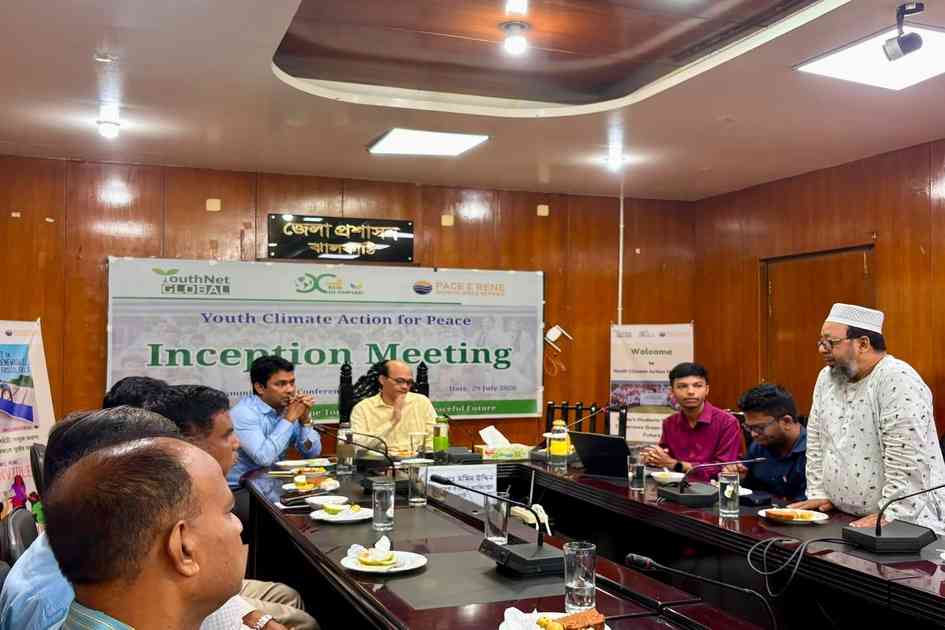
The “Youth Climate Action for Peace” programme, organised by YouthNet Global, a Bangladesh-based youth organisation working on climate action, environmental protection and youth empowerment, officially began with an inception meeting at the conference hall of the Jhalokathi Deputy Commissioner’s Office on Wednesday.
The Jhalokathi-based programme seeks to empower students not only as communities affected by climate change but also as leaders capable of developing solutions, strengthening resilience and promoting peaceful cooperation within their communities.
The launch event highlighted the global recognition received by Bangladeshi youth leader Sazid Mahamud, who was selected for the Changemaker Youth Grant 2026 by Pace e Bene Nonviolence Service, a US-based organisation focused on peace and nonviolence. Sazid was among only 11 young changemakers selected worldwide from more than 700 applications from countries including the United States, Kenya, Ethiopia, Colombia, Pakistan and Bangladesh.
Sazid Mahamud received the recognition for his “Youth Climate Action for Peace” programme, which connects climate action with youth leadership, peaceful problem-solving and community engagement.
Bangladesh is among the countries most vulnerable to climate change, facing increasing risks from floods, cyclones, sea-level rise and climate-induced displacement. In coastal Jhalokathi, where communities face growing environmental pressures, strengthening youth participation is essential for building resilient communities and preparing future leaders.
The Jhalokathi launch meeting was attended by Jhalokathi Deputy Commissioner Md Momin Uddin as the chief guest. Additional Deputy Commissioner (General) Md Kawser Hossain, Additional Deputy Commissioner of the Local Government Branch Julia Sakayna, and District Education Officer Md Abu Sayeed attended as special guests.
Heads of five educational institutions in Jhalokathi, representatives of five Jhalokathi Youth Climate Clubs, members of YouthNet Global and civil society representatives also participated in the event.
Jhalokathi Deputy Commissioner Md Momin Uddin said the programme would create an important platform for students in Jhalokathi to understand climate challenges, develop leadership skills and contribute to peaceful social change.
He added that climate change is already affecting communities across Bangladesh and young people must be prepared to become part of the solution. According to him, initiatives like the Jhalokathi climate and peace programme can help students develop awareness, creativity and leadership skills to address future challenges. The Jhalokathi district administration will provide necessary support for successful implementation of the programme.
Under the four-month Jhalokathi programme, students from five educational institutions in Jhalokathi will receive training on climate education, innovative thinking, peaceful problem-solving and leadership development. The activities will also highlight the links between climate action, social harmony and conflict prevention by encouraging students to work together on community-based solutions.
The Jhalokathi programme will organise Green Action Days at participating schools and a district-level Climate and Peace Fair, where Jhalokathi students will present their ideas and locally developed solutions for climate resilience, environmental protection and peaceful social transformation.
“This international recognition is a matter of pride for me and an important achievement for Bangladesh,” Sazid Mahamud said. “Through the Jhalokathi programme, we want to create opportunities for students to develop knowledge, leadership skills and innovative approaches so they can actively contribute to addressing climate challenges.”
He added that cooperation among the Jhalokathi district administration, educational institutions and government agencies would be important for the successful implementation of the programme.
“Through collective efforts, we can build a climate-resilient and peaceful society led by young people,” he said.
Participants at the Jhalokathi event welcomed the initiative, saying climate education, youth leadership development and social cohesion are increasingly important in addressing climate challenges. They expressed their commitment to supporting the successful implementation of the Jhalokathi programme.
YouthNet Global Executive Coordinator Sohanur Rahman said, “Sea-level rise and saltwater intrusion are affecting traditional agricultural systems in coastal districts like Jhalokathi. This programme is more than a project; it is a long-term effort to nurture climate action, peace and social responsibility among students.”
“By placing students at the centre of climate action, we believe the Jhalokathi model can be expanded to other climate-vulnerable communities across Bangladesh in the future,” he added.
Organisers hope the Jhalokathi model will demonstrate how young people in climate-vulnerable regions can lead community-based solutions and inspire similar climate and peace initiatives across Bangladesh and beyond.




