

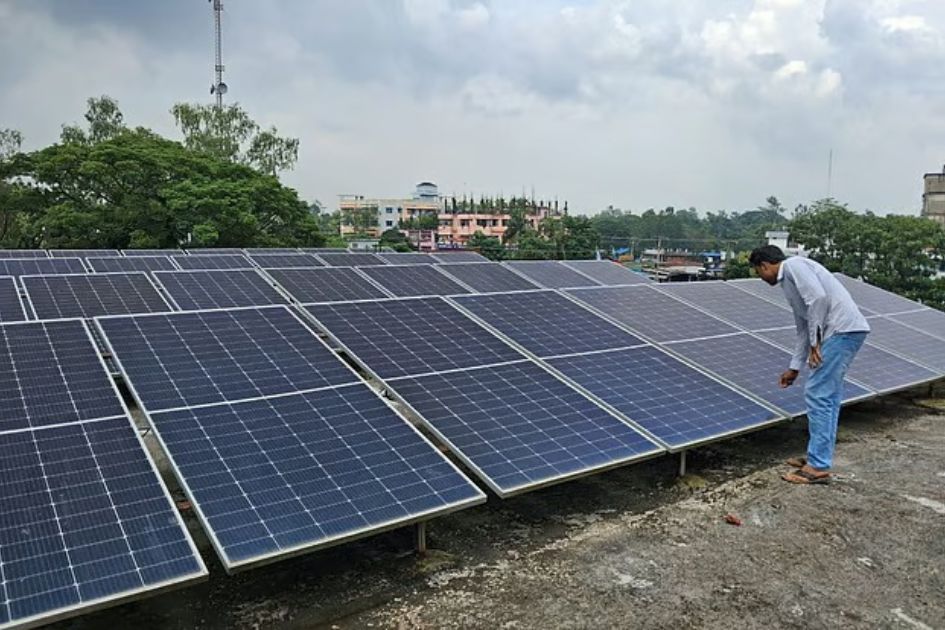



The school says its 12-kilowatt rooftop system has reduced reliance on grid electricity, eased disruption during heat and helped maintain classroom operations across 45 rooms since installation.
A secondary school in Bangladesh’s southeastern Mirsarai area is running almost all its electrical operations on solar power, cutting monthly electricity costs sharply while providing more reliable power for around 2,000 students.
Jorarganj Bouddha High School uses a 12-kilowatt solar power system to operate more than 100 fans, around 120 lights, several computers, an air-conditioning unit and other essential electrical equipment.
Rows of solar panels have been installed on the roofs of two of the school’s three buildings.
School authorities said power cuts have caused far less disruption since the solar system was introduced three years ago, while electricity expenses have also fallen significantly.
The school paid an average monthly electricity bill of around Tk 30,000 three years ago. Its monthly electricity costs have now dropped to between Tk 4,000 and Tk 5,000.
The school is located beside the Muhuri Project road near Jorarganj Bazar, about 10 kilometres from Mirsarai Upazila headquarters in Chattogram.
Electricity is currently used in around 45 rooms, including classrooms, the teachers’ common room and administrative offices. The rooms are equipped with electric fans and lights, while the head teacher’s office has an air conditioner and the accounts section has two computers. All are powered by solar electricity.
The school’s science laboratory has eight computers. When students use all of the computers at the same time, however, it becomes difficult for the solar system to maintain the normal electricity supply.
The school then relies on its Palli Bidyut rural electricity connection. The grid connection is also used during natural disasters or when there is insufficient sunlight, with teachers saying it is needed more frequently during the rainy season and winter.
The 12-kilowatt solar system was installed by a private company from Dhaka at a cost of Tk 24 lakh, financed from the school’s own funds.
According to the school, its average monthly electricity bill previously ranged from Tk 25,000 to Tk 30,000 but has now fallen below Tk 5,000.
Without solar power, the school said its current level of electricity consumption would result in monthly bills of Tk 50,000 to Tk 60,000.
The school said uninterrupted electricity since the introduction of solar power has made it easier to conduct classes during hot weather and allowed students to study more comfortably.
It also said the school achieved the best results in this year’s secondary examinations in Mirsarai Upazila.
Mirsarai Upazila Nirbahi Officer Somaiya Akter, the local government’s chief administrative official, praised the school’s initiative, saying solar power was both cost-effective and comfortable to use.
She said the government was also encouraging the use of renewable energy through various incentives.
“By bringing the entire school under solar power, Jorarganj Buddhist High School has set a unique example, and its students are also achieving good results in board examinations,” she said.




