

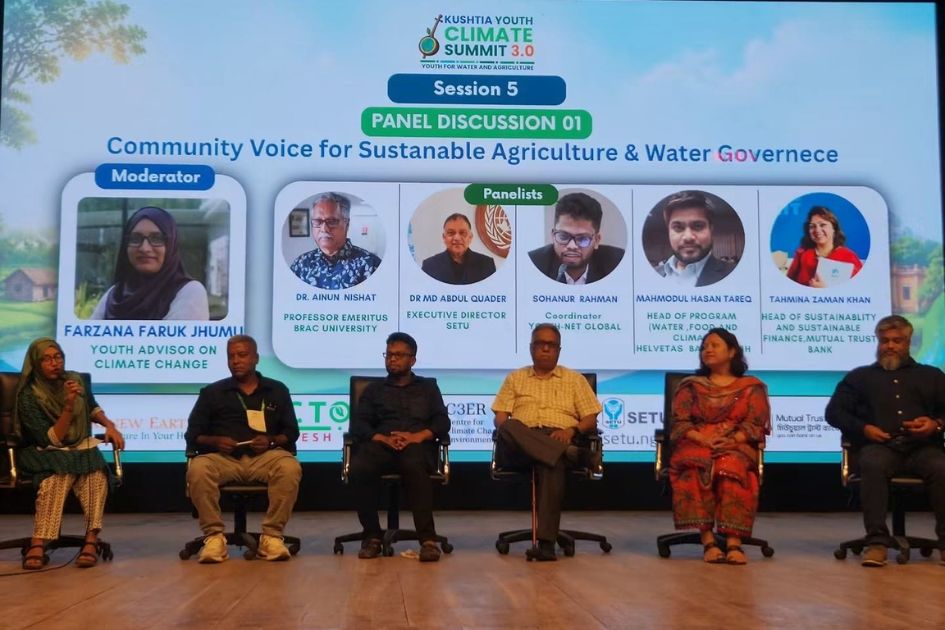



The Kushtia forum urged stronger youth involvement in climate policy, water conservation and climate-resilient agriculture, with speakers highlighting links to food security, health and livelihoods.
Young people, students, teachers, researchers, climate activists and others gathered in Kushtia for the Youth Climate Summit 3.0, focusing on climate change, water security, agriculture, environmental protection and the role of youth in climate action.
The Kushtia Youth Climate Summit 3.0 was held under the theme “Youth for Water and Agriculture”. It was organised by SEECTO Bangladesh and Renew Earth, two organisations working on environment and climate change, with support from C3ER, SETU and Mutual Trust Bank PLC.
Participants discussed the impacts of climate change, current challenges in the water and agriculture sectors and the role young people can play in addressing those crises.
A key part of the summit was a panel discussion on youth participation in tackling climate change, climate justice, the future of water and agriculture and youth leadership in climate action.
The panel featured two young climate activists: Sohanur Rahman of YouthNet Global and Farzana Faruk Jumu, a member of the United Nations Secretary-General’s Youth Advisory Group on Climate Change.
Speakers at the panel said meaningful participation by young people was essential to addressing the impacts of climate change. They said youth must be involved in climate policy-making and decision-making, while also leading practical and sustainable solutions by identifying local climate problems.
Guests at the event included Dr Md Abdul Kader, executive director of SEECTO; Roufa Khanam, deputy director of C3ER-BRAC University; Dr Abu Hena Mostafa Jamal, chairman of the Department of Biotechnology and Genetic Engineering at Islamic University; Dr Sudangshu Kumar Biswas, professor in the same department; Md Inzam ul Haque, assistant professor at the Department of Environmental Science and Geography; Md Sadiur Rahman, lecturer in Development Studies; and Dr SM Mustanzid Lotus.
The guests said climate change was no longer only an environmental crisis, but was directly linked to water, agriculture, food security, public health and people’s livelihoods.
They said young people should be made more aware of the crisis and that their leadership, knowledge and capacity for innovation should be used in responding to it.
The discussions also emphasised water conservation, climate-resilient agriculture, environmental protection, biodiversity conservation and youth-led climate initiatives.
Participants called for coordinated action by the government, private sector, educational institutions, researchers and young people to tackle the climate crisis.
Organisers said one of the main goals of Kushtia Youth Climate Summit 3.0 was to strengthen young people’s knowledge and leadership capacity on climate issues and encourage effective and sustainable youth-led initiatives in the water and agriculture sectors.
The summit ended with a commitment to make young people more active and better able to lead efforts to protect water and agriculture and respond to the impacts of climate change.




