

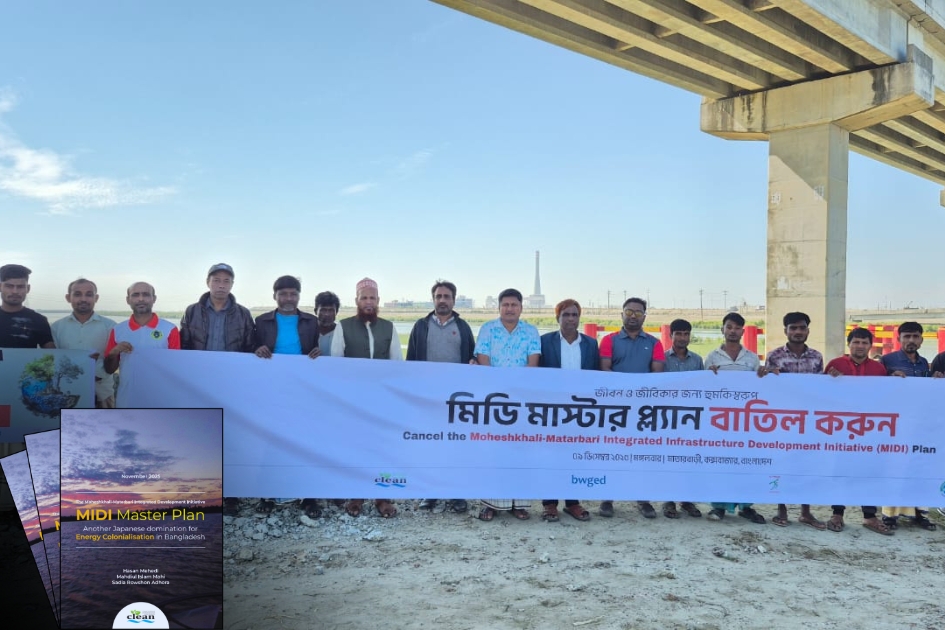



New report urges Bangladesh to drop LNG and coal projects over governance, environmental and social risks
A new CLEAN report warns that Japan-backed plans for Bangladesh’s Moheshkhali-Matarbari region risk unconstitutional governance, LNG-driven economic burdens, severe environmental damage and mass displacement, urging authorities to cancel fossil-fuel projects and prioritise renewable, rights-based development.
A new report released on Wednesday (10 December) warns that a Japan-backed development blueprint for Bangladesh’s Moheshkhali-Matarbari region poses sweeping governance, economic, environmental and social risks, urging authorities to cancel the liquefied natural gas and coal-dependent master plan.
The Coastal Livelihood and Environmental Action Network, known as CLEAN, published the study titled The Moheshkhali-Matarbari Integrated Development Initiative (MIDI) Master Plan: Another Japanese Domination for Energy Colonialisation in Bangladesh. The report delivers a detailed assessment of the Japan International Cooperation Agency’s role in shaping the Moheshkhali-Matarbari Integrated Infrastructure Development plan and its legal foundation, the Moheshkhali Integrated Development Authority Ordinance.
CLEAN warns that the MIDA framework creates unconstitutional governance by bypassing elected local bodies and establishing parallel administrative powers. The report says this sets up direct conflicts with statutory entities such as the Chattogram Port Authority and the Cox’s Bazar Development Authority.
The investigation also highlights significant economic vulnerabilities. According to the findings, the JICA-led plan rejects viable solar and wind options and instead locks Bangladesh into LNG imports, enabling the sale of Japanese fuel and technology while transferring market risks to Bangladesh. The model, the report says, ties the country’s industrial future to a volatile global LNG market and costly subsidies that have already pushed gas tariffs up by as much as 179 percent.
Environmental impacts are described as severe. The master plan’s fossil fuel expansion is projected to generate 1.3 billion tonnes of CO₂ equivalent. CLEAN notes that construction has already disrupted the Kohelia River, increased flooding and put migratory wildlife at risk, including the endangered Spoon-billed Sandpiper.
The study further documents extensive social harm. It states that 12,951 acres of land are earmarked for acquisition, putting an estimated 116,000 people at risk of eviction, effectively the entire population of Matarbari Island. The conversion of salt pans and shrimp farms into industrial zones is destroying primary livelihoods, and compensation mechanisms are reportedly plagued by corruption, with affected residents allegedly losing up to 30 percent of their payments in bribes.
CLEAN outlines several key recommendations: repeal the MIDA Ordinance, cancel the current MIDI Master Plan, halt LNG-centric energy strategies, prioritise renewable resources, carry out an independent Strategic Environmental Assessment with meaningful civil society participation, restore the Kohelia River and impose a moratorium on land acquisition until transparent, rights-based resettlement processes are in place.
Mr Hasan Mehedi, Member Secretary of BWGED, said the plan functions as a foreign-controlled machine that exploits Bangladesh’s land, resources and sovereignty while leaving communities to bear environmental and debt burdens. He said the findings underscore the urgent need to abandon LNG-driven projects and pursue a renewable energy future.
The report calls on the government, policymakers and civil society to protect local authority, safeguard livelihoods and secure Bangladesh’s environmental and energy independence.




