

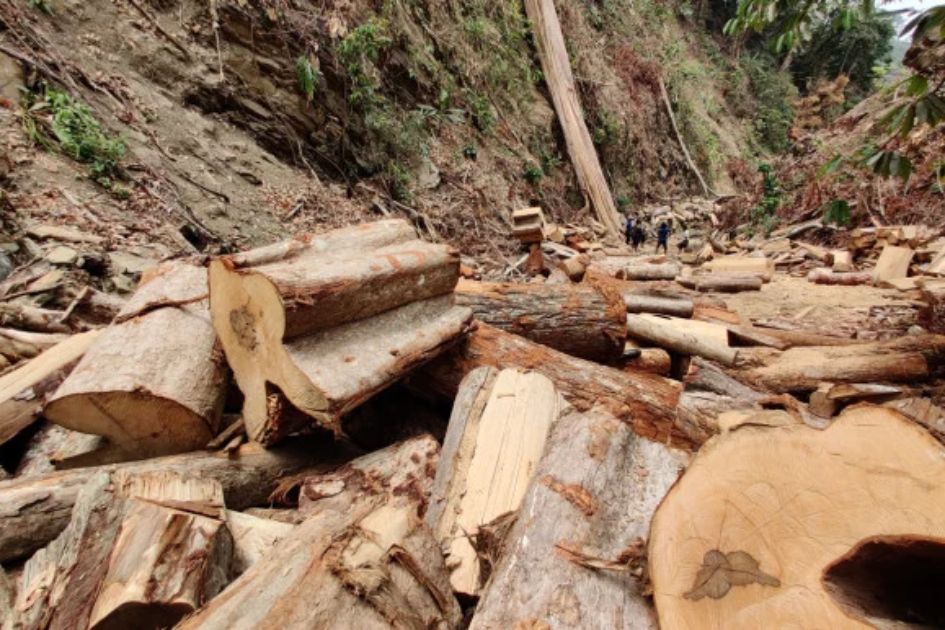



Illegal logging in Bandarban’s Dim Pahar has destroyed protected forests, dried vital streams and threatened wildlife, leaving Indigenous communities struggling to protect their environment, water sources and traditional livelihoods from ongoing devastation.
A vast illegal logging operation has devastated nearly 200 acres of natural forest in the remote Dim Pahar area of Bandarban, threatening water sources, wildlife and the livelihoods of Indigenous communities who depend on the region’s protected village forests, residents and local officials said.
Hidden beneath the lush hills and mist-covered slopes of the scenic Alikadam-Thanchi road, one of Bangladesh’s most picturesque mountain routes, the destruction has unfolded quietly for months in the deep forests surrounding Dim Pahar.
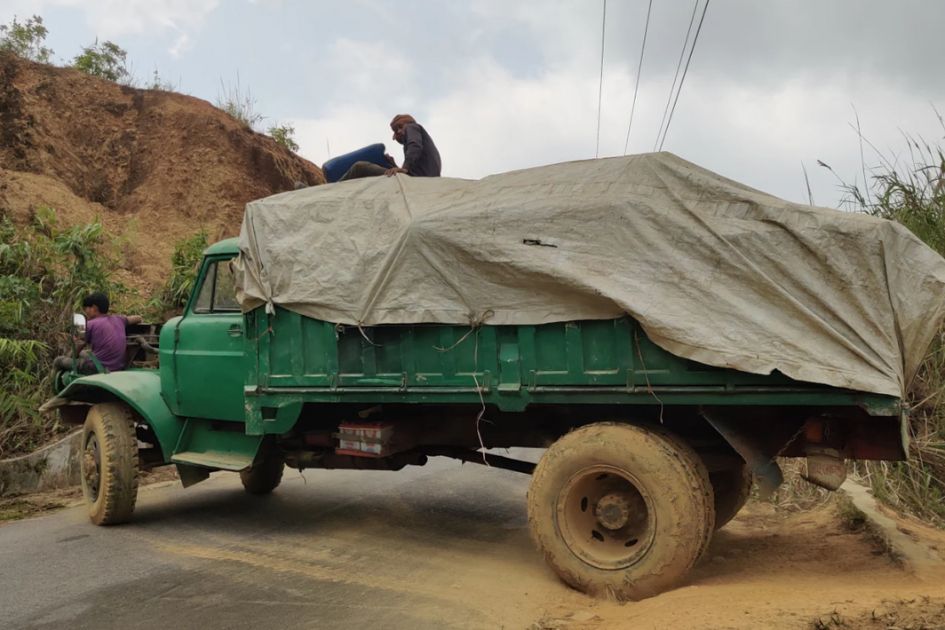
During a visit on April 22 to the “23 Kilometer” point along the Alikadam-Thanchi road, reporters discovered a narrow path concealed by dense vegetation. From the nearly invisible trail, a truck covered with a blue tarpaulin emerged carrying freshly cut timber hidden underneath. Two workers sat inside the vehicle while another man fled into the forest after spotting photographers. The truck quickly drove toward Alikadam.
Following the hidden mountain trail for around 15 minutes revealed the scale of the destruction. Freshly felled tree trunks were scattered across the hillsides. Some had been split in half while others had already been cut into square blocks for furniture production. Fresh stumps dotted the slopes and many leaves on the cut trees remained green with damp soil around their bases, indicating the logging had taken place only hours earlier.
Further downhill lay the “Bankjhari Jiri,” once a major water source for the Indigenous Mro community. The stream is now almost clogged with logs and debris. Large trees throughout an approximately 2.5-kilometer stretch of socially protected “para forests” have been systematically cleared.
Local residents and elected representatives alleged that an active timber smuggling syndicate has destroyed around 200 acres of natural forest in remote border areas near Chakkhyong Union’s Ward No. 9 including Pamiya Mro Para, Tantuyee Para, Namchak Para, Kakoi Para and Adoi Para.
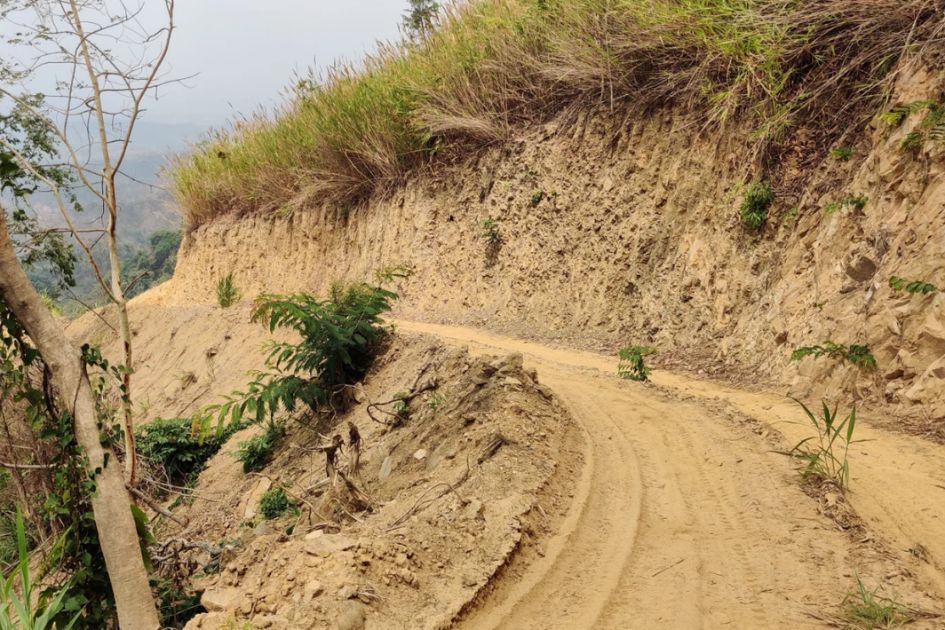
The area lies around 127 kilometers from Bandarban district headquarters and roughly 18 kilometers from Alikadam. Residents said hills were cut to build roads for transporting timber trucks and excavators were regularly used to carve through rock and mountainsides. Soil and logging debris dumped into streams have blocked the natural water flow.
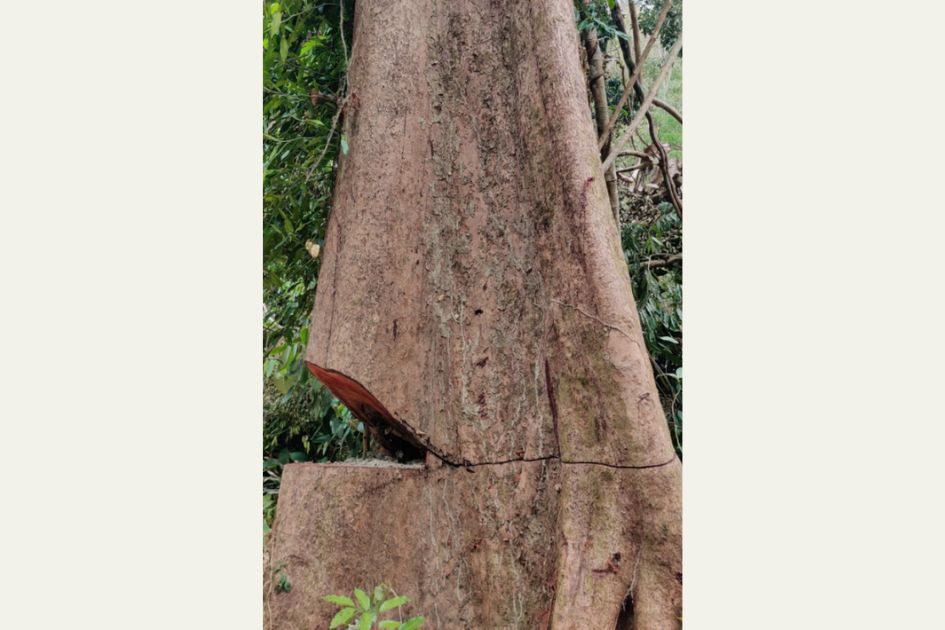
The destroyed forest included species such as garjan, champa flower trees, koroi, bailam, gutgutia, lali and chapalish, once abundant in the deep forest. Locally these forests are known as “parabon” or village forests, socially protected by Indigenous communities for collective use. Although community-managed, cutting large trees without approval from the forest department is illegal.
Residents said the logging intensified toward the end of 2024 and continued without obstruction.
Inside the forest, reporters found two temporary worker camps built beside the stream. One shelter could accommodate around 10 laborers. Electric chainsaws were stored inside while solar-powered pumps drew water from the stream through plastic pipes. Clothes hung outside and cooking preparations were underway nearby.
Mohammad Ismail, a labor supervisor from Chakaria in Cox’s Bazar district, said timber trader Abu Ismail from Alikadam had brought them there three to four months earlier.
“We survive on daily wages. There is no work in our area so we came here hoping to earn a living,” he said.
According to him, seven to eight workers were regularly cutting trees for daily wages of 450 to 500 taka ($3.70-$4.10). He claimed most of the trees were lali and tula species and that only one valuable bailam tree had been found. He also claimed tree cutting had stopped and workers were now only transporting timber once or twice daily by truck.
Another laborer from Chakaria, Shamsul Alam, said he arrived 18 days earlier and earned 450 taka per day transporting timber and cooking.
But the freshly cut trunks and wet soil suggested the logging continued until very recently.
Residents alleged that smugglers used a bypass route known as “Kolar Jiri” to avoid an army checkpoint near the 23-kilometer point on the Alikadam-Thanchi road. They also claimed some timber was being transported across the country using forest department transit permits while other wood was sold as fuel for illegal brick kilns and tobacco curing furnaces in Alikadam.
Large century-old trees on steep hillsides have been almost entirely wiped out leaving the mountains nearly barren.
Contacted by phone, accused timber trader Abu Ismail denied involvement in cutting large trees.
“I only bought firewood. It was supposed to be leftover wood from shifting cultivation,” he said.
He claimed another group from Thanchi was responsible for cutting large trees and building mountain roads.
“I became involved by mistake and now I will leave this business,” he added.

Lairu Mro, a resident of Pamiya Para, said logging continued even after journalists left the area.
“Someone may have warned the workers after hearing reporters had arrived. After you left, timber was moved throughout the day and they transported wood at night fearing raids,” he said.
Lairu said residents first tried to stop the logging at the end of 2024 but failed. When they tried again earlier this year, traders claimed they had purchased the land from a Mro resident. However, Lairu insisted the forest was a socially protected community forest.
Written complaints were submitted first to the Alikadam Army Zone and later to the local administration in January.
“The army zone told us there would be elections within a month and action would be taken afterward. The UNO office advised us to seek assistance from police and the forest department. But the tree cutting never stopped,” Lairu said.
Eventually, residents shared images of the destruction on social media after failing to secure intervention from authorities.
The environmental impact is already affecting nearby villages. At least six villages including Pamiya Para, Tantuyee Para, Namsak Para, Kakoi Para, Quiring Para and Sankhala Para depend on the Bankjhari stream for water.
Menchong Mro from Pamiya Para said the stream was rapidly drying up.
“Before, there were plenty of fish, crabs and water in this stream. Since the trees were cut, the water flow has declined. We tried many times to stop the logging but failed,” he said.
Kamplat Mro, the headman of Adoi Para, said people from seven to eight villages rely on the stream and the crisis had become severe.
Wildlife has also begun disappearing.
Men Rao Mro from Namchak Para said the forest was rich in wildlife only two years ago.
“There were wild boars, deer, jungle fowl and monkeys here. Even last year two bears were seen in this forest. If the forest is destroyed like this nothing will survive,” he said.
He estimated the village forest covered around 50 acres although no formal survey exists.
Residents accused a local man named Longle Mro of selling part of the community forest. His name appeared in written complaints submitted to the army zone and local administration.
Longle admitted selling timber but denied authorizing the cutting of large trees.
“Shifting cultivation has not produced good harvests for several years. Because of hardship I sold some wood as firewood. There was never any agreement to sell large trees,” he said.
Environmental activists sharply criticized authorities over the incident.
Juyam Lian Amlai, president of the Bandarban chapter of the Chattogram Hill Tracts Forest and Land Rights Protection Movement, blamed the forest department.
“Such massive destruction is impossible without the involvement of officials from the forest department,” he said.
Forest officials cited manpower shortages.
Tain Range Officer Khandaker Ariful Islam said the area falls under their jurisdiction although they had no active operations there.
“We have 5,784 acres of forestland under our jurisdiction. With limited manpower it is extremely difficult to work in such remote areas. Still, we will coordinate with the UNO to prevent further damage. Legal action will be taken under forest laws or through mobile courts,” he said.
Lama Divisional Forest Officer Mostafizur Rahman said authorities ordered immediate action after the allegations surfaced.
Following complaints from residents and media reports, a daylong raid was conducted in the Dim Pahar area on April 22 led by Alikadam Upazila Executive Officer Mohammad Manjur Alam.
Authorities seized around 300 cubic feet of timber, demolished worker camps inside the forest and disabled an excavator used for cutting hillsides. No arrests were made because workers fled before the operation began.
“The excavator was damaged in such a way that it cannot operate again without spending 250,000 to 300,000 taka,” Manjur Alam said.
“Soil and stones were filled into its fuel tank and its joints were broken with hammers.”
He confirmed regular cases would be filed under forest laws and said a man named Faruk and two sawmills in Pan Bazar had been identified for future raids.
For now, the scars across the Bankjhari hills remain visible: stripped slopes, clogged streams and silent forests once filled with wildlife. The roads carved through the mountains stand as evidence of unchecked deforestation while local communities watch their water sources, biodiversity and future disappear before their eyes.
This post is republished from THE BUSINESS STANDARD.




