

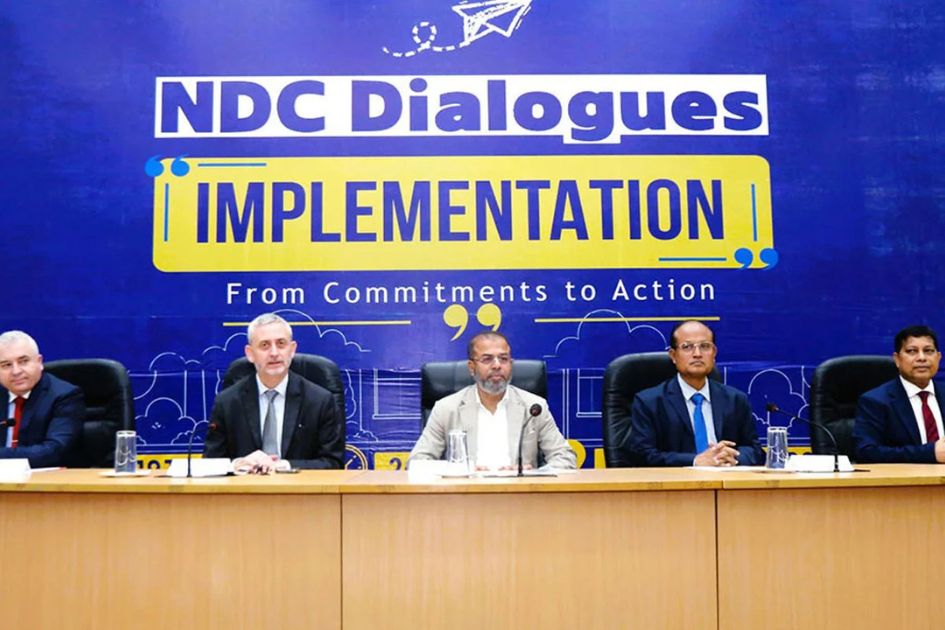

Dhaka University VC Obaidul Islam urged stronger coordination, youth participation and institutional action to turn Bangladesh’s climate commitments into effective implementation during the NDC 3.0 dialogue in Dhaka.
Dhaka University, Bangladesh’s leading public university, Vice-Chancellor Professor Dr. A B M Obaidul Islam on Monday said the effective implementation of climate commitments remains the biggest challenge in tackling climate change, stressing the need for coordinated efforts from governments, educational institutions, development partners, the private sector and young people.
He made the remarks at a dialogue titled “NDC 3.0 Dialogues: From Commitment to Action” held at the Nawab Nawab Ali Chowdhury Senate Building at Dhaka University.
The daylong event was organised by Youth for NDCs to discuss the challenges, opportunities and policy priorities surrounding the implementation of Bangladesh’s Nationally Determined Contributions (NDC 3.0).
Environment, Forest and Climate Change State Minister Sheikh Faridul Islam attended the programme as chief guest.
Speaking as a special guest, Obaidul Islam said Bangladesh is among the countries most vulnerable to climate change but has continued to play a responsible role in global climate discussions. He expressed hope that universities could make significant contributions to implementing the government’s climate policies through research, innovation and the development of skilled human resources.
European Union Ambassador to Bangladesh Michael Miller and Ulrich Kleppmann, head of Development Cooperation at the German Embassy, also addressed the dialogue as special guests.
Around 300 participants, including representatives from government agencies, development partners, teachers, researchers, students, youth climate activists and members of civil society, took part in the event.
During the first session, participants were divided into groups for thematic discussions on key climate issues.
The discussions produced a series of recommendations focusing on climate financing, institutional coordination, technology and innovation, implementation of climate policies at the local government level and greater youth engagement in climate action.
The programme was supported by Dhaka University, the European Union in Bangladesh, the Embassy of Sweden, the German Embassy, GIZ and the Bangladesh Institute of Planners (BIP). Strategic support for the event was provided by the Ministry of Environment, Forest and Climate Change.




