

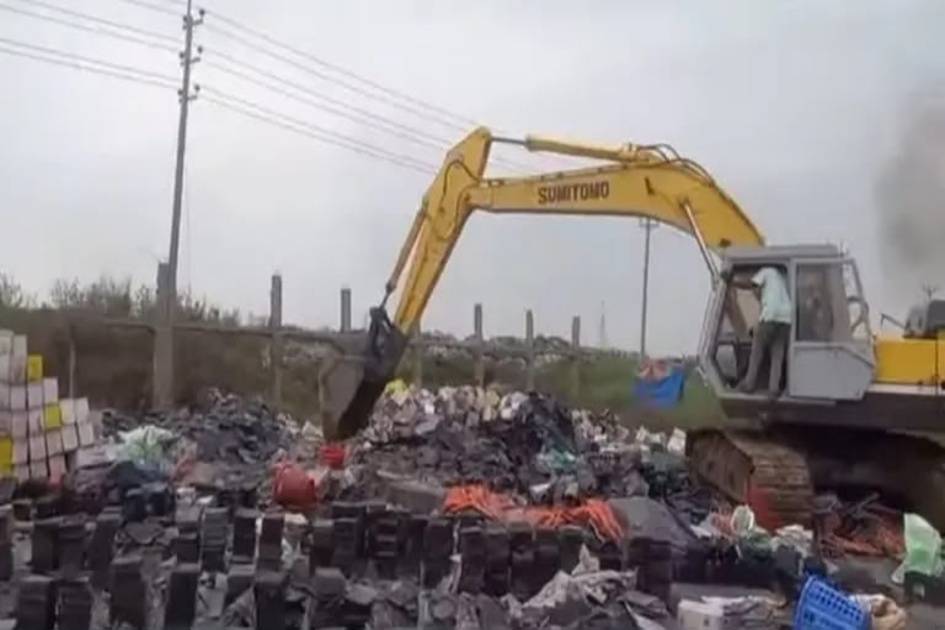



Residents say night-time battery burning has returned after enforcement drives, raising concerns over toxic smoke, alleged patronage and weak accountability in Savar’s Awal Market area near Dhaka.
Despite recent mobile court operations, the illicit and environmentally hazardous practice of lead smelting has resurfaced in the Awal Market area of Bhakurta Union in Savar, on the outskirts of Bangladesh’s capital Dhaka, creating a serious public health and environmental crisis for local communities.
Residents allege that operators of illegal factories have resumed their activities after evading enforcement actions, secretly burning old batteries under the cover of darkness. The continued operation of these facilities highlights a deeper environmental governance failure, where vulnerable communities are forced to bear the consequences of toxic pollution while illegal operators continue to profit.
According to local sources, the Department of Environment, Bangladesh’s state environmental regulatory agency, conducted a raid on July 1 and demolished six furnaces across three illegal facilities. However, within days, operators reportedly rebuilt six new furnaces, bringing the number of active illegal smelting units in the area back to twelve.
Despite repeated interventions by authorities, questions remain over how these illegal factories continue to operate, including how they secure access to land, electricity, labour and the supply chains required for their activities.
Health and environmental hazard
Residents describe a disturbing nightly routine, with illegal smelting operations reportedly running from 7:00 PM to 6:00 AM. During these hours, battery plates are burned using wood and coal, releasing dense black smoke, toxic particulate matter and a strong acidic smell that spreads across surrounding areas within a two-to-three-kilometre radius.
“Even with our doors and windows sealed, we cannot escape the toxic fumes,” said a resident, speaking on condition of anonymity. “The air is unbearable, causing chronic eye irritation, breathing difficulties and severe headaches.”
Medical experts warn that exposure to lead-contaminated smoke and dust can cause irreversible damage to the nervous system, kidneys, liver and lungs. Children, older people and pregnant women are among the most vulnerable groups. Long-term exposure to lead has been linked to cognitive impairment, developmental delays, behavioural problems and increased risks of serious health complications.
The World Health Organization has identified lead as one of the most harmful environmental pollutants, with no known safe level of exposure for children. Even low levels of exposure can affect brain development, learning capacity and overall well-being.
Environmental experts warn that toxic waste from illegal battery recycling can contaminate agricultural land, water bodies and vegetation, creating long-term risks for food security, biodiversity and ecosystem health.
Local farmers fear that contaminated dust and wastewater are affecting agricultural productivity, while parents worry about the impacts of prolonged exposure on children’s health, education and future development.
Allegations of powerful patronage
Local residents allege that a powerful syndicate is operating these factories with impunity. They have named individuals including Nasir Mir and Saju Miah from Shariatpur, and Md Manik Sarker, Md Mohsin and Ratan from Saghata upazila in Gaibandha as being linked to the operations.
The allegations could not be independently verified, and the individuals named could not be reached for comment.
Community members say that the repeated cycle of temporary raids followed by the rapid reopening of factories demonstrates the need for stronger enforcement, transparency and accountability.
Call for permanent action
Residents argue that partial demolition and temporary eviction measures are not enough to address the crisis.
“Partial eviction is not a solution. We demand that all illegal factories within these premises be permanently sealed, and those responsible for exposing communities to toxic pollution must be held accountable,” said Sohanur Rahman, executive coordinator of YouthNet Global.
The community is calling for an immediate and impartial investigation into how these illegal operations continue despite official oversight. They have urged the Dhaka divisional commissioner, the Department of Environment headquarters and the Savar upazila administration to take urgent action and ensure exemplary legal measures against those responsible.
Environmental groups and civil society organizations are demanding a coordinated, multi-agency task force involving law enforcement agencies, the Department of Environment, local administration and utility providers to permanently shut down illegal lead smelting operations.
Sohanur added, “Temporary raids and partial demolitions cannot solve a systematic environmental crime. The government must establish a coordinated, multi-agency task force involving the Department of Environment, law enforcement agencies, local administration and utility providers to permanently close illegal lead smelting operations, hold responsible actors accountable and ensure justice for affected communities.”
Experts and community representatives also called for regular environmental monitoring, health screenings for exposed residents, safe battery recycling systems and restoration initiatives for contaminated land and water bodies.
The continued operation of illegal lead smelting facilities in Savar is not only a pollution issue; it is an environmental justice crisis demanding immediate government action, stronger enforcement and protection of the communities living on the frontlines of toxic exposure.




