

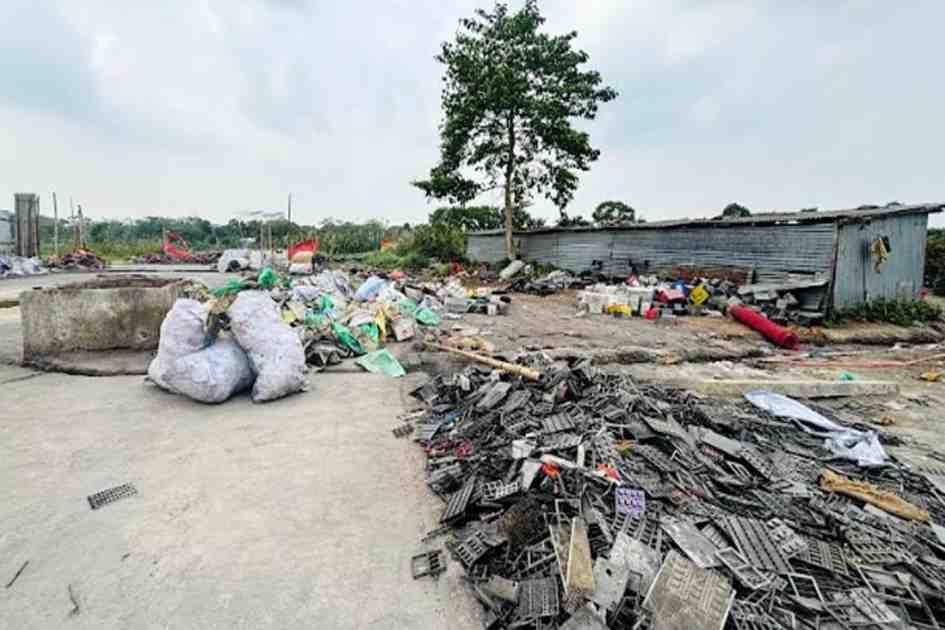

An illegal lead smelting plant in Bhedarganj is poisoning air, soil and water, killing livestock, damaging crops and exposing residents to severe health risks despite weak enforcement actions and inaction.
An illegal lead (Pb) acid battery recycling factory operating in a densely populated area of Bhedarganj Upazila in Shariatpur District has triggered a severe public health and environmental crisis, with reports of livestock deaths, crop losses and growing human health risks affecting multiple villages.
According to the Department of Environment and local sources, the facility has been set up inside an abandoned brick kiln in Mahishkandi village by an influential group, without any environmental clearance or legal authorization. The plant extracts lead by burning used batteries in open and unregulated conditions, mainly at night, releasing hazardous fumes and toxic chemicals into the air.
Residents describe thick black smoke, toxic dust and an unbearable odor as a daily reality. Experts warn that exposure to lead and battery emissions can occur through multiple pathways, including inhalation of polluted air, soil contamination affecting crops and polluted water sources impacting livestock. Even low levels of lead exposure, as highlighted in global public health guidelines, can cause serious health problems such as anemia, neurological disorders, developmental delays in children and long-term damage to the brain, kidneys and respiratory system.
The human and ecological toll is already visible. Local residents report that at least 12 to 15 cattle have died over the past three months due to suspected toxic exposure, while several families have been forced to leave their homes as pollution levels intensify. Masum Sardar, one of the affected residents, filed a formal complaint with local authorities after bringing his dead cow to the Upazila Nirbahi Officer’s office as evidence. He said toxic emissions from the plant are spreading across nearby villages, causing illness among livestock and birds while disrupting the ecological balance.
Farmer Abdur Rahim reported losing nearly 40 percent of his tomato crop, saying that pollution has made his land increasingly unsuitable for cultivation. Similarly, 65-year-old Setara Begum said two of her dairy cows, each producing around 8 kilograms of milk per day, recently died, leaving her in deep financial distress. Residents from nearby areas, including Sakhpur, also report that shifting wind patterns are carrying pollutants into their communities, expanding the scale of damage to crops, livestock and daily life.
On March 4, 2026, a mobile court led by Assistant Commissioner (Land) and Executive Magistrate K. M. Rafsan Rabbi conducted a raid on the factory. During the operation, six individuals were each fined BDT 100,000 and sentenced to three months in prison under the Bangladesh Environment Conservation Act, 1995, and the factory’s electricity connection was disconnected. However, residents allege that the factory resumed operations within 24 hours, highlighting enforcement failures and possible political protection that allow illegal and hazardous industries to continue operating with impunity.
Dr Nasir Uddin, residential medical officer at Bhedarganj Upazila Health Complex, warned that emissions from burning batteries and lead are highly toxic and pose serious health risks. He said inhalation of such fumes can cause severe lung damage and is particularly dangerous for children, the elderly and those with pre-existing respiratory conditions.
Russel Noman, assistant director at the Department of Environment, confirmed that authorities are aware the factory has resumed operations and said the issue is being treated with urgency, with stricter legal measures under consideration. Bhedarganj Upazila Nirbahi Officer Hafizul Haque also said such activities are illegal and pose a grave threat to public health and the environment, adding that coordinated enforcement action will be taken.
The incident underscores a broader pattern of environmental injustice in Bangladesh, where marginalized rural communities are disproportionately exposed to industrial pollution due to weak regulatory enforcement, limited oversight and local power dynamics.
As Sohanur Rahman, executive coordinator of YouthNet Global, said, “This is not just an environmental violation. It is a clear case of environmental injustice where vulnerable communities are being exposed to toxic pollution without protection or accountability. Immediate shutdown and long-term monitoring are non-negotiable.”
Residents are demanding the permanent shutdown of the illegal lead smelting plant, an independent environmental and public health impact assessment, continuous monitoring of air, soil and water quality as well as compensation and medical support for affected families.
Without decisive intervention, communities fear that long-term health consequences and environmental damage could become irreversible, further deepening inequality and vulnerability in already at-risk regions of Bangladesh.




