

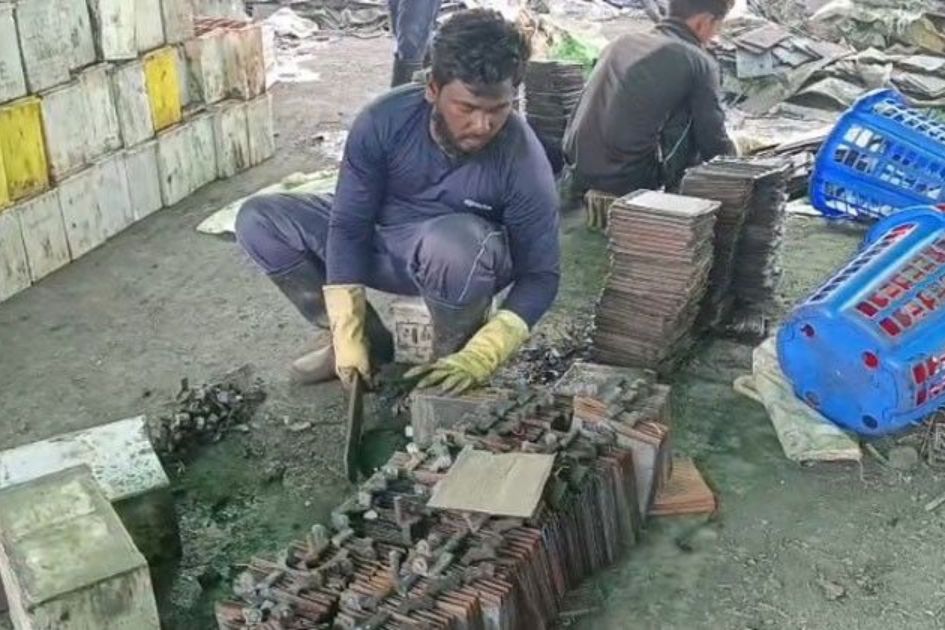



An illegal lead-acid battery recycling plant in Savar’s Hemayetpur is emitting toxic fumes and raising health concerns, with allegations of child labour and calls for urgent government enforcement action measures.
An illegal and unregulated lead-acid battery recycling factory has been identified in the Hemayetpur area of Savar, triggering serious concerns over environmental pollution, public health risks and alleged child labour inside the facility.
The operation is reportedly running inside a private industrial structure locally referred to as the “Hallmark factory compound,” where discarded lead-acid batteries are being burned in high-temperature furnaces to extract lead. Authorities confirm that the facility has no environmental clearance or legal approval.
Toxic emissions affecting residential communities
Residents say thick black smoke and strong chemical odours are regularly released, particularly during nighttime operations, severely affecting nearby households.
“When the burning starts at night, the whole area becomes filled with toxic fumes. Breathing becomes difficult and people cannot sleep,” said local resident Md. Sadequr Islam, adding that long-term exposure is becoming an increasing concern for families.
Allegations of child labour and unsafe working conditions
Local sources and eyewitness accounts claim that children aged between 12 and 15 are working inside the facility without protective equipment such as masks or gloves, exposing them to hazardous lead dust and fumes.
Health experts warn that lead exposure can cause irreversible neurological damage in children, affecting brain development, learning capacity and behaviour, along with risks of kidney damage, anaemia and long-term cardiovascular complications.
Savar Upazila Health and Family Planning Officer Dr. Md. Fazle Bari said, “Exposure to lead particles is extremely dangerous, especially for children and pregnant women. It can cause permanent damage to the nervous system and severely affect fetal development.”
Allegations of regulatory evasion
A man locally identified as “Manik,” who claims to be overseeing the operation, acknowledged that the facility does not possess legal documentation.
“We do not have any valid approval. The operation continues through various arrangements,” he said.
Call for a just transition approach
Climate and youth justice advocates argue that the issue goes beyond enforcement and reflects deeper structural gaps in managing informal and hazardous industries.
Sohanur Rahman, Executive Coordinator of YouthNet Global, said the situation highlights the urgent need for a just transition framework in Bangladesh’s informal industrial sectors.
“Crackdowns alone are not enough. We need a just transition approach that protects workers, eliminates child labour and ensures that communities dependent on informal recycling are supported into safer and dignified livelihoods. Environmental protection and social justice must move together,” he said.
Government response and planned action
Officials from the local administration have denied any knowledge of protected or tolerated illegal operations.
“This is completely unacceptable. No unlicensed lead processing facility is allowed in residential areas,” said Savar Upazila Nirbahi Officer (UNO) Md. Saiful Islam. He added that eviction drives and legal action will be initiated soon.
Growing public health concerns
Medical professionals and residents report increasing cases of respiratory discomfort, skin irritation and pollution-related illnesses in the area. Experts warn that continued exposure to lead contamination could create long-term ecological and public health consequences.
Call for urgent enforcement
Local communities are demanding immediate closure of the facility, strict enforcement against environmental violations and investigation into alleged child labour practices.
Environmental and youth voices have also called for stronger regulation of informal battery recycling operations, which remain a growing concern in rapidly urbanizing industrial zones around Dhaka.
Authorities have assured action, but residents say swift intervention is essential to prevent further harm to public health and the environment.




