




The Triple Axis of Injustice: Land, Climate, and the Women Left Behind
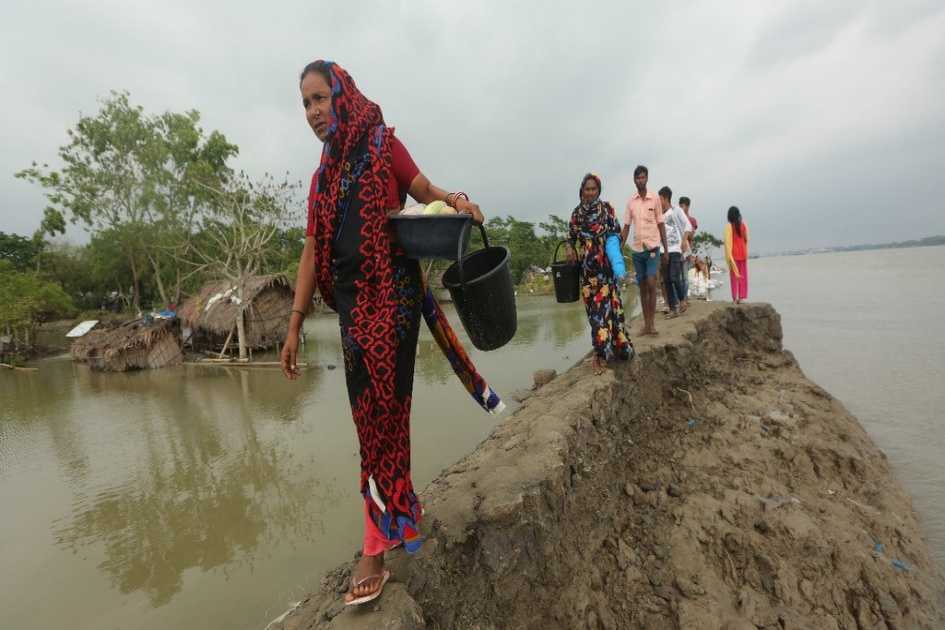
An analysis of the lived reality of a Dalit or marginalized woman in the coastal region of Satkhira makes it evident that she stands at the intersection of three profound and interconnected injustices. The generational wounds of losing land due to ethnic discrimination, familial displacement or local political instability remain an unresolved question of transitional justice. Simultaneously, the ongoing collapse of her livelihood, health and reproductive system due to rising sea levels and salinity sits at the heart of climate justice. Furthermore, her consistent absence from every decision-making process highlights the deep structural failures of gender justice.
These three deprivations reinforce one another, creating a cycle where a crisis in one domain cannot be resolved without addressing the others. An intersectional framework captures this reality, proving that these injustices cannot be viewed in isolation. While transitional justice demands truth and accountability for past structural violence, climate justice seeks to identify those responsible for environmental destruction while centering affected communities. Gender justice, meanwhile, calls for dismantling patriarchal and caste-based structures to ensure the meaningful role of women in peace processes. Though these voices may seem distinct, they converge on the same fundamental question: who holds power and who pays the ultimate price? Without an honest answer to this, no sustainable solution is possible.
What Structural Transformation Actually Means
The deepest point of agreement across all three justice frameworks is rarely named plainly, so it is worth stating here: none of them believe that surface reforms work. Transitional justice has spent decades learning that legal remedies, however carefully designed, cannot on their own dismantle the state impunity and institutional bias that made violence possible in the first place. Climate justice makes essentially the same argument in a different register, that technical fixes within the existing economic system will never challenge the logic that treats nature as a commodity and marginalized lives as acceptable losses. Gender and caste-based movements have made this case longest of all, pointing out that laws mean little when the values embedded in institutions remain unchanged.
All three, in other words, are asking for the same thing: not reform from above but transformation driven by those who have been pushed furthest from power.
The Missing History
Truth commissions almost never tell the full story. When they document political violence, they rarely document the environment: the shrimp farms that displaced farming communities in Satkhira, the embankment projects riddled with corruption and the slow conversion of agricultural land into something profitable for some and catastrophic for most. These are not merely environmental stories. They are records of how state and corporate power operated against particular communities and their absence from official histories is not an accident. It is itself a form of injustice.
The same is true of the erasure of women’s testimony. What Dalit women did during disasters, displacement and the long grind of social exclusion, how they held families together, rebuilt livelihoods and read the landscape for danger, is rarely considered historical knowledge. When truth processes fail to document this, they do not produce neutral records. They produce biased ones. Truth-seeking is a political act and who gets included in it shapes what future accountability looks like.
Reparations Without a Framework
The question of repair sits at the centre of all three justice traditions and in all three it remains largely unanswered in practice. Transitional justice talks about compensating victims but has no reliable method for calculating generational land loss for communities like the Dalit landless in Satkhira. International climate negotiations have reached a grudging consensus on Loss and Damage funding, but no transparent system exists to ensure that money actually reaches the women most affected rather than disappearing into administrative layers above them. Gender justice faces a related problem: there is no integrated legal or institutional structure capable of addressing the compound losses of a woman who is simultaneously surviving caste-based exclusion and environmental collapse.
These losses are not separable and neither can their remedies be. Reparation has to mean more than a financial transaction. It has to mean institutional recognition, an acknowledgment that these harms were connected and that the response must be too.
Participation as a Non-Negotiable
UN Security Council Resolution 1325 made the case nearly two decades ago that women’s meaningful participation in peace processes is not charity extended to a vulnerable group. It is a practical condition of agreements that hold. The evidence since then has repeatedly borne this out: peace deals with genuine women’s involvement last longer. The same logic applies to climate adaptation. Plans developed without the lived knowledge of local women fail in predictable ways in the field. The women who understand how tidal patterns have shifted, who have watched certain crops fail while others survived and who can read seasonal signals that no scientific instrument measures, hold knowledge that is not supplementary. It is foundational.
Institutional reform matters here as well, though it tends to be discussed abstractly. If courts and environmental agencies keep operating inside old frameworks, then justice becomes something performed rather than delivered. The architecture of institutions shapes what they can actually do and architecture that excludes certain voices will keep producing certain outcomes regardless of what the law says.
Why Division Is a Structural Advantage for the Wrong People
When transitional justice, climate justice and gender justice operate as separate agendas with separate advocates and separate budget lines, the result is predictable. Each becomes weaker and the power structures that benefit from all three injustices are left largely intact. The woman in Satkhira does not experience her dispossession in three tidy categories. She experiences it as one unbroken condition: inherited loss, ongoing environmental crisis and structural invisibility pressing on her at the same time.
Justice that responds to this has to be built around her perspective, not organized around institutional convenience. Community-centred participation is not a procedural nicety. It is the whole point. When the people intended to benefit from justice processes are treated as recipients rather than leaders, what is produced is not justice. It is managed dispossession with better paperwork.
Intersectionality is sometimes dismissed as academic jargon. In Satkhira, it is a survival tool. The choice is not between a unified approach and a fragmented one. It is between a framework that can actually see what is happening and one that cannot.




