

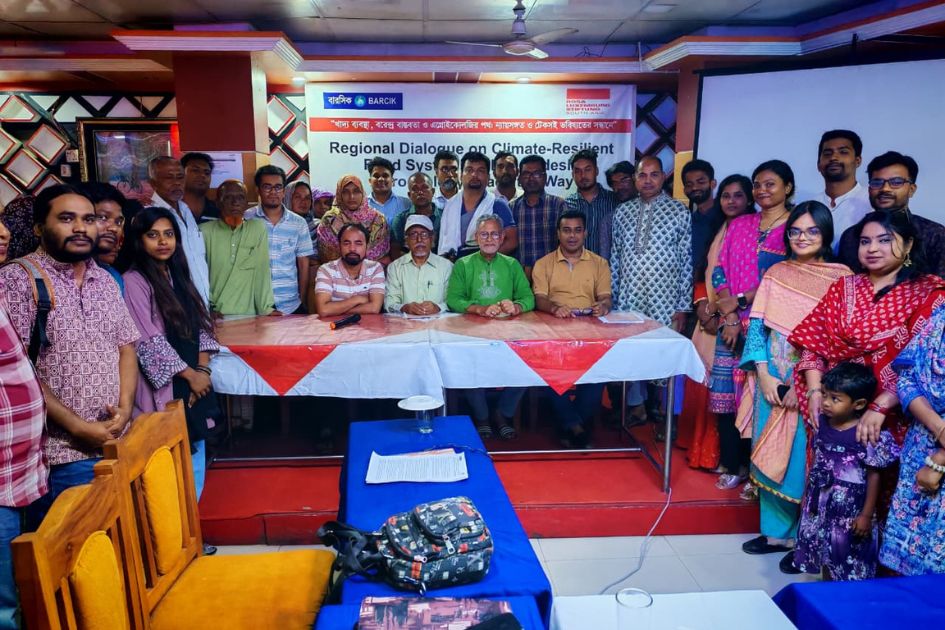

Stakeholders at a Rajshahi dialogue called for agroecology-based policies to build climate-resilient food systems, highlighting Barind water scarcity, environmental degradation, women farmers’ rights, and need for farmer-centred national planning process.
A regional dialogue in Rajshahi, a metropolitan city in northwestern Bangladesh, has called for stronger national policies to build a climate-resilient and equitable food system through agroecology, highlighting urgent concerns over water scarcity, environmental degradation and farmer rights in the Barind region.
The discussion titled “Regional Dialogue on Climate Resilient Food Systems in Bangladesh: Agroecology Shows a New Path” was held on Monday at SK Food Seminar Hall. It was organised by Barcik with support from Rosa Luxemburg Stiftung South Asia.
Farmers, researchers, development activists, civil society members and professionals took part in the event. Speakers focused on the worsening water crisis in the Barind region, impacts of climate change, dependence on chemical-based agriculture, preservation of indigenous seeds, the role of women farmers and the importance of agroecology-based food systems.
They stressed that tackling the climate crisis requires strengthening local knowledge systems, biodiversity conservation, low-cost farming practices and farmer-controlled food systems. Agroecology, they said, is not only a farming approach but also a pathway to environmental and social justice.
At the opening session, welcome remarks were delivered by Sylvanus Lamin, director of Barcik. The dialogue was moderated by Shaheda Purno. Amrin Binte Azad, policy and research officer at Barcik, presented field-based findings on agroecological challenges and opportunities.
Participants later shared their views on necessary actions to promote agroecology and climate-resilient food systems in the Barind region. The dialogue concluded with a call for coordinated efforts to establish sustainable, farmer-friendly food systems.
Mahbub Siddiki, president of Green Coalition Rajshahi and a river environment researcher, said the Barind region is highly resource-rich but unsuitable for water-intensive rice cultivation. “We must increase cultivation of Rabi crops here instead of relying on water-intensive rice,” he said, adding that environmental protection is essential to preserve agroecological balance.
Renuka Begum, a woman farmer from Karigarpara village under Paba upazila, said women are often discussed in agriculture but rarely given proper recognition or dignity. She demanded dedicated budget allocations for women in agricultural policy.
Atiur Rahman Atiq, president of Varendra Youth Forum, said agroecological knowledge and experience should be included in academic curricula. “No nation can progress without safe food and environmental protection,” he added.
Other speakers included Jamal Qaderi, convenor of Green Coalition Rajshahi city unit, Associate Professor Abhijit Roy from the anthropology department, and Zaidur Rahman, president of the Barendra Farmers Seed Bank.
In the closing remarks, Md Shahidul Islam, coordinator for the Barind region at Barcik, reflected on his agroecological experience.
He said development activities have increasingly damaged ecosystems and livelihoods, pushing agroecological practices into crisis. He also noted that existing laws addressing water issues in the Barind region are often not farmer-friendly and fail to reflect its geography and heritage.
“Policies are frequently imposed on farmers without their participation,” he said. “If laws are to be made, farmers’ opinions and regional realities must be prioritised.”




