

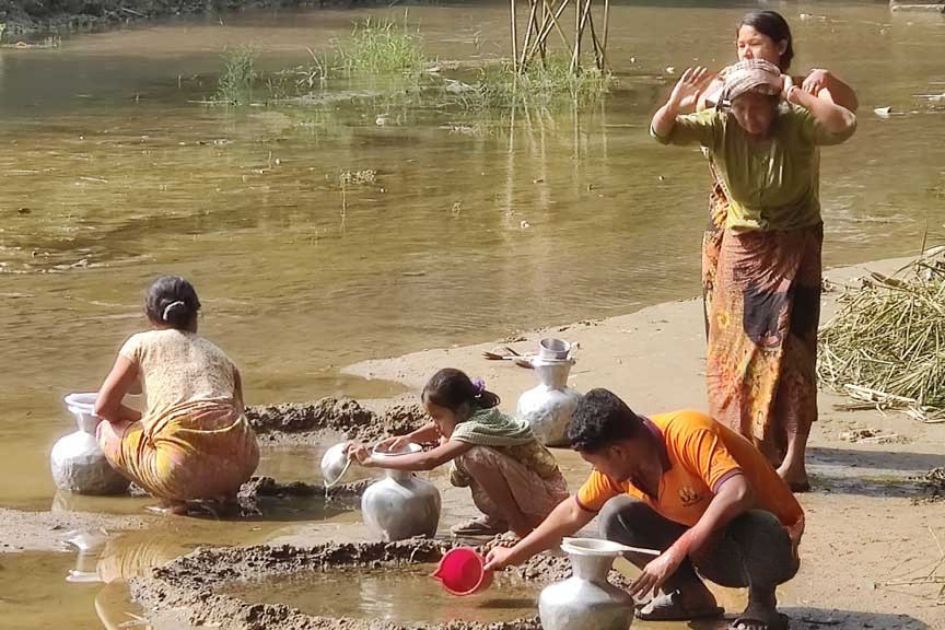



Severe dry-season water shortages in Bandarban hills push communities to depend on unsafe streamside pits, exposing health risks and underscoring impacts of deforestation, weak infrastructure, and inadequate water supply systems.
Water scarcity has worsened in the hills forcing residents to rely on small unsafe “wells” for daily use.
“Vegetation and rocks in the upper soil layer play an important role. When they exist water accumulates naturally. But these sources are being destroyed day by day.”
Even before the end of February an acute water crisis has emerged in the hills. At the start of the dry season water levels in tube wells and ring wells drop sharply. As a result residents are forced to depend on water collected in specially dug pits beside streams for drinking and household use.
These small sources locally known as “kua” are clearly not hygienic.
There is no need to go far to witness the dry season crisis in the hills. The situation is visible in Amtali Marma Para village under Sualak Union in Bandarban Sadar.
The village has one tube well and two ring wells for around 160 families. During the dry season these sources fail to supply enough water. From early morning residents queue up to collect water. Many dig pits beside streams to save time and collect water from these “kua”.
Residents say water scarcity usually begins gradually from the last week of December. While they somehow manage until February the crisis becomes severe from March to May and continues until the monsoon arrives.
Amtali Marma Para is one such settlement. Locals say there is an acute shortage of safe drinking water for most of the year except during the monsoon. While stream water is used for household chores washing and bathing drinking water remains the biggest challenge.
With no alternative they rely on water from these pits near the Sualak stream despite the health risks.
What are these ‘kua’?
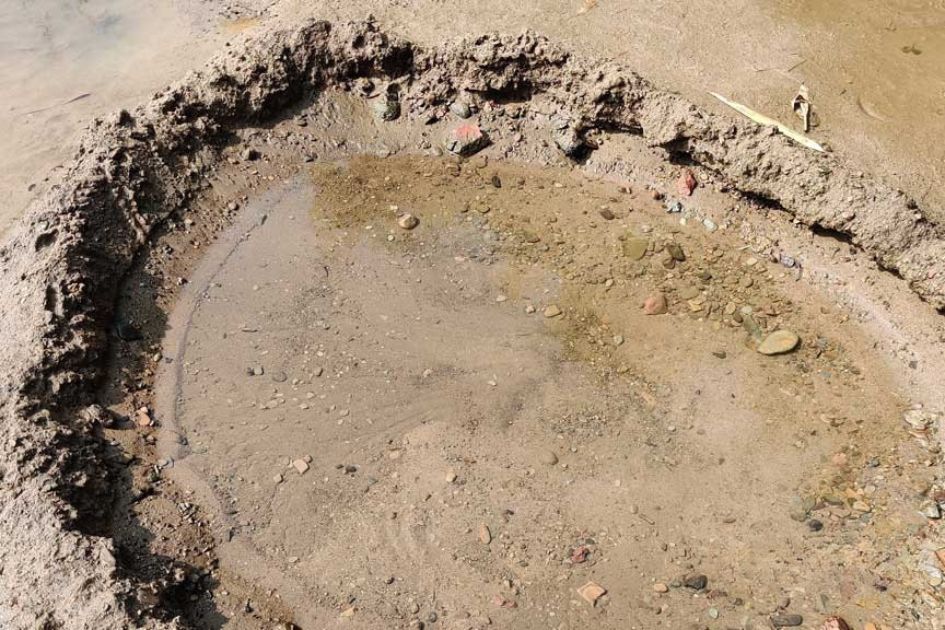
In hilly areas digging pits beside streams or collecting water in rock crevices is known as “kua”. Before digging sand is spread around the area. Water then seeps up from below and collects in the pit.
Since these pits are open and located near streams they are exposed to dust dirt and contamination making them vulnerable to germs.
This method of collecting water is traditional in the hills. In damp rocky or sandy areas water emerges from beneath after digging. It collects over time and is then used.
Before modern water supply systems people from different communities relied on such sources.
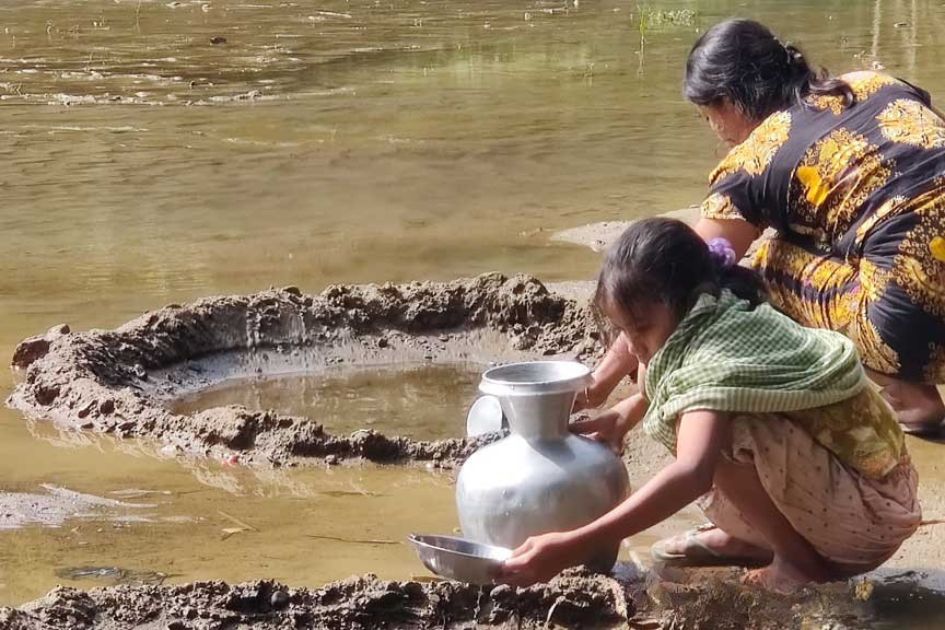
Insufficient water in tube wells
Ussai Ong Marma a resident of Amtali Para says the settlement is over 300 years old. “Back then there were fewer families and dense forests surrounded the area. Streams flowed well and water was available year-round. There was no such severe crisis. People still used to dig pits beside streams for drinking water as there were no tube wells.”
Now with 160 families there is only one tube well and two ring wells. One ring well is for the community and the other for a Buddhist monastery. Water output has declined significantly. People queue early in the morning for a single pitcher of water.
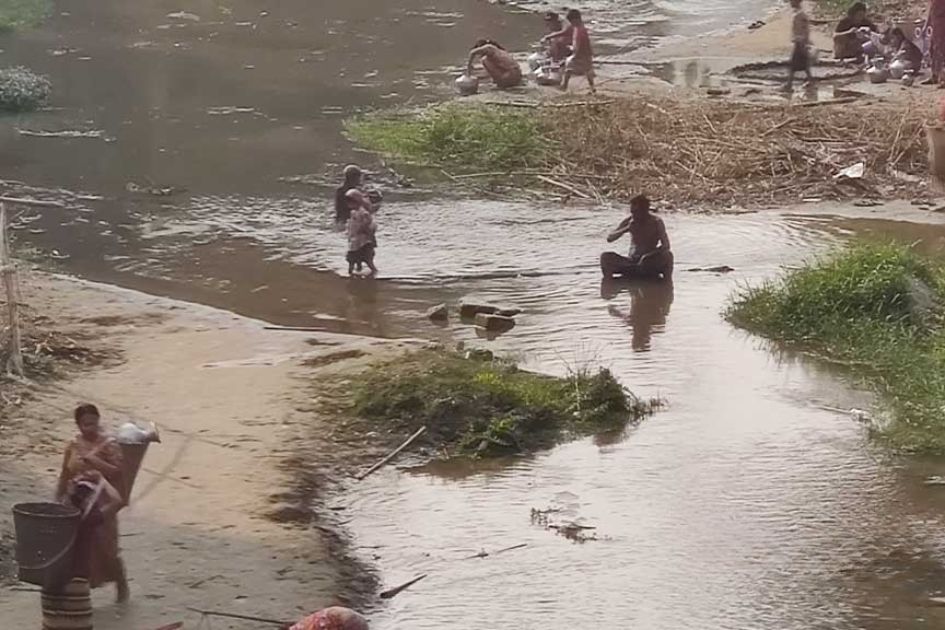
A recent visit showed men and women collecting water from pits beside the Sualak stream. No filtration is used. Water is taken directly with mugs into containers. Nearby some people bathe while others wash clothes.
Maiching Marma said “We finish collecting drinking water in the morning. Now I will take another pitcher while bathing after work. Tube wells require more effort and yield less water. In a few days there will be even less.”
She added that sometimes they collect water from the monastery ring well but its output has also declined.
Asked about waterborne diseases she said “We mostly drink water from the kua. We do not boil it. It is our only source in the dry season. We have not suffered from illness not even diarrhoea. We are used to it.”
Two other women Thoimraching Marma and Hlamraching Marma said during the monsoon stream water becomes muddy making it difficult to dig pits. At that time tube wells and ring wells provide some relief and some residents collect rainwater.
How long can we rely on this?
Resident Suikyaseng Marma said that a few years ago water levels in the Sualak stream dropped dangerously. Even digging pits did not yield enough water. There was not enough water even for bathing and what remained was muddy.
He said upstream stone extraction and deforestation had worsened the situation. “Large rocks were blasted and removed. These activities made the stream water muddy. Although extraction has now stopped the dry season crisis remains.”
He added that tube wells installed by the Department of Public Health Engineering stopped working after one or two years. “They do not go deeper than 200 to 300 feet. If pipes could go down to around 1,000 feet water might be found. We have raised this issue. How long can we keep drinking water from pits?”
Ward member Suikyahla Marma said the two ring wells contain high iron making the water unsuitable for drinking though still usable. Water output also drops in the dry season.
“This time ring wells need to go down to about 600 feet. If that does not work a deep tube well will be installed on the other side of the stream. An application has already been submitted.”
Union Chairman Ukynu Marma said tube wells are ineffective in the area and ring wells are necessary. “We have applied for 10 ring wells for several areas in the union. Two will be installed in Amtali Marma Para. That should reduce the crisis.”
How safe is the water?
Locals claim they have not suffered from diseases despite drinking from these pits. The water appears clear cool in summer and slightly warm in winter. Most do not use filters unless the water looks dirty.
However Dr Dilip Chowdhury resident medical officer at Bandarban Sadar Hospital warned that drinking such water directly is unsafe. “If people have no choice they should at least filter the water and boil it before drinking.”
He added that many patients from both urban and rural areas suffer from waterborne diseases.
‘Unsuccessful zone’ for water supply
Executive engineer Anupam Dey of the Department of Public Health Engineering described Sualak as an “unsuccessful zone” for water supply.
“Despite long efforts we have not been able to resolve the water crisis. Tube wells do not work here. Ring wells are the only option and applications from residents are under consideration.”
Chief scientific officer Mahbubul Islam from the Soil Conservation and Watershed Management Centre said the geological structure of the hills is different.
“The water table is very deep and often trapped between rocks and compact layers. Solutions must match the soil conditions. Vegetation and rocks on the surface help retain water but these natural sources are being destroyed.”
This post is republished from bdnews24.com.




