


New research and grassroots initiatives explore how masculinity, political identity and social norms influence emissions, climate attitudes and participation in environmental action across wealthy nations and climate-vulnerable communities alike today.
A debate gaining momentum in climate scholarship is asking whether gendered norms and identities may shape patterns of consumption, emissions and engagement with environmental action. At the centre of the discussion is a more complex question: how do socially constructed ideas of masculinity intersect with climate responsibility in different economic and cultural contexts?
A recent study titled “Men, Masculinities, and the Planet at the End of (M)Anthropocene,” involving 22 researchers from 13 countries and published in the International Journal for Masculinity Studies, has reignited this debate. The research explores how gendered norms intersect with consumption habits and participation in carbon-intensive sectors while cautioning against simplistic or deterministic interpretations.
The study does not suggest that men are inherently responsible for environmental harm. Instead, it argues that certain dominant or traditional forms of masculinity in specific contexts may be associated with higher emissions and lower engagement with climate action. The authors emphasise variation across individuals, cultures and class backgrounds, framing their findings as patterns rather than fixed traits.
It identifies recurring differences in areas such as transport use, long-distance travel and meat consumption. These behaviours, the authors argue, may contribute to higher average emissions profiles among men in some societies, particularly when combined with structural roles in high-emitting industries and decision-making positions.
The study situates these patterns within broader structural conditions, including economic systems, consumption-driven lifestyles and political ideologies. It notes that these dynamics are especially visible in higher-income countries where climate debates are increasingly polarised and entangled with questions of identity, cost and industrial transition.
Prof Jeff Hearn of the University of Huddersfield, one of the study’s authors, has previously argued that gendered dimensions of environmental impact remain underexplored in mainstream climate policy despite growing academic attention in the field.
Within this wider framework, researchers also examine how climate attitudes are shaped by political identity and economic anxiety. In many contexts, climate change has become embedded in debates over jobs, energy prices and industrial restructuring, particularly in fossil-fuel-dependent economies.
Some scholars use the term “petro-masculinity” to describe how fossil fuel consumption and resistance to environmental regulation can become symbolically linked to strength, autonomy and traditional gender roles. While contested, the concept has gained traction in gender and climate studies as a way of understanding cultural resistance to climate policy.
Alongside this, researchers point to a well-documented pattern known as the “green gender gap”, referring to the tendency in several countries for women, on average, to express higher concern about climate change than men.
Political scientist Amanda Clayton of the University of California argues that this gap is less about increasing female concern and more about declining male concern in wealthier and more politically polarised societies. She links this to the growing politicisation of climate change in high-income countries where environmental policy is often framed through debates over cost, employment and industrial change.
These dynamics, she suggests, intersect with identity in male-dominated sectors, reinforcing divisions in public attitudes towards climate action and transition pathways.
Against this backdrop of academic debate, lived experience and practice suggest that engagement with climate action is also shaped by identity, purpose and how environmental responsibility is communicated.
Mike Smith, a former US Navy fighter pilot who spent more than a decade in military aviation, later transitioned into reforestation and carbon offset work. He describes this shift as moving from a high-intensity military career to ecological restoration and climate-focused work.
A formative childhood experience of witnessing a major wildfire in Idaho stayed with him into adulthood. On returning years later, he was struck not only by visible environmental change but also by landscapes that had not recovered. That experience ultimately influenced his decision to work in ecosystem restoration and large-scale tree planting.
Today, Smith works in climate technology and reforestation initiatives aimed at restoring degraded landscapes and supporting emissions reduction efforts. He also notes a recurring pattern in climate spaces: women often appear more engaged than men in environmental discussions, reflecting trends identified in academic research.
He argues, however, that engagement depends less on gender itself and more on whether climate action is framed in ways that connect with identity, purpose and practical relevance in everyday life.
In parallel, dialogue-based approaches developed by climate educators such as psychologist Vidar Vetterfalk of the Swedish organisation MÄN focus on emotional engagement with climate issues. Participants are encouraged to reflect on personal experiences of nature, loss and responsibility in a non-judgemental setting, though such programmes often struggle to reach those least engaged in climate discourse.
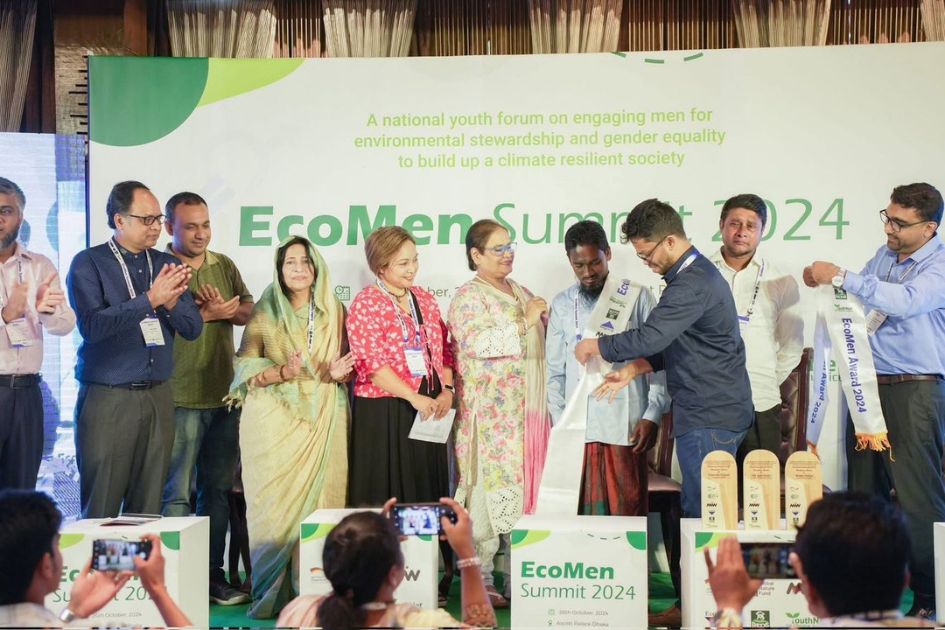
In Bangladesh, similar questions around masculinity, responsibility and environmental justice are being explored through youth-led initiatives that link climate vulnerability with gender transformation.
In coastal and climate-affected areas such as Shyamnagar in Satkhira, the EcoMen initiative works with men and boys through courtyard discussions and community workshops. Rather than relying on abstract policy discussions, the programme encourages reflection on how social norms shape ideas of care, responsibility and leadership in relation to environmental protection and climate resilience.
The initiative is implemented by YouthNet Global and forms part of its broader work on gender-transformative climate action in frontline communities. Discussions often connect lived experiences of floods, salinity intrusion and livelihood loss with wider questions of inequality, responsibility and collective survival.
Participants describe these sessions as distinct from conventional training spaces, particularly because they allow open discussion of emotions, fears and environmental concerns among men in community settings.
According to Sohanur Rahman, executive coordinator of YouthNet Global, the approach reflects a broader shift in how climate justice is understood at the grassroots level.
“EcoMen shows that climate justice requires accountability from men and boys and a shift from control-based masculinity to care-based leadership in frontline communities,” he said.
While emerging from different contexts, both academic research and field experiences converge on a shared insight: climate action is not only a technical or policy challenge but also a cultural and psychological one shaped by identity, meaning and social norms.
Efforts to expand engagement are also visible in how climate solutions are being reframed. Renewable energy and electric mobility, for instance, are increasingly presented not only as environmental necessities but also as high-performance, practical technologies that meet everyday needs.
Researchers suggest that such framing may help broaden participation by linking climate action to widely valued ideas such as efficiency, reliability and independence rather than positioning it solely as sacrifice or restriction.
Ultimately, the debate does not reduce climate responsibility to gender. Instead, it highlights how social norms, political identity and economic context shape how people understand and respond to environmental change.
From wildfire-affected landscapes in the United States to community courtyard discussions in coastal Bangladesh, a shared question emerges: how can climate action become a source of purpose that resonates across identities while still addressing the structural drivers of environmental harm?
Rather than offering a single answer, both research and practice point to a more tentative conclusion: lasting engagement may depend less on assigning blame and more on reshaping the narratives through which responsibility, care and collective futures are understood.




