

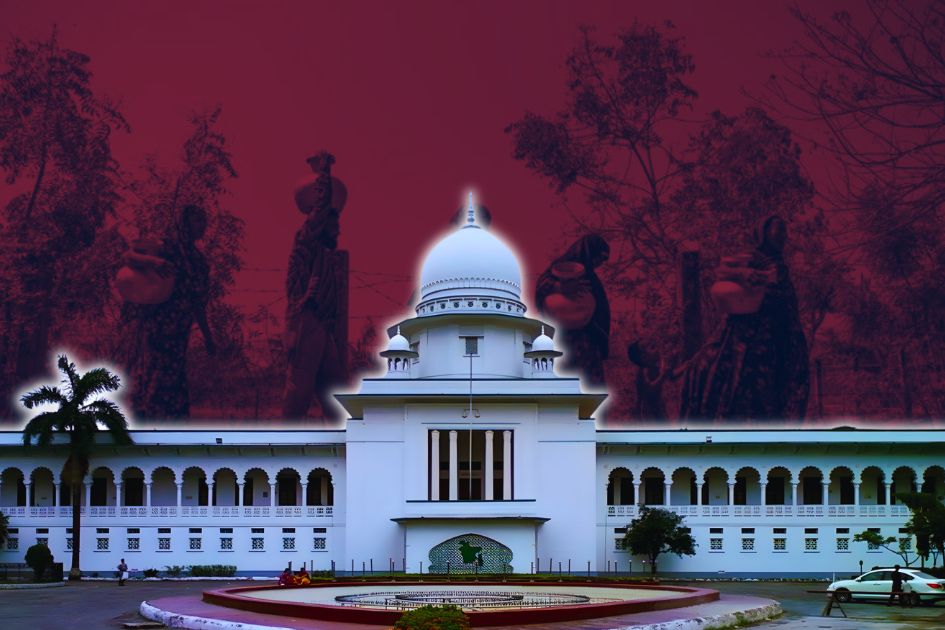



The order follows a writ petition citing salinity, falling groundwater levels and long journeys by residents, including women and children, to collect drinking water in coastal Satkhira.
The High Court has issued a rule directing that the supply of safe and adequate drinking water be ensured for the residents of Shyamnagar Upazila in the coastal district of Satkhira in southwestern Bangladesh.
Simultaneously, the High Court bench comprising Justice Ahmed Sohel and Justice Fatema Anwar issued an order, following the preliminary hearing of a writ petition on Sunday (August 9), directing the Chief Engineer of the Department of Public Health Engineering and the Deputy Commissioner of Satkhira to submit a progress report to the court within 60 days, in the form of an affidavit, regarding the measures taken by the state to supply safe drinking water to the residents of Shyamnagar Upazila.
Supreme Court lawyer Barrister Mohammad Humayun Kabir Pallab argued the case on behalf of the organization that filed the writ petition, assisted by lawyers Barrister Md. Kawsar, Maksudur Rahman and Maruf Hasan Tamal.
Earlier, Supreme Court lawyers Barrister Mohammad Humayun Kabir Pallab, Barrister Md. Kawsar and Advocate Maruf Hasan Tamal sent a legal notice on behalf of the human rights organization Law and Life Foundation Trust, demanding the assurance of a safe and adequate drinking water supply for the residents of Shyamnagar Upazila in Satkhira.
The notice was sent to the Secretary of the Ministry of Local Government, Rural Development and Co-operatives; the Secretary of the Ministry of Water Resources; the Director General of the Directorate General of Health Services; the Chief Engineer of the Department of Public Health Engineering; the Executive Director of the Bangladesh Water Development Board and the Deputy Commissioner of Satkhira.
Subsequently, a writ petition was filed with the High Court against the same authority, seeking a directive to ensure the supply of safe and adequate drinking water for the residents of Shyamnagar.
During the hearing, it was stated that the right to safe and pure water is a component of citizens’ fundamental rights under Article 32 of the Constitution and ensuring this right is a constitutional obligation of the state.
The writ petition noted that Shyamnagar Upazila has been facing a long-standing crisis regarding potable water. Most tube wells have become non-functional due to the depletion of the groundwater level and excessive salinity. This crisis intensifies significantly every year between April and July.
The hearing noted that the right to safe and pure water is a fundamental right of citizens under Article 32 of the Constitution and ensuring this right is a constitutional obligation of the state.
Many residents of the area are compelled to travel long distances to obtain safe water, while women and children spend hours collecting it.
The writ petition states that Shyamnagar has been facing a prolonged crisis of pure water due to the depletion of the groundwater table and severe salinity.
Residents of the upazila’s Dhumghat, Harinath and Munshiganj areas, including many men and women like Shefali Rani Mondal, have to walk several kilometers and cross a river every day to collect drinking water. The writ petition states that ensuring access to potable water is the responsibility of the state, falling under the right to life recognized by the Constitution.
Citing the example of Shefali Rani Mondal, a resident of the Dhumghat area in Shyamnagar Upazila, it is noted that she collects water daily by walking several kilometers and swimming across a river. This practice is having a negative impact on family life, children’s education and the social fabric.




