


More than 500 families in Pabna say a solar power project displaced them from ancestral land, exposing tensions between renewable energy expansion, land rights, compensation and climate justice.
A renewable energy project intended to support Bangladesh’s transition to clean power has left more than 500 families homeless in Pabna district, triggering allegations of land grabbing, forced displacement and legal harassment.
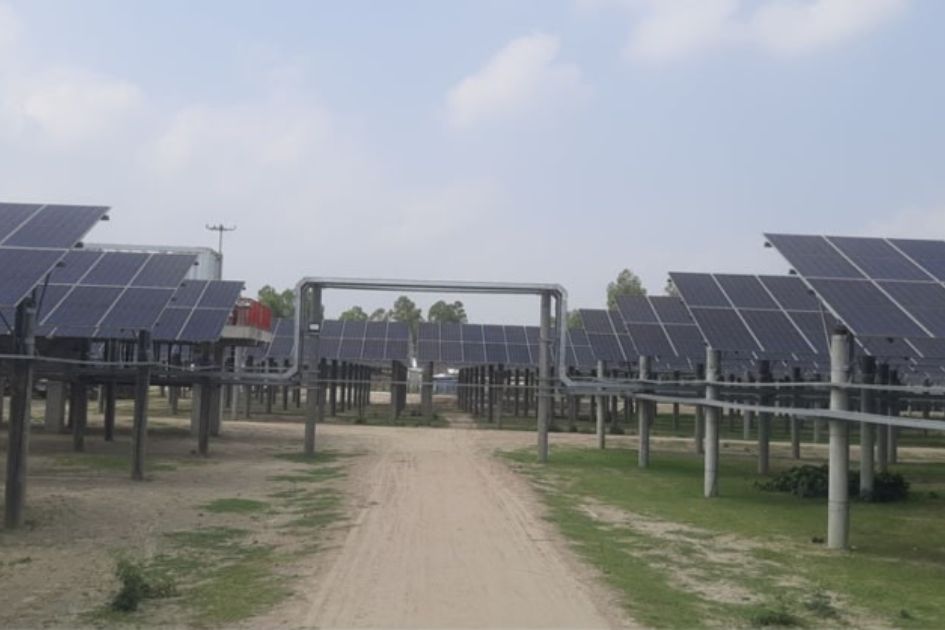
The controversy centers on a 64-megawatt solar power plant in Ramakantapur village along the banks of the Padma River. Developed through a joint venture involving Bangladeshi and Chinese investors, the project occupies approximately 206 acres of agricultural land and has been supplying electricity to the national grid since August 2025.
Residents say the land, once home to hundreds of families and used for productive agriculture, was classified by authorities as state-owned khas land despite generations of occupation by local communities. The designation enabled the land to be leased for the solar facility, they said.
Many affected families allege that the acquisition process was marked by deception and intimidation. According to residents, intermediaries linked to influential political figures from the previous government collected land-related documents, national identity cards and biometric information after promising to help secure legal ownership rights or government compensation.
“They told us the documents were needed to register our land and protect our rights,” one villager said. “Instead, many families lost their homes and livelihoods.”
Several residents further alleged that people who protested against the project faced legal cases, detention and other forms of harassment. These allegations could not be independently verified.
The solar park authority declined to comment on specific allegations of fraud, coercion or intimidation. However, project representatives said the facility was established in accordance with applicable laws and regulatory requirements.
Despite the project’s commercial operation, the dispute over land rights and displacement remains unresolved.
Pabna Deputy Commissioner Aminul Islam acknowledged the hardship faced by affected families but said compensation is constrained by existing legal provisions.
“The land is officially recorded as khas land in government records,” he said. “As the occupants do not possess formal ownership documents, they are not eligible for compensation under the current legal framework.”
He added that the district administration is exploring options to rehabilitate displaced families by identifying alternative government-owned land for resettlement.
Commenting on the issue, Sohanur Rahman, Executive Coordinator of YouthNet Global, said the dispute highlights a growing “just transition gap” in renewable energy development.
“Bangladesh’s renewable energy transition must not come at the cost of rural livelihoods. While expanding clean energy is essential, environmental progress cannot advance faster than social safeguards. Solar development is not only an energy issue but also a question of land justice, fair compensation and community participation,” he said.
Rahman said greater emphasis should be placed on transparent consultation, benefit-sharing, protection of food systems and innovative alternatives such as agrovoltaics and floating solar projects to reduce pressure on fertile agricultural land.
“Communities must be recognised as partners in the transition and beneficiaries of its opportunities, not passive recipients of its costs,” he added.
For many residents, however, relocation offers little comfort. Families say they have lost not only their homes but also fertile agricultural land, sources of income and deep-rooted social and cultural connections built over generations.
Rights advocates and development experts say the case highlights a growing challenge facing many countries in the Global South as they expand renewable energy infrastructure to meet climate commitments. While solar and other clean energy projects are widely viewed as essential for reducing greenhouse gas emissions, concerns are increasingly being raised about land rights, community consultation and fair compensation for affected populations.
Bangladesh has pledged to expand renewable energy generation as part of its efforts to address climate change, reduce dependence on fossil fuels and strengthen long-term energy security. However, the dispute in Ramakantapur illustrates the challenges that can arise when large-scale infrastructure projects move forward without broad community consultation and adequate social protections.
The situation underscores the importance of transparency, due diligence and meaningful participation by local communities in development planning. As investigations and discussions continue, the case is likely to become an important test of whether Bangladesh’s clean energy transition can be both environmentally sustainable and socially just.




