





Researchers from three Bangladeshi universities say climate education must better reflect local realities by combining technical expertise with leadership, systems thinking and community-focused learning to support an inclusive green transition.
Bangladesh needs a new approach to climate education and workforce development to prepare for the growing demand for green jobs, according to a new study by researchers from three leading Bangladeshi universities.
The study, titled “Contextualizing Green Skills and Competencies in Climate Education in Bangladesh and the Global South,” published in World Development Sustainability, found that while demand for technical green skills is increasing, existing education and training systems are failing to adequately develop the broader competencies needed for an inclusive and sustainable green transition.
The research represents a significant academic collaboration among the University of Liberal Arts Bangladesh (ULAB), a private university in Bangladesh, the Independent University, Bangladesh (IUB), a private university in Bangladesh, and BRAC University, a private university in Bangladesh, bringing a Bangladesh-led perspective to the global discussion on green skills and climate education.
The study explored how education systems can better respond to Bangladesh’s climate vulnerabilities, labour market realities and future workforce needs while contributing to the broader green transition agenda in the Global South.
At a time when Bangladesh is expanding renewable energy, promoting climate-resilient industries and seeking new employment opportunities for its growing workforce, the findings highlight the urgent need to align education and training with emerging green sectors.
Technical Green Skills in High Demand
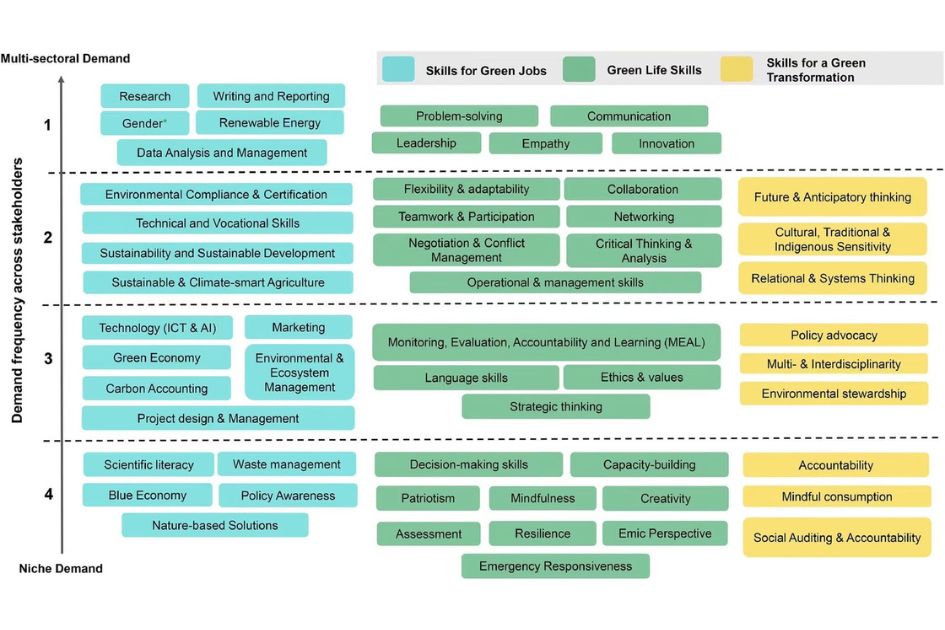
The study found strong demand for technical competencies related to renewable energy, waste management, environmental research and data analysis.
As Bangladesh moves toward cleaner energy systems and sustainable development pathways, these skills are becoming increasingly important for future employment opportunities.
However, the research warned that technical knowledge alone will not be sufficient to achieve a successful green transition.
A future-ready workforce will require a combination of technical expertise, human-centred skills and transformative abilities to address complex climate challenges.
Communication, Leadership and Empathy Emerging as Critical Skills
The research identified communication, leadership, empathy, teamwork and problem-solving as some of the most important green life skills required by employers and institutions.
The findings suggest that climate action increasingly depends on collaboration among governments, businesses, communities and civil society organizations.
Workers engaged in green sectors must be able to communicate effectively, understand community needs and develop solutions that are environmentally sustainable and socially inclusive.
Transformative Skills Remain Underdeveloped
The study highlighted a significant gap in transformative skills, including systems thinking, policy advocacy, cultural sensitivity and the ability to understand connections between environmental, social and economic challenges.
These skills are essential for addressing climate change as a complex issue involving livelihoods, inequality, governance and social justice.
Despite their importance, transformative skills remain weakly integrated into climate education curricula in Bangladesh.
Global Frameworks Need Local Perspectives
The research argues that many existing global green skills and climate education frameworks remain too broadly defined and often fail to reflect the realities of countries in the Global South.
The study noted that education models developed without sufficient consideration of local climate vulnerabilities, labour market conditions, cultural contexts and community knowledge can create a mismatch between training programs and actual employment needs.
The authors argued that green skills solutions for Bangladesh and other climate-vulnerable countries must be developed with local knowledge, community experiences and regional realities at the centre.
Curriculum Reform Urgently Needed
Although Bangladesh has made policy commitments toward renewable energy expansion, climate action and sustainable development, limited curriculum reform continues to slow progress in green skills development.
The study called for climate education and green competencies to be integrated across schools, universities, technical institutions and vocational training programs.
It recommended multidisciplinary learning approaches combining science, technology, social sciences, governance and community-based knowledge.
The authors emphasized that South-led research and context-specific education models are essential for reducing the gap between global climate ambitions and local workforce realities.
Key Findings of the Study
- Technical green skills such as renewable energy, waste management and data analysis are increasingly demanded across sectors.
- Communication, leadership, empathy and problem-solving are among the most valued green life skills.
- Transformative skills such as systems thinking and cultural sensitivity remain neglected despite their importance.
- Stronger links between education systems and labour market demands are needed to prepare youth for future green employment.
- Community-centred and locally relevant training programs are essential for an inclusive green transition.
Youth, Women and Vulnerable Communities Must Be Included
The study stressed that green skills development is particularly important for Bangladesh’s young population as new opportunities emerge in renewable energy, climate adaptation, sustainable agriculture, waste management and other green sectors.
The research also highlighted the importance of ensuring that women, marginalized groups and climate-vulnerable communities have equal access to green employment opportunities.
A just transition, the study noted, must ensure that economic transformation does not leave behind the communities most affected by climate change.
Building a Green Skills Revolution
The authors urged policymakers, educational institutions, businesses and development organizations to collaborate in designing training programs that reflect Bangladesh’s environmental challenges and economic realities.
The study stressed that green skills development should go beyond preparing workers for specific industries and focus on creating innovative problem-solvers capable of leading climate action.
As Bangladesh moves toward a low-carbon and climate-resilient future, investing in people and skills will be as important as investing in green technologies.
The study concluded that the country’s success in building a sustainable green economy will depend on developing a skilled, inclusive and locally grounded workforce capable of driving long-term transformation.




