

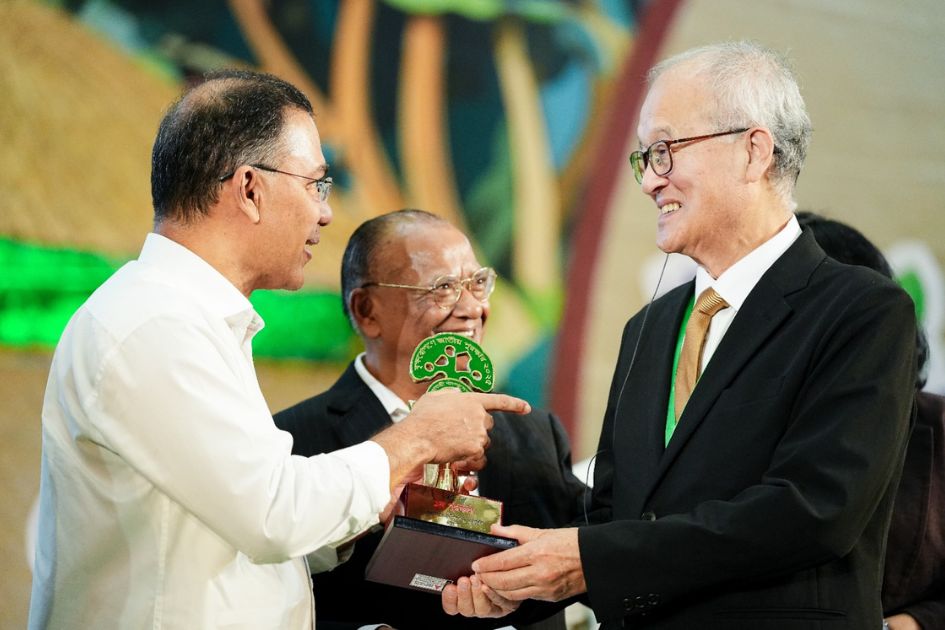

The recognition highlights decades of afforestation, ecosystem restoration and sustainable industrial planning that have transformed KEPZ into a nationally recognised model for balancing industrial growth with environmental conservation.
Korean Export Processing Zone (KEPZ) has secured first place in Bangladesh’s National Tree Plantation Award 2025 in recognition of its outstanding contribution to environmental sustainability and afforestation in the country.
Kihak Sung, chairman and chief executive officer of Youngone Corporation and KEPZ, received the award from Bangladesh’s Prime Minister Tareq Rahman on Thursday (July 9).
The award recognises KEPZ’s visionary leadership in transforming once barren land along the banks of the Karnaphuli River in Chattogram, Bangladesh, into one of the country’s largest environmentally friendly private industrial zones. Through decades of continuous afforestation, ecosystem restoration and environmentally sustainable industrial development, KEPZ has established a model in which economic progress and environmental conservation advance together. The award also acknowledges the organisation’s long-term commitment to building a greener future while setting a national benchmark for sustainable industrialisation.
Built on 2,492 acres of previously barren land in Karnaphuli, Chattogram, KEPZ has preserved 52 percent of its total area as forestland, botanical gardens, lakes, ponds of various sizes and open green spaces. The remaining 48 percent has been allocated for industrial and infrastructure development.
Since taking ownership of the land in 1999, KEPZ has planted more than three million trees across the area. It continues to plant around 200,000 additional trees every year. Researchers from the University of Chittagong have identified and documented more than 400 plant species within the zone. The botanical garden is directed by Dr Mohammad Kamal Hossain, supernumerary professor at the Institute of Forestry and Environmental Sciences at the University of Chittagong.
He said the site is currently home to around 1,400 plant species, including rare and endangered native species. A target has been set to increase that number to 1,850 by 2027. If achieved, it will become the country’s largest protected botanical garden and serve as a major research centre for researchers, teachers, students and tree enthusiasts.
Under its water conservation programme, KEPZ has constructed 37 reservoirs capable of storing more than 600 million gallons of rainwater. There are plans to expand that capacity to one billion gallons in the future. The restored ecosystem has now become a habitat for 292 animal species, including 11 species of mammals, 159 species of birds, nine species of reptiles, seven species of amphibians, 86 species of butterflies and 20 species of dragonflies and damselflies.
Youngone Corporation, founded by Kihak Sung, has been operating in Bangladesh since 1980. The company has earned widespread recognition for incorporating environmental conservation, worker welfare and sustainable industrialisation as integral parts of its long-term investment strategy.
Mushfikur Rahman, deputy general manager of KEPZ, said the National Tree Plantation Award 2025 is national recognition of KEPZ’s vision in which industrial development and environmental conservation complement each other.
“It is recognition of an ideal model for sustainable economic growth in Bangladesh. This is one of the country’s highest national honours for environmental conservation and a significant milestone on Bangladesh’s path towards green industrialisation,” he said.




