

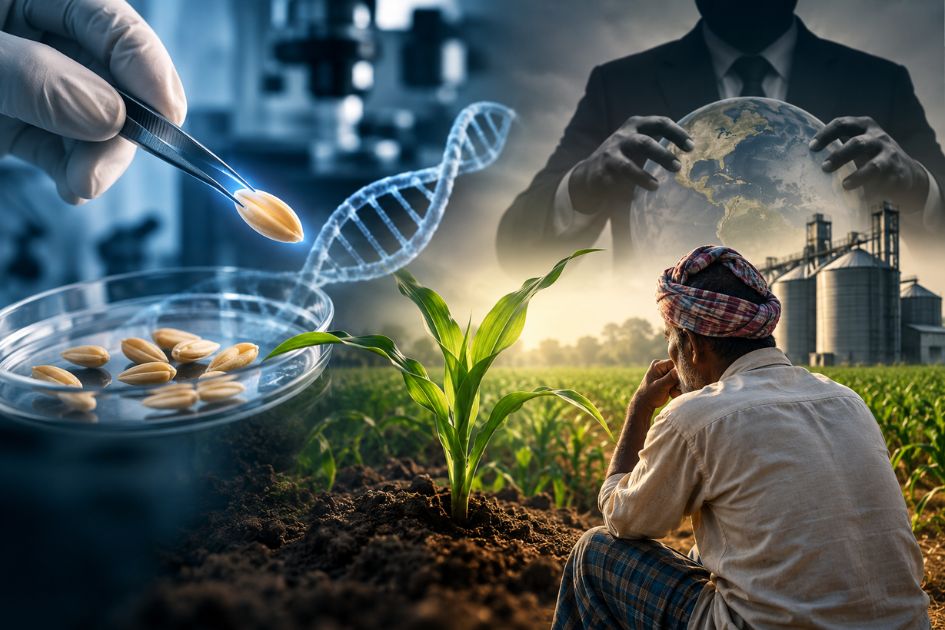



Pakistan’s GMO debate raises concerns over farmer dependence, indigenous seed protection and food-chain control, with calls for careful assessment of environmental conditions and potential risks.
Over the millennia of human history, two sides of human nature have greatly influenced its course. First, curiosity, and secondly, the quest for power and control.
As for curiosity, humans travelled to the outer orbit of the Earth, I mean the Moon, and they went down to the crust of the Earth. They have extracted pearls from the bosom of the sea, and they have flown like birds in nature. So, curiosity took us this far. And still, from the wheel to the Internet, and from the world to a global village, this journey is the result of human curiosity.
Curiosity has always pushed human beings far beyond the natural boundaries. Human curiosity has sometimes gone against the laws of nature, but yet they have proved and brought something back to humanity for its ease and comfort. But the excess of everything is bad, and everything should have a limit. That’s what I think, because nature is designed in a way which is favourable in terms of nutrition and protection for humans.
Now, human beings are deliberately trying to alter the nature of things, which sometimes turns devastating. Human curiosity about gene alteration of seeds, deliberately or technically, has brought humans to this point where they are changing the DNA of seeds and making them the way they desire them to be. So, to get the desirable outcome from seeds, the seed is genetically modified nowadays.
A genetically modified seed is a seed which is deliberately modified in a laboratory, making it adjustable to the outer environment. This is a genetically modified seed. To argue whether it is good or bad should be left to other people. It has not yet been proven that it is bad for human health or other things, but it is also not proven that it could quench the thirst or hunger of humans on Earth.
So, I’m not saying whether it is good or bad. The question is: why should it be allowed? And if it comes, if it is inevitable, the government must take very precise action so that this may not go to a tech company or a singular entity which controls the food sector, which should rule over the food sector.
Food is universally needed. It should not be controlled like other tech giants.
Whenever we hear about technology, we directly conclude that the advancement of technology is for the betterment of humanity and that it always brings better results to human history or human life. So, it is not the case. In many cases, we must analyse the very dark side of technology.
With GMO technology, many people or countries are not directly jumping to the conclusion that, yes, it is good and let’s go GMO. There are a lot of countries that have shown their concerns about it, like Mexico, the European Union, and Russia. They have their concerns and are not letting GMOs be easily adopted. They have concerns and, keeping those concerns in mind, they are deliberately, carefully, and precisely trying to analyse the risks of GMOs.
Russia went a bit further. Putin said that those who will grow GMOs will be considered terrorists. Why is he doing this?
As for Pakistan, Pakistan is trying to adopt GMO seeds, but there are certain factors which the Pakistani Agriculture Ministry and the people of Pakistan should recognise before blindly adopting GMOs.
We have the example of Bt cotton, which did not have the favourable results or the desirable results Pakistan sought from it. And the PKRC, Pakistan Kisan Rabta Committee, has opposed the agriculture bill, which was passed on 31 August 2026, and which has indicated the normalisation of GMOs and their adoption.
So, for Pakistani farmers and the Pakistani Agriculture Ministry, they should not go blindly for that. First, they have to analyse the very soil and the environmental conditions of the soil: what kind of seed it requires, how it will work, and whether GMO seeds would survive here.
So, before properly analysing all those factors, after that, if the result is okay, yes, they should go, but with some limits. They should not let a few companies or a few people control the food chain.
To conclude, I would say that the reason why the world is sceptical about GMOs is because of the pattern in human history, the same pattern repeating again and again. We have had many technological advancements which promised more, a lot more, but ended up enslaving us to our needs and made us dependent upon a few things.
So, keeping that pattern in mind, the whole world is sceptical about it. But yet, if one goes alongside this scepticism, one must properly analyse the factors as to how it would be imported, how it would be distributed, and what will ensure the safety of indigenous seeds and health.




