

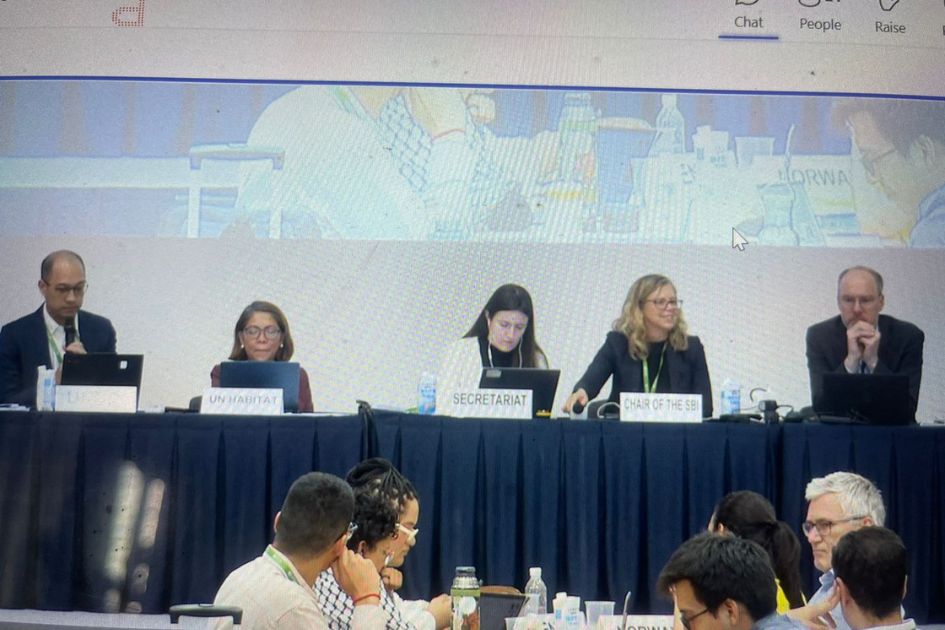



Talks in South Korea exposed sharp divisions on finance, food systems and ocean governance, as countries debated how to turn just transition commitments into actionable, equitable climate solutions.
Global dialogue on just transition entered a more politically charged and implementation-focused phase in Yeosu, South Korea, as governments and stakeholders debated how to translate climate commitments into concrete action on food systems, ocean economies and future institutional arrangements under the UNFCCC.
The fifth dialogue ended Saturday under the United Arab Emirates Just Transition Work Programme (JTWP), bringing together delegates from Bangladesh, India, Brazil, Saudi Arabia, the Philippines, Germany, Chile, South Africa, Egypt, Japan, Norway, the United Kingdom, Vanuatu and others, alongside civil society organisations, women and gender groups, trade unions, Indigenous Peoples, youth constituencies, workers’ groups and international agencies.
While there was broad agreement on the importance of a just transition, the talks exposed clear divisions over finance, governance, sovereignty and the pace of implementation.
AGROECOLOGY GAINS GROUND BUT FARMER INCOME SUPPORT DIVIDES DELEGATES
Agriculture emerged as one of the most convergent areas, with widespread recognition that agroecology, agroforestry and circular economy approaches are central to climate-resilient and sustainable food systems.
Delegates from India, Brazil, the Philippines and Germany highlighted that agroecological systems restore soil health, strengthen biodiversity, reduce reliance on chemical inputs and improve long-term agricultural productivity after an initial transition phase.
However, differences emerged over how farmers should be supported during this shift.
Developing country delegations, farmers’ organisations and civil society actors called for stronger income protection, including social safety nets, price stabilisation mechanisms and guaranteed income support to safeguard rural livelihoods during transition periods. Speakers warned that without income security during the transition, agroecology risks becoming a promise without protection for farmers.
Several developed country delegations, including the European Union and Japan, emphasised building on existing subsidy reforms and market-based incentives, cautioning against approaches that could create additional fiscal pressure or distort markets.
The debate reflected a broader divide between structural income security approaches and incremental reform within existing agricultural policy systems.
The COP28 UAE Declaration on Sustainable Agriculture, Resilient Food Systems and Climate Action, endorsed by 159 countries, was cited as a key reference point for integrating food systems into national climate strategies.
OCEAN TRANSITION TALKS HIGHLIGHT TENSIONS OVER FISHING RIGHTS AND GREEN ENERGY
Ocean-based climate action exposed some of the most visible tensions of the dialogue, particularly over access to marine resources and coastal livelihoods.
While there was broad agreement on mangrove restoration, marine protected areas, sustainable aquaculture and blue carbon initiatives, several delegations including the Philippines, Chile, Brazil and small island states stressed that ocean ecosystems are central to food security and resilience.
Civil society groups and some delegations raised concerns that offshore renewable energy expansion and marine spatial planning are restricting traditional fishing grounds without adequate consultation or compensation. This triggered pushback from several countries, including Saudi Arabia and others, which stressed national sovereignty over marine zones and cautioned against externally driven interpretations of ocean governance.
Labour conditions in fisheries also emerged as a sensitive issue, with calls for stronger protection of fishers, recognition of informal workers and ratification of ILO Convention 188 receiving mixed responses.
The exchanges reflected growing friction between expanding ocean-based climate solutions and safeguarding long-established coastal livelihoods.
JUST TRANSITION MECHANISM TALKS REVEAL STRONGEST DIVISIONS
The most politically sensitive debates centred on the future Just Transition Mechanism and its relationship with the JTWP.
Delegates broadly agreed that the JTWP, supported by countries including South Africa, India, Brazil, Germany, Egypt and Vanuatu, has become a key platform for dialogue, knowledge exchange and shared understanding of just transition pathways across sectors.
However, positions diverged sharply on the design and mandate of a future mechanism.
Developing countries, least developed countries, small island states, youth constituencies (YOUNGO) and civil society organisations called for a strong implementation-focused mechanism capable of mobilising finance, supporting capacity building and enabling technology transfer for vulnerable countries and communities.
In contrast, several developed countries including the United Kingdom, Japan, Norway and Saudi Arabia stressed that any mechanism must remain party-driven, non-prescriptive and aligned with national sovereignty and existing UNFCCC structures.
A further point of divergence emerged on accountability, with proposals for enhanced tracking and transparency met with caution from several parties, who warned against additional reporting burdens or quasi-compliance frameworks.
“Implementation support must be at the heart of the mechanism, including making finance more accessible through grant-based windows and direct access for farmers and fishers,” said Marie Cosquer of Action Against Hunger (ACF).
Teresa Anderson, Global Lead on Climate Justice at ActionAid International, said the JTWP “can play a stronger role in encouraging fund pooling, while the mechanism should guide funding bodies and help develop shared principles that can inform COP30 outcomes.”
Sohanur Rahman, Executive Coordinator of YouthNet Global, said just transition pathways in food systems cannot be implemented without predictable, accessible and concessional climate finance. He noted that the current financial architecture remains fragmented and insufficient for countries with limited fiscal space to translate NDCs and NAPs into bankable and implementable pipelines.
He called for strengthened international cooperation that goes beyond pledges and enables direct access modalities, community-based finance windows and simplified investment pathways for vulnerable countries.
On technology transfer, he underscored the importance of context-appropriate, open and accessible solutions, stressing that climate-resilient agriculture, early warning systems and adaptive coastal technologies must not be constrained by restrictive intellectual property regimes, but should instead support locally led innovation and adaptation.
He further highlighted agroecology and nature-based solutions, including mangrove restoration and sustainable coastal fisheries, as central pillars of food security, adaptation and mitigation co-benefits in delta systems.
He supported a just transition mechanism that is implementation-oriented, inclusive and responsive to country realities, particularly those facing the most severe climate risks.
FINANCE GAP REMAINS CENTRAL UNRESOLVED FAULT LINE
Across all thematic areas, finance remained the most persistent dividing line.
Developing countries, including Burkina Faso, South Africa, Egypt and the Philippines, alongside civil society actors, stressed that fragmented and difficult-to-access climate finance remains the primary barrier to implementing just transition pathways, particularly for farmers, fishers and local communities.
Developed country delegations, including Germany, Norway and the European Union, emphasised improving coordination, efficiency and coherence of existing financial flows rather than expanding new funding obligations.
This structural divide shaped much of the negotiation dynamic, even where agreement on broader principles was evident.
LOOKING AHEAD TO BONN AND COP31
The outcomes of the Yeosu dialogue are expected to feed into upcoming UNFCCC processes, including the 64th Sessions of the Subsidiary Bodies in Bonn, Germany, from 8 to 18 June 2026, and COP31 in Antalya, Türkiye, in November 2026.
While there was broad support for continuing the Just Transition Work Programme, the talks made clear that the next phase will be defined less by conceptual convergence and more by unresolved questions over finance, governance design, sovereignty and implementation responsibility.
Across countries and constituencies, a shared message emerged: the credibility of just transition will ultimately depend not on negotiated language, but on whether it delivers fair, adequately financed and locally grounded outcomes for those most affected by climate and economic transformation.




