




Bangladesh’s wind energy ambitions face delays as policy uncertainty, weak infrastructure and financing gaps slow progress, even as industries push for renewable power and experts highlight untapped coastal potential.
Bangladesh’s push to scale up wind power is moving slowly despite large untapped potential, as policy uncertainty, weak infrastructure and financing gaps continue to stall projects in a sector seen as critical for reducing dependence on imported fossil fuels.
The country imports nearly 95 percent of its commercial energy, leaving it exposed to volatile global fuel markets. While renewable energy is increasingly seen as a strategic alternative, wind power still contributes less than 1 percent of electricity generation and overall renewables account for under 3 percent.
The government has set a target of generating 10,000 megawatts of electricity from solar by 2030 as part of efforts to ensure the country’s energy security.
Vast potential, limited deployment
A 2018 study by USAID and the U.S. National Renewable Energy Laboratory estimated that Bangladesh’s wind power capacity could be expanded from about 60 megawatts to as much as 30,000 megawatts, particularly along its long coastal belt and offshore zones.
However, actual development has lagged far behind projections. Experts and developers cite weak wind resource data, limited grid readiness, financing constraints and complex logistics as key barriers.
First utility-scale project remains an exception
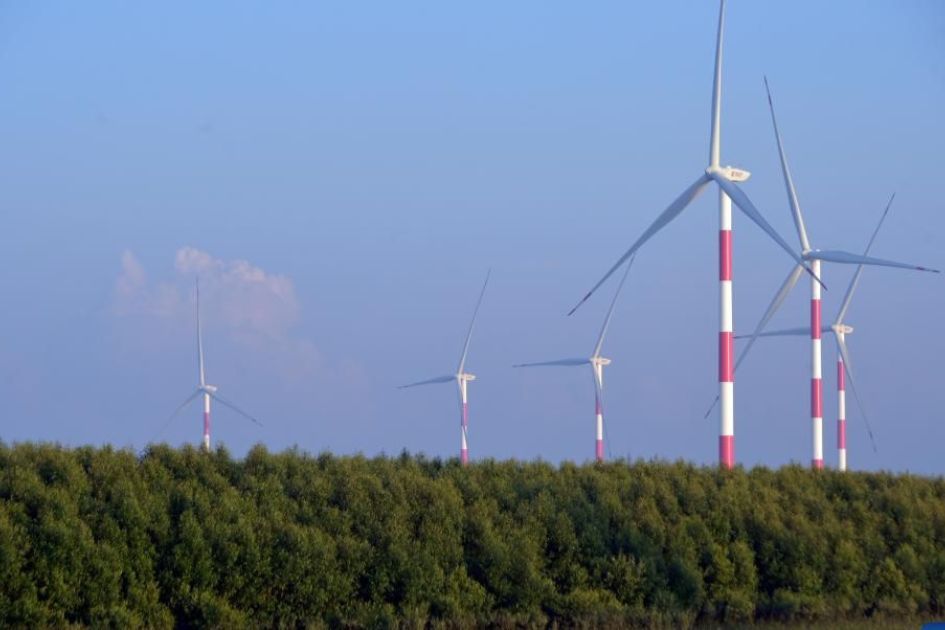
The Khurushkul wind facility near Cox’s Bazar remains Bangladesh’s only operational utility-scale wind project.
Project manager Mukit Alam Khan said newer turbine technology has made wind generation viable even in relatively low wind conditions.
“The latest turbines can operate efficiently in Bangladesh’s wind profile and open the door for coastal and offshore expansion,” he said.
But he acknowledged major practical constraints, including transporting large turbine components.
“Blades and towers cannot be moved by road. We had to rely on river and sea transport using specialised barges,” he said.
Offshore ambitions slowed by policy uncertainty
A 500-megawatt offshore wind project planned near the Cox’s Bazar coast, approved in 2023 and initially positioned as Bangladesh’s first large-scale offshore wind farm, has faced repeated delays.
The project, backed by Denmark’s Copenhagen Infrastructure Partners with interest from international corporate buyers including global apparel brands, has been affected by political transition and subsequent policy review following the 2024 change in government.
The interim administration’s reassessment of energy contracts led to delays and restructuring within the project consortium, including changes in local partnerships.
Industry sources say the uncertainty has slowed momentum in what was expected to be a landmark offshore wind development.
Industry demand driving renewable shift
Export-oriented industries, particularly the garment sector, are increasingly pushing for renewable energy access to meet global emissions requirements.
“The textile sector is under growing pressure from international buyers to decarbonise,” said Mahyuddin Rubel, director of Denim Expert Ltd. “Direct access to renewable power could significantly improve competitiveness.”
A recent regulatory change now allows private renewable energy producers to sell electricity directly to commercial users, a shift widely seen as a breakthrough after years of state monopoly over power sales.
Civil society push for faster transition
Sohanur Rahman, Executive Coordinator of YouthNet Global, said Bangladesh’s renewable energy transition must move beyond targets and focus on delivery and accountability.
“Energy transition will only be meaningful if it is fast, transparent and inclusive, with renewable projects moving from commitments on paper to real implementation on the ground,” he said.
Infrastructure and data gaps remain critical
Despite policy changes, analysts warn that structural constraints continue to limit progress.
Energy expert Shafiqul Alam said offshore wind development requires an entire supporting ecosystem.
“This includes staging ports, heavy-lift equipment, specialised vessels, transmission infrastructure and reliable wind data,” he said, adding that data gaps remain a major challenge for investment decisions.
Outlook
Bangladesh’s wind sector sits at a crossroads. While technical studies suggest significant long-term capacity, scaling up will depend on stable policy direction, stronger infrastructure investment and improved investor confidence.
For now, Khurushkul stands as a rare proof of concept rather than the beginning of a wider rollout.
As global energy transition pressures intensify, the challenge for Bangladesh is no longer potential but execution.




