

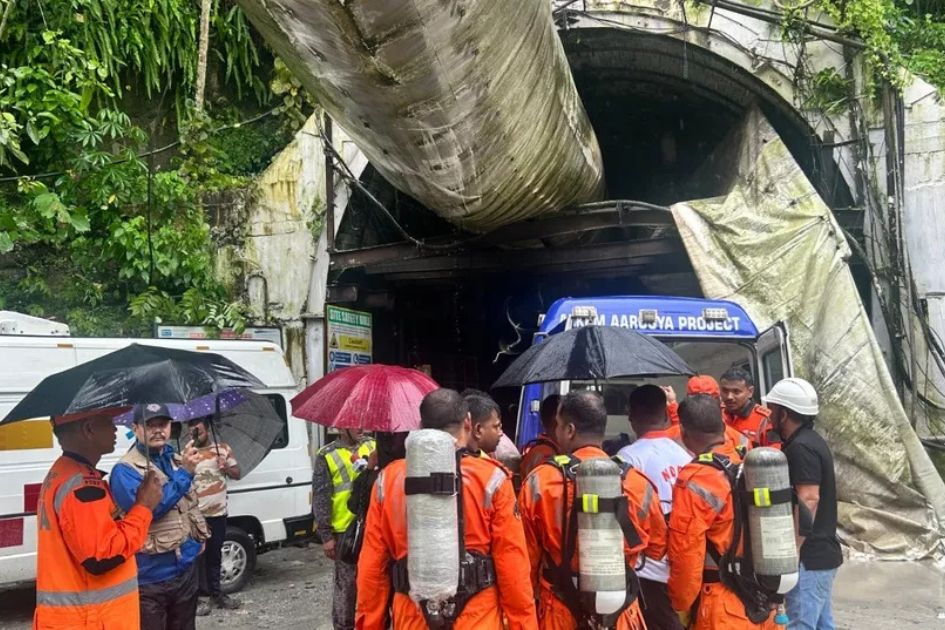



Rescue teams continue searching with specialised breathing equipment after toxic gases hindered operations at the Teesta hydropower project, highlighting the safety challenges of major infrastructure construction in the seismically active Himalayan region.
At least 10 people were killed and 17 others remain missing after a gas explosion triggered the collapse of a tunnel at an under-construction hydropower project near the China border in India’s northeastern Himalayan state of Sikkim.
The accident occurred on Monday, July 20 in Samardung village, about 40 kilometres from the state capital Gangtok, where construction was underway on the 500-megawatt Teesta hydropower project, local officials said on Tuesday.
Anupama Tamling, a local administration official, said several workers were inside the tunnel when the explosion occurred. Survivors who managed to escape said they first heard a loud blast before the tunnel collapsed, trapping many of the workers inside.
After news of the accident spread, six officials from India’s state-owned National Hydroelectric Power Corporation (NHPC) entered the tunnel to assist with rescue operations. They also became trapped inside, according to officials.
Local police chief Sonam Dolma said, “Ten bodies have been recovered so far. Another 17 people are feared to be trapped inside the tunnel.”
Rescue teams, including India’s National Disaster Response Force (NDRF), have struggled to reach those trapped because of the hazardous conditions inside the tunnel. Officials said the rescue effort has been hampered by the accumulation of toxic gases.
NDRF official Nitin Kumar said methane, carbon monoxide and hydrogen sulphide had been detected inside the tunnel.
“Rescuers are continuing their search for survivors in the dangerous environment using specialised breathing equipment,” he said.
Construction accidents are not uncommon in India as the country rapidly expands its infrastructure. Such incidents frequently occur because of weak geological formations, construction flaws, adverse weather conditions and inadequate safety measures.
Tunnel construction projects in the Himalayan region are particularly hazardous because of fragile mountains, earthquake-prone terrain and unstable underground conditions. In 2023, 41 workers were rescued after being trapped for 17 days following the collapse of a tunnel in Uttarakhand.
According to experts, the Teesta river basin is located in an earthquake-prone region. The area contains relatively young and fragile rock formations, numerous geological faults and pockets of naturally trapped underground gas.
Professor Debesh Walia of the Department of Geology at North-Eastern Hill University in the neighbouring state of Meghalaya said the area contains relatively young geological formations, including coal-bearing rock strata. He said methane and other gases trapped underground may have triggered the explosion.




