

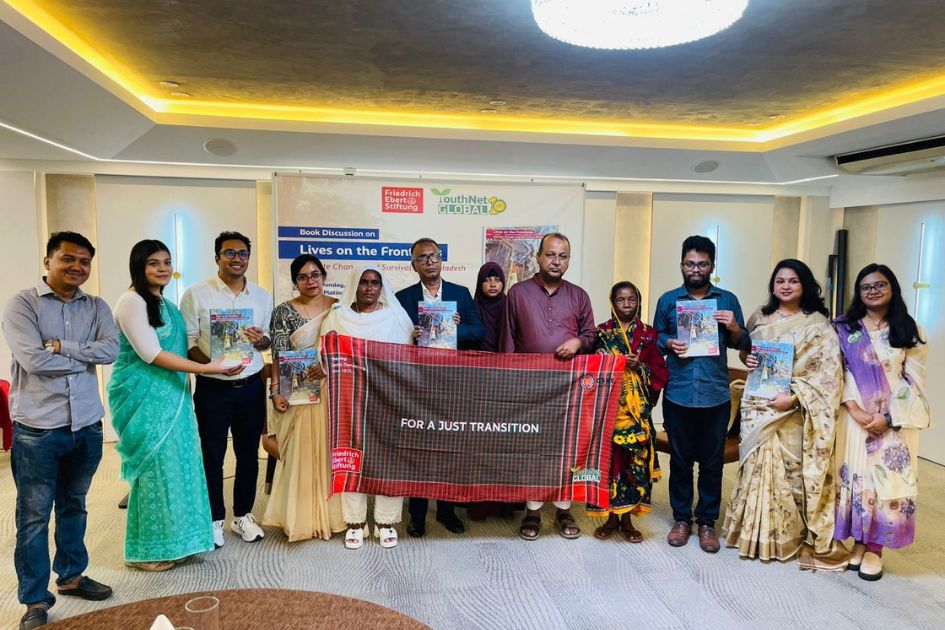



A Dhaka policy dialogue called for placing climate-affected communities at the heart of climate governance, stressing climate justice, locally led adaptation, equitable finance, and stronger representation in national and global decision-making.
A policy dialogue in Dhaka on Monday called for placing climate-affected and marginalised communities at the centre of national and global climate decision-making, stressing that no climate policy can be complete without their lived experiences.
The call came at a photo book discussion and policy dialogue titled “Lives on the Frontlines: Climate Change and Survival in Bangladesh”, jointly organised by YouthNet Global and Friedrich-Ebert-Stiftung (FES) Bangladesh in the capital.
Speakers said climate change is a lived reality that shapes livelihoods and survival, not just a matter of statistics. They urged stronger adaptation support, fair climate finance and greater inclusion of local leadership in climate governance at both national and global levels.
They also highlighted the upcoming UN Climate Conference COP31 as a key opportunity to advance climate finance, loss and damage mechanisms, adaptation and the just transition agenda. Emphasis was placed on ensuring fair participation of vulnerable countries, along with stronger transparency and accountability in climate funding.
Additional Secretary of the Economic Relations Division (ERD) Dr Kazi Shajahan said climate finance is not only about mobilising resources but also about ensuring fair distribution.
“Climate finance is not just about raising funds. It must ensure priority access for the most vulnerable people. Transparency, accountability and local priorities are essential,” he said.
FES Bangladesh Resident Representative Dr Felix Gaerdes said climate change is not an abstract issue but a lived reality affecting people’s daily lives and existence.
“The policy must reflect the reality people face every day,” he said.
YouthNet Global Executive Coordinator Sohanur Rahman said climate justice requires affected communities to be recognised as active decision-makers, not passive participants.
“Without the lived experiences of marginalised communities, no climate policy can be complete. Their voices must be at the centre of decision-making,” he said, adding that youth and women’s leadership must be strengthened in climate action.
ICCCAD Youth and Gender Programme Coordinator Sumaiya Binte Selim said locally led adaptation is essential for an effective and sustainable climate response.
“Without empowering local communities, climate action cannot be sustainable,” she said.
The panel discussion was moderated by YouthNet Global Deputy Executive Coordinator Aruba Faruk and climate policy analyst Ilmi Tabassum.
In a special session, representatives from climate-affected regions shared their lived experiences.
Tiger widow Sonamoni from coastal Shyamnagar said communities continue to face cyclones, salinity intrusion and uncertainty.
“We are not only fighting disasters but also silence and neglect. Our voices are still not heard,” she said.
Mamtaz Begum from the Manta community in Barishal said river-dependent communities remain excluded from policymaking.
“We live with the river but we are not part of policy,” she said.
Shahina Akter from Char YouthNet in Kurigram said women face increasing health risks due to floods and river erosion.
Teacher Mudasser Alam from Sunamganj said haor communities seek dignity and security, not just survival.
“We are living but survival alone is not enough. We need dignity and security,” he said.
Author of the photo book Harunur Rashid Sagar said visual storytelling can influence policymaking beyond numbers and statistics.
“Images speak truths that statistics often cannot capture,” he said.
Filmmaker Mohammad Rakibul Hasan said visual media can bring climate realities closer to policymakers and create stronger pressure for action.
Organisers said the initiative aimed to bring frontline experiences into the centre of national and global climate discourse and that such efforts will be expanded to better reflect grassroots realities in policymaking.




