

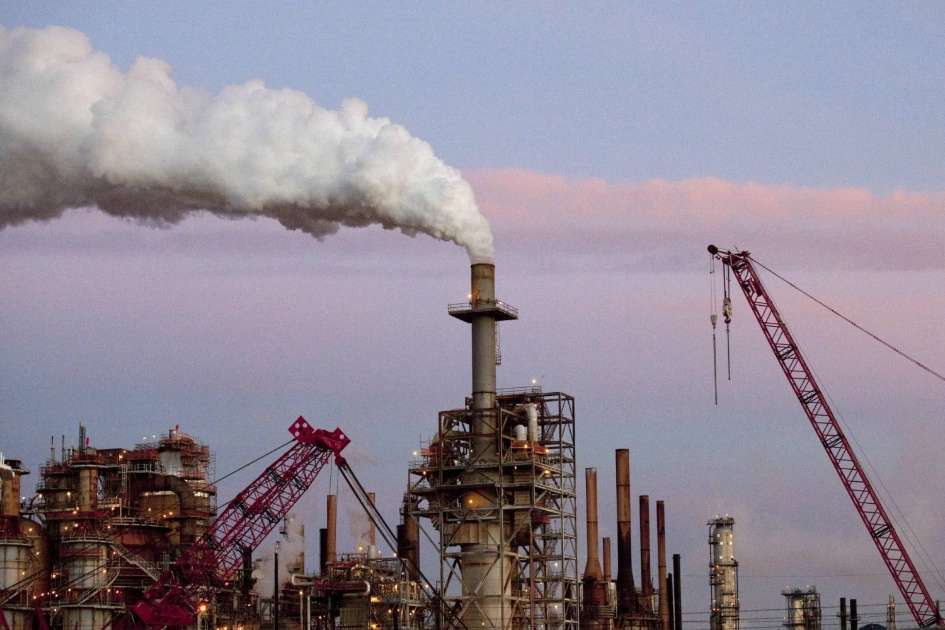



Scientists are calling for greater attention to a group of overlooked pollutants that they say have become the world’s third-largest contributor to global warming, despite being absent from official greenhouse gas inventories and most climate mitigation plans.
A research analysis published Thursday in the journal Science argues that so-called indirect greenhouse gases should be treated as a major climate concern because of their substantial role in heating the planet.
Unlike carbon dioxide or methane, indirect greenhouse gases do not trap heat themselves. Instead, they are released through fossil fuel combustion or evaporate from industrial chemicals before triggering atmospheric chemical reactions that create heat-trapping pollutants.
The group includes carbon monoxide, nitrogen oxides and non-methane volatile organic compounds (VOCs). Once in the atmosphere, these substances contribute to the formation of tropospheric, or ground-level, ozone, a toxic gas in the lower atmosphere that also traps heat. Together with heat-absorbing black carbon, they account for around 15% of global warming recorded so far, equivalent to nearly 0.3 degrees Celsius, according to the analysis.
The greenhouse gases most commonly associated with climate change remain carbon dioxide, methane and nitrous oxide.
Scientists have long understood the chemistry behind indirect greenhouse gases. However, researchers have only recently been able to determine the warming contribution of individual compounds.
According to the study, carbon monoxide and volatile organic compounds indirectly contribute about 0.25 degrees Celsius of warming, exceeding the direct warming impact of nitrous oxide, which is estimated at 0.1 degrees Celsius. Researchers noted that the 0.25-degree figure reflects the overall warming effect, although not all indirect pollutants contribute solely to warming. Nitrogen oxides, for example, can also produce cooling effects under certain conditions.
“I talk to a lot of industry leaders that are like, ‘Well, these aren’t greenhouse gases.’ Or even tropospheric ozone: ‘This isn’t a greenhouse gas,'” said Ilissa Ocko, lead author of the analysis and senior climate scientist at the nonprofit Spark Climate Solutions.
“Even though it’s obviously a greenhouse gas, scientifically, it is not in the ‘basket,'” she added.
The issue dates back to 1997 when dozens of countries signed a climate agreement in Kyoto, Japan, and identified six greenhouse gases of concern. Carbon dioxide, methane and nitrous oxide were among the pollutants scientists had determined were warming the planet. A seventh gas was added several years later.
Since then, international climate negotiations, agreements, laws, regulations and policies have focused largely on what became known as the “Kyoto basket of gases.”
The researchers behind the new analysis, several of whom previously served in the administrations of former US presidents Barack Obama and Joe Biden, argue that the current framework overlooks other significant contributors to warming and should be expanded to include indirect greenhouse gases.
The study also highlights molecular hydrogen as an emerging concern. As industries increasingly turn to hydrogen as an energy source, leaked hydrogen could contribute to future warming in the decades ahead, the authors said.
Ocko said the timing is favourable for bringing the issue into the climate policy debate because recent years have seen growing efforts to reduce greenhouse gases beyond carbon dioxide. Policymakers and companies have increasingly focused on cutting methane, nitrous oxide and hydrofluorocarbons (HFCs), creating momentum for broader discussions.
“The indirect greenhouse gases have really flown under the radar,” she said. “Now’s the right time to call wider attention to this issue and see if we can make progress and really just tackle all major drivers of climate change.”
Many indirect warming pollutants are already regulated in several parts of the world because of their harmful effects on human health. Ocko said recognition of their climate impact should influence future policymaking as well.
Governments may need to expand atmospheric monitoring beyond existing systems that focus primarily on peak urban pollution episodes when health risks are greatest. Scientists also need more information from tropical regions, where stronger sunlight contributes to higher levels of these pollutants and where understanding their global impact remains limited.
The researchers said their findings are intended to encourage policymakers to identify additional opportunities for reducing pollution and slowing climate change.
“If we do something about it, we may uncover new opportunities to slow down warming in the near term,” Ocko said. “And that’s really exciting.”
Accurately measuring each pollutant and identifying its source remains a significant challenge, according to Vaishali Naik, a senior physical scientist at the NOAA Geophysical Fluid Dynamics Laboratory who was not involved in the analysis.
Naik supported the authors’ call for expanded research and improved accounting systems to help guide climate policy.
She cautioned, however, that achieving those goals “will be challenging in the current geopolitical environment.”
Source: BLOOMBERG




