


The Bangladeshi campaigner highlights gaps in biodiversity financing, women’s representation and national implementation, calling for stronger coordination between ministries and civil society.
Bangladeshi biodiversity justice campaigner Farida Akhter has called on governments to put agroecology at the heart of biodiversity action and ensure women’s participation in environmental decision-making, saying both are essential to protecting nature and securing resilient food systems.
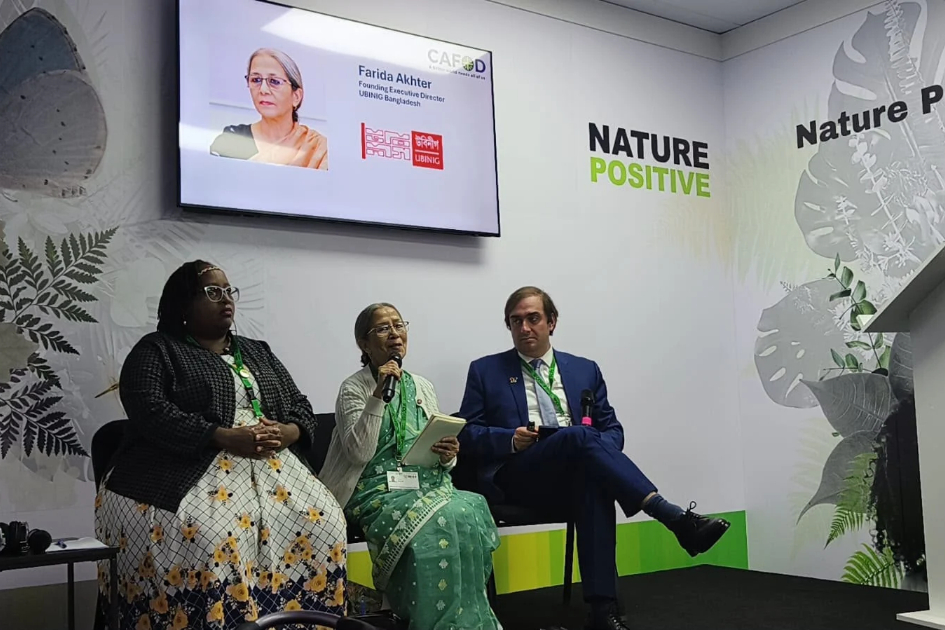
In an interview with The Climate Watch at the UN Biodiversity Conference (COP17) in Yerevan, Armenia, she also urged stronger biosafety safeguards and closer cooperation between governments and civil society to turn global commitments into practical results.
A women’s rights activist, researcher and writer, Farida works on sustainable agriculture, biodiversity conservation and reproductive rights. She is the founding executive director of UBINIG (Policy Research for Development Alternative), a policy and action research organisation established in 1984. She previously served as an adviser with ministerial rank to the Ministry of Fisheries and Livestock in Bangladesh’s interim government led by Muhammad Yunus. She is attending COP17 as a civil society representative.
“We came here to advocate for agroecology”
Agroecology applies ecological and social principles to agriculture and food systems, drawing on scientific understanding alongside farmers’ knowledge and experience.
“We primarily came here to advocate for agroecology,” she said.
Referring to the Kunming-Montreal Global Biodiversity Framework (KMGBF), Farida said agroecology’s importance extends beyond targets directly addressing agriculture. In her assessment, at least 14 to 15 of the framework’s 23 targets are linked to agrobiodiversity and agroecology.
She connected the protection of genetic resources with the wider defence of local biodiversity, livelihoods and food systems.
“Our core focus must remain safeguarding biodiversity, protecting local livelihoods and securing resilient food systems,” she said.
Farida said exchanges with international participants facing similar challenges had reinforced her conviction that agroecology must play a central role in food production.
“It is no longer viable to claim that industrial food production is our only option. In reality, sustainable food systems cannot survive without agroecology,” she said.
Trade and biosafety concerns prompt call for tougher rules
Farida raised concerns about genetically modified agricultural imports and Bangladesh’s capacity to assess them.
“If governments fail to enforce strict regulatory frameworks, we face immense risks,” she said.
Regarding bilateral trade agreements, such as the one with the US, she said: “Bangladesh cannot even test the LMOs/GMOs once they are imported. These trade agreements undermine biosafety protocols. However, we need a strong biosafety Act, not only the rules,” Farida said. She argued that stronger national biosafety safeguards would give authorities a firmer basis to scrutinise imports and intervene to protect local biodiversity.
“If our national biosafety regulations are reinforced, we gain a stronger basis to intervene,” she said.
Women’s knowledge recognised, but not their leadership
Farida said women’s traditional knowledge was gaining recognition in conference discussions, but women remained largely excluded from leadership and executive decision-making.
“Women possess crucial traditional knowledge essential for biodiversity preservation,” she said.
She described women’s presence across conference sessions as highly visible and the Gender Forum as exceptionally active. Nevertheless, she said, core decision-making structures remained predominantly male-centric.
Farida credited long-standing advocacy for securing the inclusion of gender equity under Target 23 of the framework, stressing the demand for women’s representation in decision-making.
She also highlighted the active engagement of Indigenous Peoples’ delegates, particularly their advocacy around Article 8(j) of the Convention on Biological Diversity, concerning traditional knowledge relevant to conservation and sustainable use.
Funding gap: “the single greatest bottleneck”
Asked about financing for nature, Farida pointed to the wider gap between financial pledges and delivery, referring in her response to climate finance.
She said funds actually delivered fell drastically short of pledges. With four years remaining until 2030, she questioned whether financing commitments would be fulfilled.
“We will observe the final hours of negotiations to see the ultimate outcome, but in every discussion with representatives from developing nations, funding remains the single greatest bottleneck,” she said.
From commitments to implementation: “One ministry will not work”
Turning to Bangladesh’s National Biodiversity Strategy and Action Plan (NBSAP), Farida called for coordinated implementation across government.
“Delegating implementation to a single ministry will not work,” she said.
She proposed a national committee or governmental forum bringing together all relevant ministries, alongside close cooperation between public authorities and civil society organisations.
“Furthermore, unless civil society organisations and government authorities work in close coordination, these plans will remain mere words on paper without yielding practical results.”