

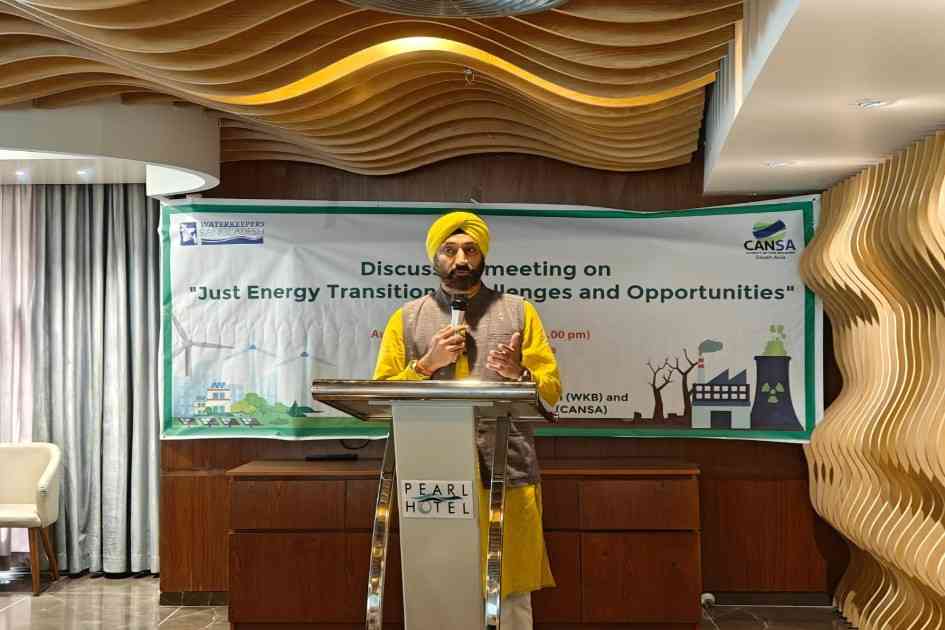



Bangladesh must urgently shift from fossil fuels to renewables, experts told a Dhaka dialogue. Speakers highlighted economic risks, policy gaps, pollution and exclusion of marginalized voices, urging just energy transition, stronger global cooperation, and fair incentives for renewable energy development.
As the world faces a climate emergency, Bangladesh stands at a critical juncture in shaping its energy future. Experts, policymakers and civil society leaders have called for urgent steps to adopt a just and fair energy transition, stressing that this shift is not merely about adopting renewable sources but also about ensuring justice, inclusivity, and sustainable development.
The discussion, titled “Fair Energy Transition: Challenges and Opportunities”, was jointly organised by Waterkeepers Bangladesh and Climate Action Network South Asia at Hotel Pearl, Banani, in Dhaka on Sunday, said a press release.
The event drew a wide range of participants, including academics, energy experts, government officials and campaigners.
Fossil fuel dependence and vulnerability
Bangladesh’s economy is expanding rapidly, and with it, energy demand has soared. But this growth has been powered primarily by imported coal, oil, and liquefied natural gas (LNG), leaving the country vulnerable to price volatility and energy insecurity.
Although the government is promoting renewable energy, its share remains negligible in the total energy mix. The drafting of the Renewable Energy Policy 2025 has set new targets, yet experts observed inconsistencies between the policy and other national development plans, making the transition more complex.
“Coal-based power projects have caused irreversible damage to agriculture, public health, salt cultivation, and livelihoods,” warned Sharif Jamil, Member Secretary of Dhora (Save the Earth), who moderated the session. “We needed thorough environmental assessments, but those were ignored, and now communities are paying the price.”
Keynote: A global perspective
Delivering the keynote, Harjeet Singh, Strategic Advisor to the Fossil Fuel Non-Proliferation Treaty Initiative, placed Bangladesh in the global energy debate.
“Bangladesh has shown leadership in renewable initiatives, and other countries have learned from it,” he said. “But global warming has already touched 1.6°C, and new pressures are mounting. The Paris Agreement never even mentioned fossil fuels. Without decisive action, challenges will multiply.”
Singh also underlined the importance of international solidarity. “Many countries have the capacity but refuse to act, fearing financial commitments. That is why a global treaty to end fossil fuel expansion is essential,” he added, highlighting the countries that have already joined the treaty.
Speakers repeatedly stressed that a just transition must be inclusive. Banasree Mitra Neogi, Director of Rights and Governance Programme at Manusher Jonno Foundation, pointed out that marginalized communities are often excluded from these debates.
“Questions of energy justice are never asked to those who are most affected the poor, the displaced, the marginalized. We must ensure their voices are at the center,” she said.
Economic and market realities
Bangladesh’s overreliance on imports was identified as a structural weakness. Shafiqul Alam, Lead Energy Analyst at the Institute for Energy Economics and Financial Analysis (IEEFA), explained:
“Our import dependence means repeated price hikes, and still we cannot meet demand. We must fundamentally transform our entire energy system, not just patch it up.”
Shibayan Raha, Asia Campaigner for the Fossil Fuel Non-Proliferation Treaty Initiative, warned against “false solutions.” He said: “We are shifting from coal to ammonia-based coal projects, which is simply replacing one problem with another. But as one of the 17 countries supporting the treaty, Bangladesh can take bold steps. Civil society here has the power to lead.”

Government perspectives were also highlighted. Md. Ziaul Haque, Director of the Department of Environment (DoE), admitted the situation is worrying. “Coal already accounts for 23% of our power generation, and this cannot increase. In the next 15 years, if we do not secure new technologies and financing, the situation will worsen,” he cautioned.
Academic and industry insights
Professor Badrul Imam of Dhaka University’s Geology Department reminded participants of the balance between demand and production. “Our energy demand is growing, but production lags far behind. Awareness and global campaigning are essential. Only then can we reduce dependence on fossil fuels,” he said.
Industry perspectives also featured prominently. Shahriar Ahmed Chowdhury, Chair of the Centre for Renewable Energy Services Limited, argued that government policy remains a bottleneck. “Everyone talks about subsidies for renewables, but once in office, they forget. Instead, we impose taxes that discourage renewable adoption. If import duties were reduced, the sector would grow much faster,” he noted.
Civil society’s closing call
In his concluding remarks, M.S. Siddiqui, Co-Convener of Dhora, criticised the imbalance in government policy. “We are still subsidising fossil fuels while taxing renewables. That is a direct barrier to transition,” he said.
The event ended with a vote of thanks from Palash Das, Senior Advisor at Climate Action Network South Asia, who praised the diverse participation and stressed the urgency of united action.
The Dhaka dialogue revealed a strong consensus: Bangladesh has no choice but to accelerate its transition away from fossil fuels. But to succeed, policies must be harmonised, incentives must favor renewables over coal, and communities especially the marginalized must be at the heart of decision-making.
With its inclusion among the signatories of the Fossil Fuel Non-Proliferation Treaty and its reputation for resilience, Bangladesh has the opportunity to play a leadership role in the global fight for a just energy transition.
Prof. Dr. Ahmad Kamruzzaman Majumder, Director of the Centre for Atmospheric Pollution Studies (CAPS) and Amanullah Parag (350.org South Asia) were also addressed at the programme.




