

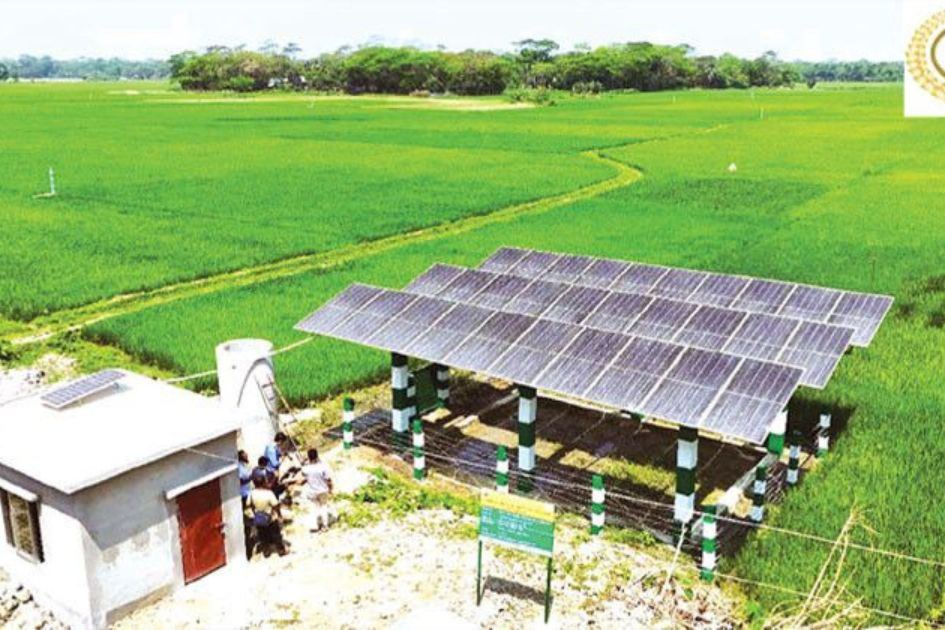



Farmers in southern Bangladesh are adopting solar irrigation, sharply reducing costs and diesel reliance while improving water access, climate resilience, and long-term agricultural sustainability amid rising global fuel pressures.
Farmers in southern Bangladesh are increasingly shifting toward solar-powered irrigation systems as global diesel price volatility and supply pressures continue to strain agricultural production.
Experts say the expansion of solar irrigation could play a key role in strengthening climate resilience, reducing fossil fuel dependence and supporting long-term food security in climate-vulnerable regions of Bangladesh.
In the southern Barishal Division, irrigation systems are undergoing a gradual transformation, with renewable energy-based pumps emerging as a cost-effective alternative to diesel-dependent agriculture.
According to the Bangladesh Agricultural Development Corporation (BADC), irrigation using diesel currently costs farmers around Tk 40 per decimal of land, while solar-powered irrigation reduces the cost to approximately Tk 0.25 per decimal. Officials also note that diesel-based irrigation can cost up to Tk 4,000 per acre, compared to about Tk 25 per acre under solar systems.
To improve water access and reduce costs, BADC has introduced solar irrigation schemes across six districts, including Barishal, Bhola, Pirojpur, Patuakhali, Barguna and Jhalakathi. The region also has 340 diesel-operated irrigation schemes, alongside 45 solar-powered pumps and 31 electric pumps.
The Bangladesh Water Development Board has also implemented 78 pump houses under its irrigation project across seven sub-districts. Each pump, with a capacity of 25 cusec, can lift around 700 litres of water per second and supplies irrigation through locally managed distribution systems.
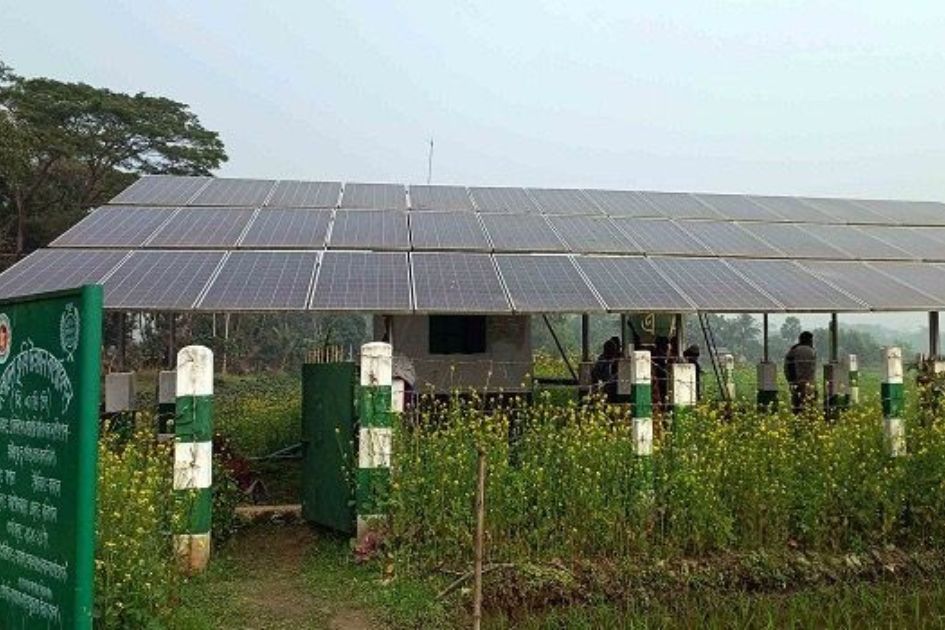
Officials say that around 1,000 acres of farmland are now receiving irrigation through surface water systems, reducing dependence on groundwater and diesel-based pumping.
Under a cooperative model, farmer groups manage solar irrigation systems covering roughly 25 acres each. Farmers contribute a one-time payment of Tk 30,000 for installation and an annual fee of Tk 15,000 to the government.
The government investment per system stands at around Tk 16.9 million for pump installation and underground drainage infrastructure, with an additional Tk 12 million spent on underground pipelines to reduce water loss and improve efficiency.
Farmers say the shift has significantly reduced production pressure.
“We are no longer worried about diesel prices,” said Wahed, a farmer from Babuganj upazila, who cultivates IRRI-Boro rice on 30 acres. “Water availability has also been stable this year.”
Similar views were expressed by farmers in Barishal Sadar and surrounding areas, who reported improved irrigation access and reduced costs during the current season.
Nurul Islam Gazi, head of a local irrigation committee, said the annual Tk 15,000 contribution is minimal compared to diesel or kerosene-powered systems, which previously required several times higher expenditure.
BADC sub-assistant engineer Biswajit Sarker said the shift toward surface water-based irrigation is improving efficiency and reducing costs for farmers.
“Solar-powered irrigation allows farmers to significantly cut costs while ensuring a reliable water supply,” said Syed Wahid Murad, Executive Engineer of BADC in Barishal. “Per acre, irrigation cost drops to about Tk 25 with solar systems, compared to nearly Tk 4,000 under diesel-based systems.”
Sohanur Rahman, Executive Coordinator of Sohanur Rahman and YouthNet Global, said the transition reflects a broader structural shift driven by global energy instability and climate change.
“Rising fuel prices driven by global geopolitical tensions, including conflicts such as the Iran war and the wider Middle East crisis, are directly affecting food production systems in vulnerable countries like Bangladesh. At the same time, the climate crisis is making agriculture even more fragile. In this context, solar irrigation is not just an innovation but a necessity for resilience and justice,” he said.




