

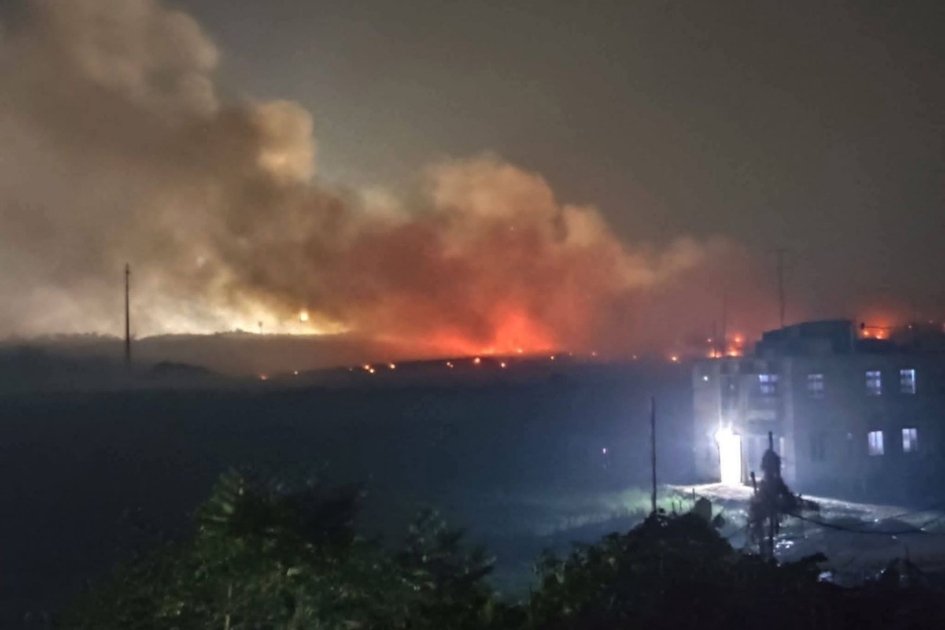



Dhaka ranked world’s most polluted city as brick kiln emissions and landfill waste burning pushed AQI to very unhealthy levels, raising alarm over mounting health risks for millions of residents.
Thick smog blanketed Dhaka this week, pushing the city to the top of global pollution rankings and raising serious concerns about worsening air quality and public health risks in the densely populated Bangladeshi capital.
Dhaka ranked first among the world’s most polluted cities on Wednesday morning, recording an Air Quality Index, or AQI, of 277 at 8:18 am, according to Switzerland-based air monitoring organization IQAir.
The city’s air was classified as very unhealthy, indicating a significant health threat to residents.
Delhi in India, Lahore in Pakistan and Karachi ranked second, third and fourth respectively, with AQI scores of 241, 241 and 141.
According to the AQI scale, a reading between 50 and 100 is considered moderate, though sensitive individuals should limit prolonged outdoor exertion. AQI levels of 101 to 150 are considered unhealthy for sensitive groups, 151 to 200 unhealthy, 201 to 300 very unhealthy and readings above 301 hazardous, posing severe health risks.
The AQI reports daily air quality and informs residents how clean or polluted the air is and what associated health effects might be. In Bangladesh, the AQI is calculated based on five key pollutants: particulate matter PM10 and PM2.5, nitrogen dioxide, carbon monoxide, sulfur dioxide and ozone.
Dhaka has long struggled with air pollution and frequently ranks among the most polluted cities in the world, particularly during the dry winter months when dust and emissions accumulate in the atmosphere. Air quality usually improves during the monsoon season.
Environmental authorities say the recent spike in pollution is mainly linked to the reopening of brick kilns around the city and the burning of waste at major landfill sites on its outskirts.
Officials from the Department of Environment said these activities have sharply increased the concentration of airborne particles, creating dense haze across much of the capital, which is home to more than 20 million people.
Additional Director General of the Department of Environment Md Ziaul Haque said two key factors are behind the recent deterioration in air quality.
“Currently, two major reasons are intensifying air pollution in Dhaka. Waste is being burned at the Matuyail and Aminbazar landfills under city corporation management and previously closed brick kilns around Dhaka have gradually reopened. Because of this, the overall situation has become severe,” he said.
He added that authorities had previously taken steps to control these pollution sources.
“For the past one and a half years we have been putting pressure on city corporations to stop large-scale waste burning. They had largely complied earlier but recently the practice has started again in some areas,” he said.
Ziaul Haque also noted that enforcement actions had been taken in key pollution hotspots.
“Savar was declared a degraded airshed area due to severe air pollution and all brick kilns there were shut down. However, around 40 kilns resumed operations in December and more have reopened in January and February,” he said.
Meteorologists said seasonal weather patterns also contributed to the smog. Cool northwesterly winds carrying suspended dust and fine particles reduced visibility across the city, creating haze that appeared similar to fog but was actually pollution-driven.
Authorities and experts say several pollution sources are contributing to the worsening situation, including landfill waste burning, emissions from reopened brick kilns, smoke from aging vehicles and dust from construction activities.
Investigations indicate that toxic smoke from waste burning at major landfill sites, including those in Matuyail and Aminbazar, has spread across large parts of the city and surrounding communities.
At the same time, several previously closed brick kilns in areas such as Keraniganj, Savar and Bosila have resumed operations, further increasing emissions of fine particulate matter into the atmosphere.
Environmental researchers warn that if the situation is not brought under control quickly, it could lead to a serious public health crisis.
Saif Shah Rukh, a teacher at the Soil, Water and Environment Department of the University of Dhaka, said open waste burning remains one of the major sources of air pollution in the capital.
“Burning waste releases toxic pollutants including dioxins, furans, fine particulate matter such as PM2.5 and PM10, heavy metals and carbon monoxide. These substances can increase the risk of respiratory illness, lung disease and cancer,” he said.
Residents across Dhaka reported breathing difficulties, eye irritation and headaches while commuting to work and school as the smog persisted throughout the day. Health experts warn that children, elderly people and those suffering from respiratory illnesses are particularly vulnerable to polluted air.
Environmental experts say weak enforcement of pollution control laws, poor waste management and unregulated emissions continue to worsen Dhaka’s air quality crisis.
Experts warn that without urgent enforcement of pollution control measures and stronger coordination among authorities, Dhaka may continue to rank among the world’s most polluted cities.
According to the World Health Organization, air pollution causes about seven million deaths worldwide each year, mainly from stroke, heart disease, chronic obstructive pulmonary disease, lung cancer and acute respiratory infections.




