

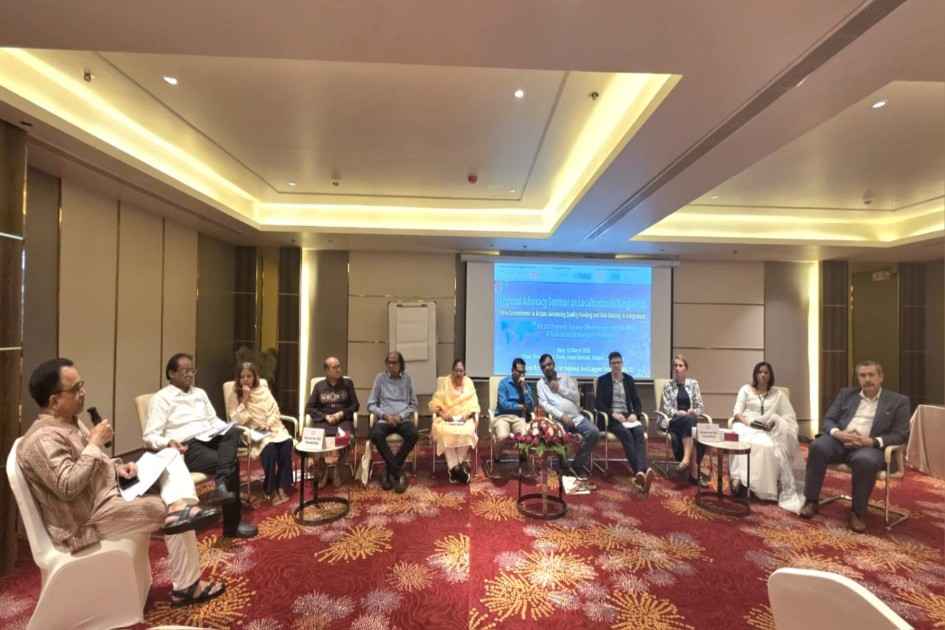



Aid leaders, government officials and civil society representatives gathered in Cox’s Bazar to urge greater direct funding for local organizations and stronger risk-sharing mechanisms, warning that humanitarian responses remain ineffective unless frontline communities receive equitable support and resources.
A regional seminar on improving the quality of humanitarian funding and strengthening risk sharing among aid actors was held in Cox’s Bazar on Thursday, bringing together representatives from government agencies, the United Nations, international NGOs, and local civil society groups.
The event, titled “From Commitment to Action: Advancing Quality Funding and Risk Sharing,” focused on advancing localization in humanitarian response and ensuring stronger support for local organizations working on the frontline of crises.
Organized by local NGO PHALS, the seminar took place at a hotel conference hall in the coastal district, which hosts more than one million Rohingya refugees from neighboring Myanmar.
The discussion was held under the Together Project with overall support from Malteser International.
Opening the event, PHALS voluntary Executive Director Abu Murshed Chowdhury said humanitarian responses have historically operated through a “risk transfer” model, where financial, legal, compliance and security risks are often shifted from international agencies to local and national organizations.
“The future of localization requires a balanced and collaborative approach built on trust, mutual accountability and shared responsibility,” Chowdhury said.
During the seminar, Mohammad Arif Dewan, coordinator of Malteser International Bangladesh, presented an overview of the Together Project’s activities across eight countries, including Bangladesh.
The keynote paper was presented by Rashedul Hasan, project coordinator at PHALS, who outlined challenges faced by local organizations in accessing direct funding and participating in decision-making processes within the humanitarian system.
A plenary discussion on quality funding, risk sharing and localization followed, moderated by Chowdhury.
The panel included representatives from a range of government agencies, aid groups and civil society organizations.
Participants included Md. Shariful Islam, deputy secretary representing the Office of the Refugee Relief and Repatriation Commissioner (RRRC); A K M Morshed, senior director at BRAC; Shishir Dutta, executive director of BETA; Kirti, country director of Malteser International; David Bugdan, principal coordinator of the Inter-Sector Coordination Group (ISCG); Bimal Chandra De Sarkar, chief executive officer of Mukti Cox’s Bazar; Astrid, representative of the UN refugee agency UNHCR; Marko Miljevic, coordinator of the NGO Platform; Shiuli Sharma, executive director of Jenas; Zobaida Akhter, head of field office at Oxfam; and Md. Mujibur Rahman, adviser at Sushilon.
The seminar was also attended by Mahbubur Rahman, president of the Cox’s Bazar Press Club, Advocate Romij Ahmed, secretary of Cox’s Bazar Civil Society, Advocate Abdus Shukkur, and other representatives from civil society, media outlets and humanitarian organizations.
Speakers noted that local organizations and communities are typically the first responders during humanitarian emergencies and often remain active long after international agencies scale down operations.
Their close relationships with affected communities enable faster and more context-sensitive responses, participants said.
However, despite global commitments to localization, speakers observed that direct funding to local organizations remains limited, with most humanitarian funds continuing to flow through international intermediaries.
Participants recommended increasing direct and flexible funding for local organizations, establishing multi-year funding mechanisms, covering administrative costs, creating dedicated funding pools for local initiatives, and developing equitable risk-sharing frameworks among governments, donors and international agencies.
The seminar concluded with Shishir Dutta, executive director of BETA, thanking participants for their contributions and emphasizing the importance of continued dialogue to strengthen locally led humanitarian responses.




